
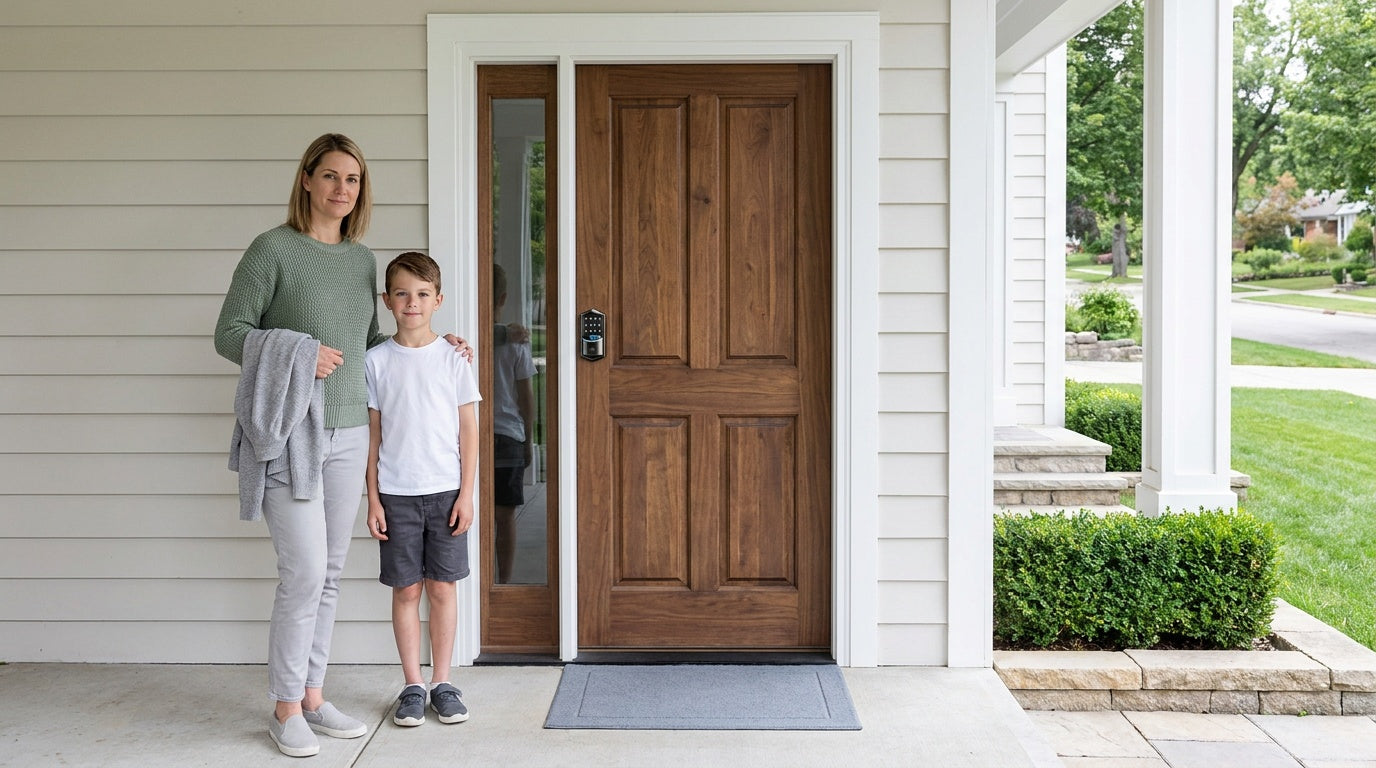
The moment your child asks — or the moment it just dawns on you — is one most parents remember. Can they stay home by themselves? It's a question that carries real weight, mixing pride in your child's growing independence with the very natural anxiety of not being there. And the honest answer isn't a single number. It depends on where you live, how mature your child is, and whether your home is set up to support them safely.
This guide walks you through the legal landscape across U.S. states, what pediatric experts actually recommend, how to assess your child's readiness, the safety skills they need to develop, and the smart home tools — including keyless entry — that give working parents genuine peace of mind when their kids are home alone.
There Is No National Law — Here's What That Means
There is no federal minimum age in the United States for leaving a child home alone. The decision is largely left to individual states — and, in most states, to individual parents. That might feel like a surprising gap in the law, but it reflects a widely held view among child welfare experts: maturity, not age, is the more reliable measure of a child's readiness. Many lawmakers understand that a child's maturity is more accurate criteria to determine whether a child can be left home alone than a number alone.
That said, "no federal law" doesn't mean "no consequences." Parents remain legally responsible if a child is harmed due to lack of supervision. In states without a specific statute, child protective services agencies can still investigate if a report is made — and the assessment typically weighs the child's age, maturity, ability, and the surrounding environment together. Knowing your state's position is the critical first step before anything else.
States With Legal Minimum Ages
Most states have not set a hard legal age. Roughly 36 states have set out guidance but do not have strict legislation with a named minimum. However, a smaller group of states — currently around 14 — have enacted statutes or formal guidelines that specify a minimum age. Here's an overview of the states that have defined a number:
| State | Minimum Age | Notes |
|---|---|---|
| Illinois | 14 | Highest in the U.S.; child neglect charges possible if violated |
| Colorado / Connecticut / Mississippi | 12 | State law permits 12-year-olds to stay home unsupervised |
| Michigan | 11 | |
| New Mexico | 10 | City of Albuquerque ordinance raises this to 11 |
| Oregon / Tennessee / Washington | 10 | |
| Georgia / North Dakota | 9 | Georgia: ages 9–12 may be left alone for a maximum of 2 hours |
| Maryland / North Carolina | 8 | Maryland: children 12+ may be left alone for longer periods; fine and imprisonment possible for violations |
| Kansas | 6 | Lowest legal threshold in the U.S. |
A few important caveats: some states cap how long a child can be left alone, not just the minimum starting age. Minnesota, for example, advises that children ages 8–9 may be left alone for up to two hours, while ages 10–13 should not exceed 12 hours. Duration matters as much as the age itself. Also note that local city or county ordinances may impose stricter rules than state-level law. Always check with your local child welfare agency or police department to confirm what applies in your specific community.
What Experts Recommend by Age Range
Beyond what the law requires, pediatric and child welfare experts have their own guidance — and it generally skews older than many parents expect. The American Academy of Pediatrics (AAP) suggests that 11 or 12 years is an appropriate age to stay home alone for a few hours. The National SAFEKIDS Campaign similarly recommends that no child under the age of 12 be left home alone as a general rule.
That said, experts consistently frame these as floors, not finish lines. Age is only a starting point — maturity and individual readiness are the more meaningful measures. Here's how the general consensus maps out across age groups:
- Under 8 years: Should not be left alone, period. Children this young lack the cognitive and emotional resources to handle unexpected situations independently.
- Ages 8–10: In states that permit it, some short stints — an hour or two during daytime hours only — may be appropriate for exceptionally mature children. This is not typical, and most experts caution against it as a regular arrangement.
- Ages 10–12: Most children begin developing the maturity and skills to stay home alone for brief periods at this range. That said, readiness depends on the individual child, not just the birthday.
- Ages 12+: Generally considered a reasonable baseline by most expert organizations, provided the child has the skills and your home has the right safety setup. Longer stretches become more appropriate as confidence and competence build.
- Caring for a younger sibling: This is a separate and more demanding scenario. Many states apply different — and stricter — legal guidelines to an older child being left in charge of a younger one, because babysitting a sibling requires a different and higher level of maturity than simply managing one's own time.
The Readiness Test: It's More Than a Birthday
The most consistent finding across child welfare research is that age alone is an unreliable predictor. Some 10-year-olds are genuinely ready; some 13-year-olds are not. Before deciding, honestly evaluate your child against several behavioral and cognitive markers. If you find yourself hesitating on more than a couple of these, it's a strong signal to wait.
Signs your child may be ready:
- They want to stay home alone — and are excited, not anxious. If the idea frightens them, wait.
- They follow directions reliably, even when you're not watching.
- They can make simple decisions independently — what to eat, what to do — without becoming overwhelmed.
- They know how to call 911, can reach you by phone, and know at least one nearby backup adult to contact.
- They understand basic household safety: keeping doors locked, not opening the door for strangers, not posting online that they're home alone.
- They can handle a minor injury — a scrape, a small spill — without panicking.
- They're aware of what to do in a power outage or severe weather event.
If your child is excited but you're still unsure, have a direct conversation about what they'd need to demonstrate before getting solo time. Frame it as a milestone to work toward, not a punishment withheld. The goal is a gradual, supported progression — not a sudden leap from supervised to fully independent.
Safety Skills Every Child Needs First
Before your child spends time at home alone, make sure these specific skills and plans are in place. Talking through scenarios once is a start, but practice matters more. Run through each situation with your child so the response becomes automatic, not something they have to think through under stress.
Emergency contacts and 911
Your child should have a fully charged phone with your number, a backup adult's number, and Poison Control (800-222-1222) readily available. They should know that 911 is always the right call in a genuine emergency and should be able to describe their address clearly.
Door and entry security
Set a firm rule: doors and windows stay locked, and the door does not open for anyone your child is not specifically expecting. This is one area where your physical setup matters enormously — a child shouldn't have to decide whether to open a door for an unexpected knock. The answer should simply be no, every time, with a clear plan for what to say if someone is persistent.
Kitchen and household safety
Decide together what's off-limits until you're home — stove use, microwave-only snacks, areas of the house that are out of bounds. Go over what to do if something goes wrong with an appliance, a small fire, or a detected smell of smoke.
Online and social media rules
Make it clear your child should never announce on social media that they're home alone. Beyond the safety risk, it's a rule they should internalize before they ever start spending solo time at home.
How Smart Home Access Makes It Safer
One of the most practical changes a homeowner can make when a child starts staying home alone is upgrading the front door. Traditional keys create a real vulnerability: kids lose them, forget them, or loan them to friends. A keyless lock removes the need for your child to carry a key at all, and the right one gives parents something even more valuable — visibility into who comes and goes, and when.
Veise smart locks are designed exactly for this kind of practical, family-first upgrade. Built on Kaadas Group's 38 years of lock industry expertise and 711 patents — the world's largest smart lock patent portfolio — Veise combines engineering depth with everyday simplicity. The brand has sold 10M+ smart locks across 41+ countries and is recognized by Frost & Sullivan as the global No.1 high-end smart lock brand by sales. That's the kind of track record that matters when you're securing the door your child is coming home to. Easy from Day One.
Keypad Entry: No Key to Lose
For families where the primary goal is simple, reliable entry — no key to lose, no lockout drama after school — a Veise Keypad Deadbolt Lock is a straightforward fit for the main entry door. Every model supports a keypad code plus a physical key backup. The KS02 series adds fingerprint recognition on every SKU, with a scan speed of under 0.3 seconds — fast enough that a child coming in from the cold won't be standing on the porch fumbling. Auto lock (configurable between 10 and 99 seconds on Keypad Deadbolt and Keypad Latch locks) re-engages the lock on a timer, so it does not depend on your child remembering — just make sure the door is closed before the interval expires, since the countdown runs regardless of door position. Two other built-in features are worth knowing: anti-peep code entry lets your child pad the real PIN with extra random digits so onlookers can't read it off the keypad, and lockout protection automatically pauses the lock for three minutes after 10 wrong attempts. Installation takes about 15 minutes with a screwdriver and no wiring, and every product ships with a user manual and installation video — a practical weekend upgrade for any homeowner.
For interior doors — a home office, a room with items you'd like kept off-limits during solo hours — start with the Mechanical Locks lineup, where a keyed entry knob or lever is usually all an interior room needs. If you'd rather not hand a child another key, a Keypad Latch Lock handles the same job with keypad code access and a physical key backup, with no app or subscription required.
Remote Monitoring: Know When They're Home
For parents who want to go further — seeing exactly when the door opens, getting a real-time alert when your child arrives home, and being able to lock the door remotely if they forget — a connected smart lock is the right choice. Remote access requires a smart lock, either gateway-paired or Wi-Fi enabled, not a standard keypad-only lock.
Veise's Wi-Fi Smart Locks connect directly through your home's Wi-Fi and support app control, keypad code, fingerprint, voice commands via Alexa or Google Assistant, and a physical key backup on all models. The app lets you review entry history, lock or unlock remotely, and receive arrival notifications — so you know the moment your child walks in without having to wait for a text. The Wi-Fi line comes in two series: the Touchscreen Wi-Fi Smart Lock (VE027 Series), which includes a USB-C emergency power port on every SKU in the series along with key fob support and on-device voice prompts in English, Spanish, and French; and the Push-Button Wi-Fi Smart Lock (VE012W Series), with a traditional press-button keypad and none of those three extras. Both use an 8 AA/LR6 alkaline battery design for a stronger signal and longer-lasting power reserve compared to standard 4 AA setups.
If you prefer a gateway-paired approach, Smart Locks w/ G1 cover the entire line through a single product series, with multilingual voice prompts in English, Spanish, and French — a meaningful feature in multilingual households. Every Smart Lock w/ G1 includes fingerprint recognition, a key fob, a physical key backup, and keypad code entry, plus remote app control through the paired gateway (a separate device, sold separately on nearly all SKUs, positioned within wireless range of the lock). Smart Lock w/ G1 uses a Veise-developed first-party app. Smart Locks w/ G2 offer more SKU variety — including non-fingerprint options and Apple Watch unlock — making them worth exploring if those features fit your family's setup.
All Veise smart locks are ANSI/BHMA Grade 3 certified, the residential standard for home entry doors, and are compatible with standard wood doors (1-3/8" to 2" thick). They require full lock replacement, so they're designed for homeowners and property managers with authority to modify door hardware. At $30–$180 across the lineup, the entire range sits at an accessible, mid-range price point — well within reach for a meaningful safety upgrade.
A Graduated Independence Plan
The most effective approach to home-alone readiness is incremental. Think of it like learning to swim — you don't start in the deep end. A gradual, structured progression builds both your child's competence and your own confidence at the same pace.
- Stage 1 — Practice runs with you home: Let your child manage 30–60 minute stretches of independence while you're in another part of the house. Don't intervene unless necessary. Observe how they handle boredom, minor problems, and the urge to break house rules.
- Stage 2 — Short solo windows: Start with 30–45 minutes when you need to run a quick errand. Make it daytime only. Confirm they have a charged phone, know the emergency contacts, and understand the house rules. Debrief afterward — what went well, what felt hard.
- Stage 3 — Extended solo time: Gradually extend to 1–2 hours, then longer as maturity and the track record build. Revisit the rules periodically, especially around visitors, the kitchen, and online activity.
- Stage 4 — Consistent independent afternoons: For many families, this is the after-school routine that works — your child comes home from school, enters using a keypad code or fingerprint, and has a clear structure for the hours until you arrive. Your smart lock's activity log and app alerts do the monitoring so you don't have to interrupt your workday to call and check in.
When Your Child Isn't Ready Yet: Alternatives
If your honest assessment is that your child needs more time before solo hours are appropriate, that's completely normal — and there are practical options that bridge the gap without disrupting your schedule.
- After-school programs: Many schools offer before- and after-school programs specifically designed to give children a safe, structured, and social environment when parents can't cover the school schedule. These are often subsidized and worth investigating even if you expect your child will eventually transition to staying home alone.
- Trusted neighbors: A nearby neighbor whose child attends the same school can be an informal but invaluable resource. A standing arrangement for your child to go to their house on late work days can be easier and more comfortable than a formal childcare arrangement.
- Babysitters or nannies: Vetted sitters remain a reliable option for younger children or for longer unsupervised windows. Platforms like Care.com conduct background checks and include parent reviews to help you find the right fit.
- Keep building the skills: Use the waiting period productively. Practice emergency procedures, kitchen safety, and the decision-making conversations that will eventually make your child genuinely ready — not just old enough by the calendar.
Frequently Asked Questions
What is the minimum age a child can legally stay home alone in the U.S.?
There is no national federal minimum. Individual states set their own rules, and most have not established a specific legal age. Among states that have, minimums range from age 6 (Kansas) to age 14 (Illinois). Always check the specific law and local ordinances in your state and city.
What age do most experts recommend for leaving a child home alone?
The American Academy of Pediatrics generally recommends waiting until a child is 11–12 before leaving them home alone for a few hours. The National SAFEKIDS Campaign advises against leaving any child under 12 home alone. These are general guidelines, not universal rules — maturity and readiness matter more than the exact age.
What signs show a child is ready to stay home alone?
Key indicators include: the child wants to be home alone and isn't frightened by the idea; they follow rules reliably without supervision; they can handle minor problems or injuries calmly; they know emergency contacts and can describe their home address; and they understand basic home security, like keeping doors locked and not answering the door for strangers.
Can a child stay home alone and watch a younger sibling?
This is a distinct and more demanding responsibility. Many states apply stricter legal standards when an older child is in charge of a younger sibling, since babysitting requires a higher level of maturity than managing one's own time. Check your state's specific guidelines for this scenario separately.
How can a smart lock help when a child is home alone?
A smart lock solves several common home-alone challenges at once: keypad or fingerprint entry means your child doesn't have to carry a key at all, auto lock re-engages the lock on a set timer so it doesn't depend on them remembering, and a connected smart lock (Smart Lock w/ Gateway 1/2 or Wi-Fi) lets parents check entry history and receive real-time arrival alerts through the app. Remote lock control means you can secure the door from work if your child forgets. For families with children coming home to an empty house, a connected smart lock is one of the most practical safety upgrades available.
There's no single right answer to the question of when a child can stay home alone — and any guide that gives you a single number without context is leaving out most of the story. The legal minimum in your state is your starting floor. Your child's genuine maturity, specific safety skills, and emotional readiness determine whether it's actually the right time. And the physical setup of your home — including how your front door works — is a factor most parents underestimate.
A smart lock won't replace the conversations, the practice runs, or the gradual trust-building that makes this transition go well. But it does solve a real, daily problem: keys get lost, doors get left unlocked, and parents spend hours wondering whether their child made it home safely. The right entry setup means you don't have to wonder. Explore Veise's full lineup of smart and keypad locks to find the right fit for your family's entry doors — from simple keypad deadbolts to fully connected Wi-Fi smart locks with remote monitoring built in.
Ready to Upgrade Your Home's Entry?
Whether you need a simple keypad lock your child can use without a key or a fully connected smart lock that sends real-time arrival alerts to your phone, Veise has an affordable, easy-to-install option for your home. Have questions about which lock fits your door and setup?
Contact Us — We're Happy to Help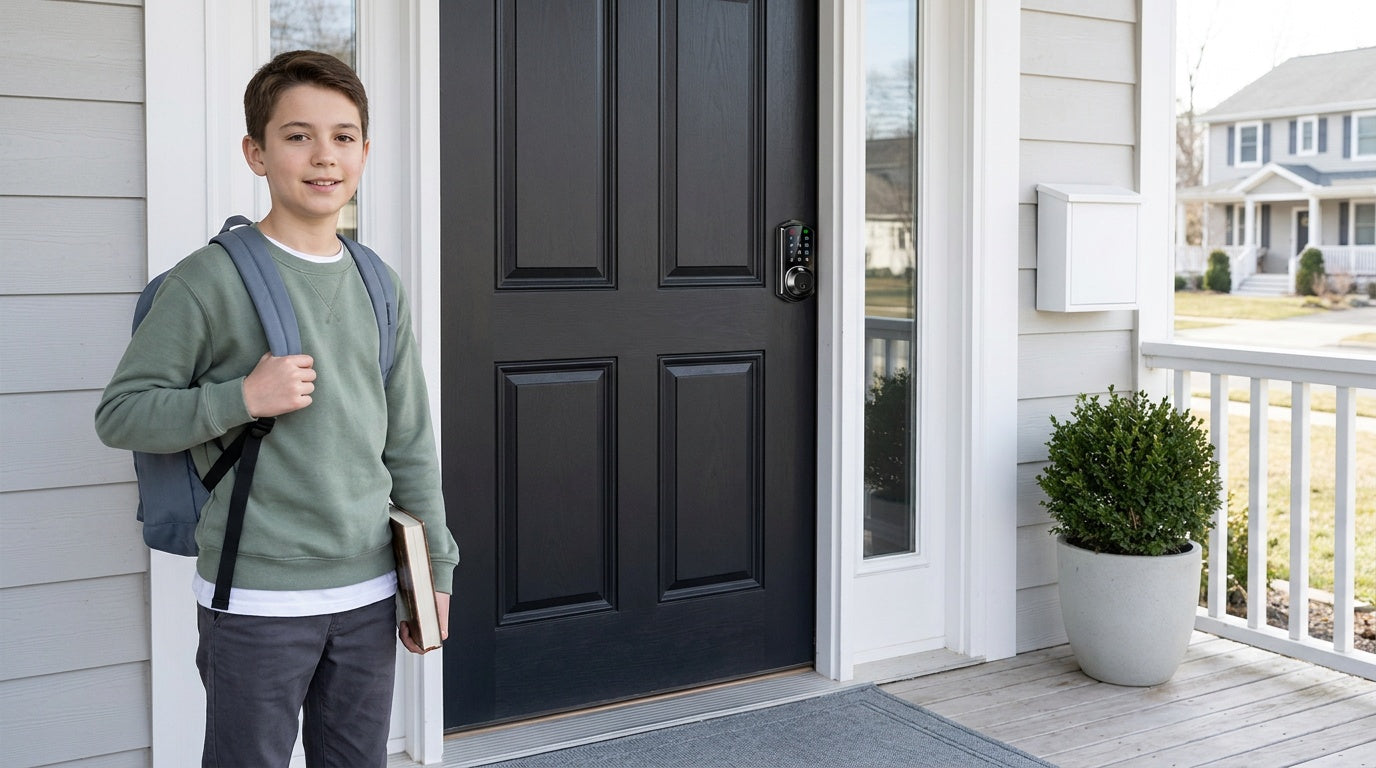

Leave a comment
This site is protected by hCaptcha and the hCaptcha Privacy Policy and Terms of Service apply.