
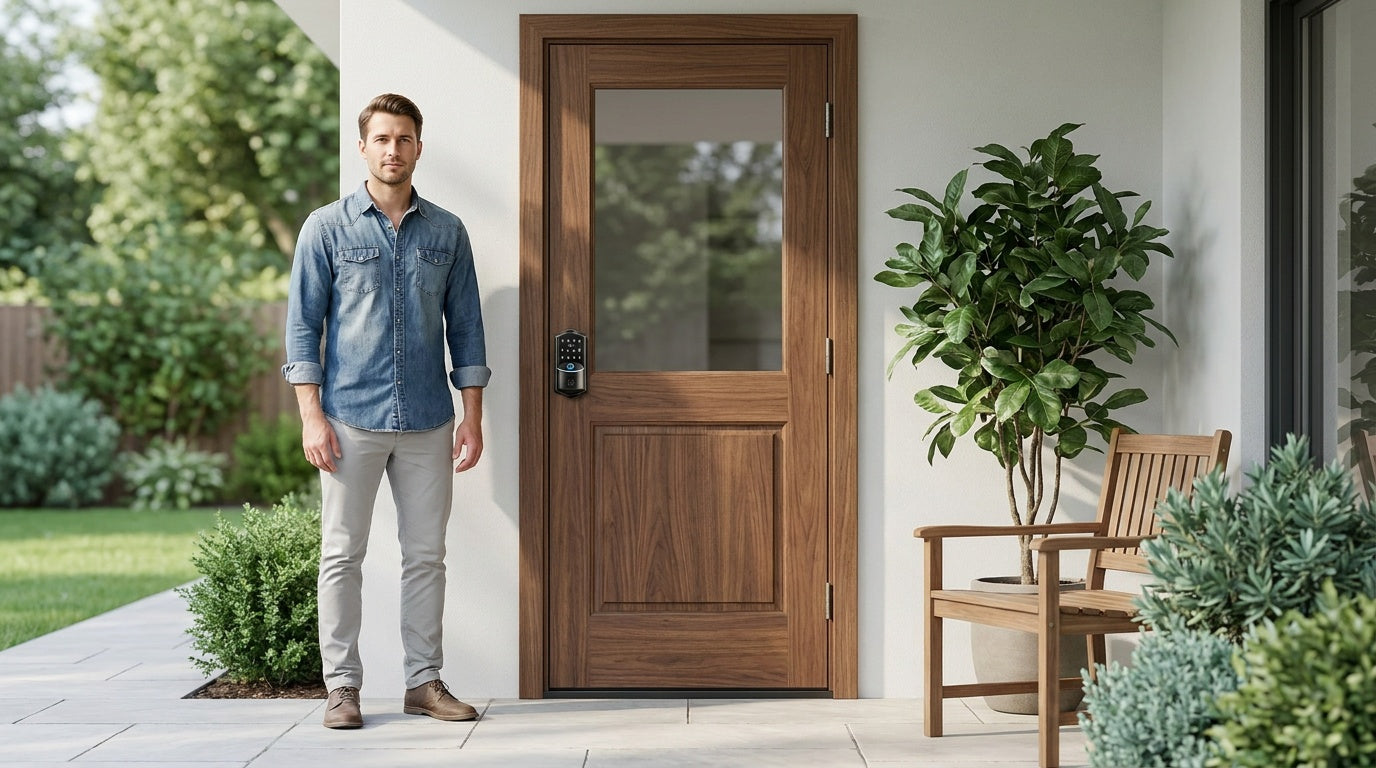
When most people search for a "smart lock for a patio door," they picture one thing: that glass sliding door off the living room. But the reality is that "patio door" covers two very different door types — sliding glass doors that glide on a track, and hinged doors (including French doors and single swinging doors) that open on hinges just like a front door. Those two designs take completely different locking hardware, and confusing them is the most common mistake homeowners make when shopping for an upgrade.
This guide breaks down both categories clearly. You'll learn what lock options are available for each patio door type, which technologies are compatible with wood hinged doors (and which aren't), and how to match the right lock to your actual situation — whether you want simple keyless entry, remote app access, or a full smart home setup. If you have a hinged wood patio door, you'll also find a practical rundown of the Veise options that fit it. Easy from Day One.
First, What Kind of Patio Door Do You Have?
Before shopping for any lock, it helps to know exactly what type of patio door you're working with, because the hardware category changes entirely depending on the answer. Patio doors generally fall into two groups: sliding glass doors and hinged doors.
Sliding glass patio doors operate on a horizontal track — one panel is fixed while the other slides to the side to open. They're a common feature in modern and contemporary homes, especially where interior space is limited, because they require no clearance for a door swing. Most sliding doors are framed in aluminum or vinyl and are specifically designed to slide, not swing.
Hinged patio doors open on hinges, just like a standard entry door. This category includes single swinging doors that lead to a deck or backyard, as well as French doors — the classic double-panel style where both sides swing open from the center. Hinged patio doors are frequently built with wood frames and accept the same type of lock hardware used on front doors: a deadbolt, a handle, or a combined keypad lock set.
Why does this distinction matter so much? Because standard smart locks — including deadbolt-style keypad and Wi-Fi locks — are engineered for hinged doors with a door frame, a bore hole, and a latch pocket. They physically cannot be installed on a sliding door's glass panel or aluminum track frame. Identifying your door type first saves you from buying the wrong product entirely.
Sliding Glass Patio Doors: Lock Options Explained
Sliding glass doors present a genuine security challenge. Most come from the factory with a basic hook latch that is more of a convenience catch than a true lock. The larger vulnerability, however, is the track itself: a determined intruder can sometimes lift the door panel off its track or pry the latch open without much effort. Upgrading the locking hardware on a sliding door is a smart move regardless of whether you go keyless or not.
The lock options for sliding doors break down into three tiers:
- Mechanical keyless locks — Surface-mounted push-button locks that replace the standard latch and require a PIN to open. They have no electronic components, so battery failure is never a concern, and they typically carry long mechanical warranties. The trade-off is that most offer only a single user code and can require removing the lock to change it.
- Electronic keypad locks — Battery-powered locks that accept multiple user codes and make code changes easy through a programming sequence at the lock itself. They don't offer remote monitoring or app access, but they're a significant upgrade over the factory latch.
- Smart sliding door locks — Full-featured smart locks purpose-built for sliding door frames, offering PIN, fingerprint, RFID card, app control, and remote monitoring. These are a smaller and more specialized product category than standard deadbolt-style smart locks. Because they mount to the door frame rather than drilling through glass, installation is more involved and best approached carefully.
One important note: Veise locks are designed for wood hinged doors and are not compatible with sliding glass doors. If you have a sliding door, Veise is not the right fit — and any honest guide should say so clearly. The options above represent the general market for sliding door security. For a hinged patio door, however, the full range of Veise smart lock technology becomes available, as explained below.
For sliding doors, pairing any new lock with a physical security bar or anti-lift track pin is also worth considering. A bar placed in the track prevents the door from sliding open even if the latch is bypassed, adding a low-cost second layer of protection.
Hinged Wood Patio Doors: Where Smart Locks Shine
If your patio door swings open on hinges and has a wood frame, you're working with the same hardware standard as a front door. That means you have access to the full range of smart lock technology — keypad deadbolts, gateway-paired smart locks, and Wi-Fi smart locks — all of which install through a standard bore hole using nothing more than a screwdriver. No wiring, no special tools, no contractor required.
This is great news for homeowners, because it means the patio door leading to a backyard deck, a side yard, or a covered patio can have the exact same smart functionality as the front door. You can assign separate access codes to family members, check entry history from your phone, enable auto lock so the door always secures itself after you step outside, and even grant temporary access to a service provider without being home. For short-term rental properties where guests come and go through a rear door, the value of that remote access is hard to overstate.
Veise locks are built for exactly this use case. Compatible with wood doors between 1-3/8" and 2" thick, they are not designed for fiberglass, metal, storm, or sliding doors. Within those parameters, though, the lineup covers every scenario from simple keypad entry to full remote Wi-Fi control.
Veise Lock Options for Hinged Wood Patio Doors
Veise is a vertically integrated smart lock company — meaning it designs, engineers, manufactures, and supports every lock it sells. There are no middlemen, no OEM resellers, and no outsourced parts. That direct ownership of the product is part of why Veise ranked as the #1 smart lock brand on Amazon North America in both 2024 and 2025. The lineup covers three main categories relevant to hinged patio doors: keypad deadbolts, gateway-paired smart locks, and Wi-Fi smart locks. Prices range from $30 to $180, no subscription fees on any model.
Keypad Deadbolt Locks
A keypad deadbolt is the simplest upgrade from a traditional keyed lock. It replaces the existing deadbolt with a keypad-equipped unit that lets you enter by typing a code, keeping a physical key as a backup. There's no app, no gateway, and no Wi-Fi needed — it works as a standalone device, which means it functions reliably even in areas with spotty connectivity or on doors where you simply don't need remote access.
Veise keypad deadbolts split into two main lines. The KS02 series adds a fingerprint reader, so family members can register their fingerprint and get in with a quick touch — scans complete in under 0.3 seconds. Fingerprints are processed and stored directly on the lock itself, with no data sent to a cloud server, which is both a privacy and reliability benefit. The KS02 series comes in handle-set bundles (KS02B with a lever, KS02C with a knob, KS02D with a vertical handle) as well as a keypad-deadbolt-only version (KS02A) if you want to keep your existing handle. The non-fingerprint line (RZ and KS01 series) covers standalone deadbolts (RZ-A) and handle-set bundles with a keyed lever or knob, making it easy to match whatever handle style suits the door.
All Veise keypad deadbolts include keypad code and physical key backup on every model. Auto lock is configurable between 10 and 99 seconds — meaning the deadbolt re-engages automatically once the configured countdown elapses (regardless of whether the door is open or closed), which is genuinely useful for a back patio door that gets used multiple times a day and is easy to forget. All models are ANSI/BHMA Grade 3 certified, the standard for residential security.
A keypad deadbolt is a good fit when you want keyless entry without the complexity of an app, when the patio door is used frequently by multiple family members who'd rather type a code than carry a key, or when budget is the primary consideration. It is not the right pick if you want to check the lock remotely or get notified when someone comes home — for those scenarios, a smart lock is the better choice.
Smart Lock w/ Gateway 1/2
Gateway-paired smart locks add full remote access — app control, entry history, lock alerts, and voice assistant integration — to the lock by pairing with a small hub that connects to your home's Wi-Fi router. The lock itself communicates wirelessly with the gateway, and the gateway handles the Internet connection. This architecture keeps the lock hardware lean while delivering all the connected features. Remote access requires a smart lock paired with a gateway (G1 or G2), not a keypad-only lock with a gateway added on — a keypad deadbolt cannot be paired with a gateway.
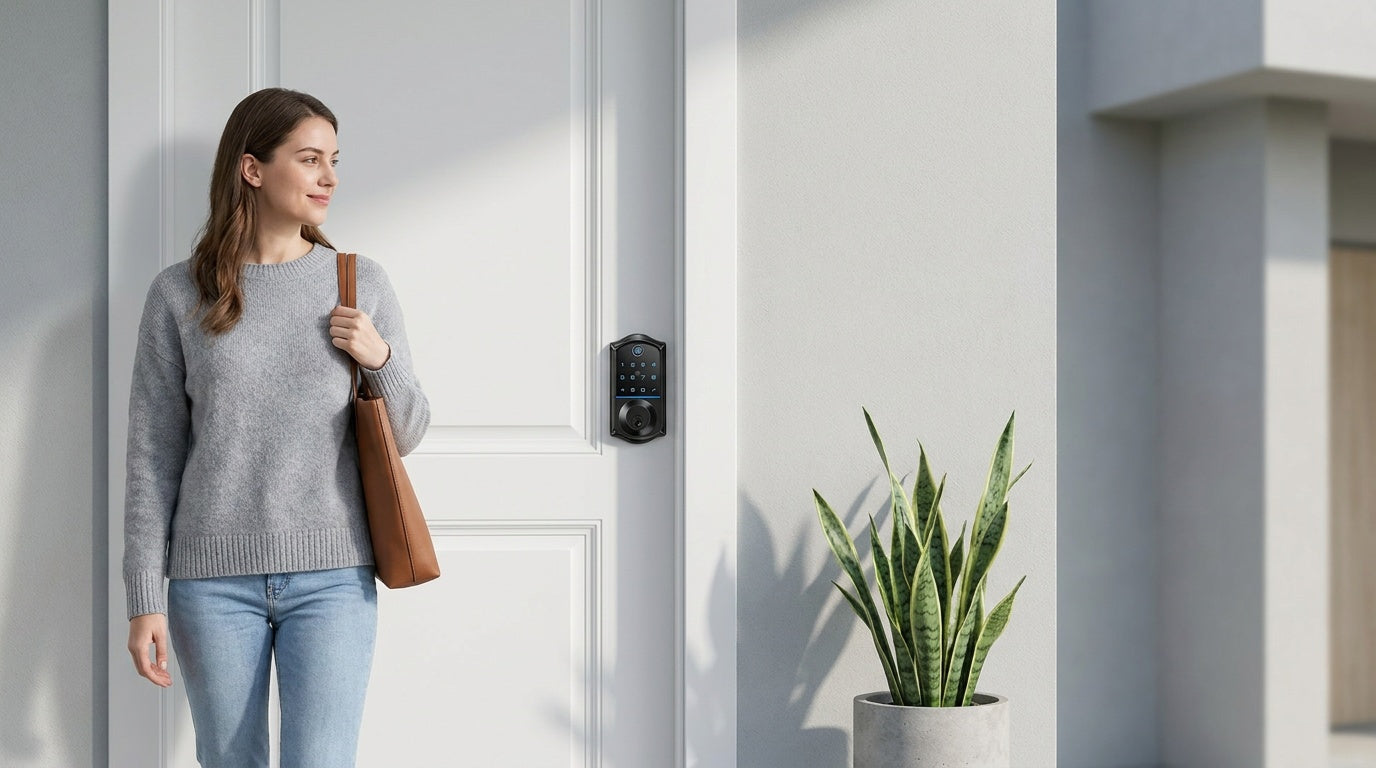
Smart Locks w/ G1 represent the entire G1 line, built on a single series — the VE017. Every G1 lock ships with fingerprint access, multilingual voice prompts (English, Spanish, and French), and a USB-C emergency power port (on VE017/VE027 series models), so if batteries run flat, you can jump-start the lock with a phone charger rather than hunting for a battery. The G1 series also pairs with a Veise-developed first-party app, which tends to be the more reliable integration. For multilingual households or families where not everyone reads English, the three-language voice prompt is a concrete, practical advantage. All G1 models include keypad code, key fob, and physical key as backup entry methods, in addition to fingerprint and remote app control. Explore the Smart Locks w/ G1 collection.
Smart Locks w/ G2 cover more SKU variety — both fingerprint and non-fingerprint options, in standalone deadbolt-only or handle-set bundle form factors. G2 line is also the only Veise line that supports Apple Watch unlock and web portal control, making it a strong pick for Apple-heavy households. Voice prompts on G2 series are English only. Like G1 models, smart locks w/ G2 include keypad code, key fob, and physical key as standard backup methods. Browse the Smart Locks w/ G2 collection.
When Wi-Fi goes down, gateway-paired locks don't fully lose app functionality — if you're within short-range wireless distance of the lock, app control continues to work locally even when Wi-Fi is down. Only long-distance remote features (checking the lock from across town, off-site alerts) require a live Internet connection. For most day-to-day use, the lock operates just as reliably with or without active Wi-Fi.
Voice control with gateway-paired locks works when the gateway is in place — the gateway bridges the lock to Alexa or Google Assistant. As long as the gateway is connected, you can use voice commands to lock or unlock the door just as you would with any other smart home device.
Wi-Fi Smart Lock
Wi-Fi smart locks skip the gateway entirely. The lock connects directly to your home's Wi-Fi router, giving you remote access, real-time entry alerts, activity history, and voice assistant control (Alexa and Google Assistant) all from the lock itself — no hub required. Veise offers two Wi-Fi series that share the same core Wi-Fi features but differ in four concrete ways — interface, USB-C emergency power, key fob support, and on-device voice prompts.
The Touchscreen Wi-Fi Smart Lock (VE027 Series) uses a touchscreen keypad for a sleek, modern look. It also includes a USB-C emergency power port, so a low-battery lockout is easy to solve with a phone charger. The Push-Button Wi-Fi Smart Lock (VE012W Series) uses a traditional press-button keypad — a familiar interface that some users find more reliable in very cold or wet outdoor conditions. Both series use an 8 AA battery design (instead of the more common 4 AA setup) for stronger signal stability and a more substantial power reserve. Both include fingerprint access, keypad code, app control, and voice commands (Alexa and Google) via built-in Wi-Fi; three-language on-device voice prompts (English, Spanish, and French) and key fob support come on the VE027 series only.
A Wi-Fi smart lock is the strongest fit for parents who want to check the app when their child arrives home after school, for owners managing a short-term rental where guest codes need to be set and changed remotely, or for anyone who wants the convenience of a full smart lock without the extra step of setting up a separate gateway. Browse the Wi-Fi Smart Lock collection.
How to Choose the Right Lock for Your Patio Door
The right choice usually comes down to three questions: How often is this door used? Who needs access? And do you need to control it remotely?
If the patio door is a secondary entry that gets occasional use and you mostly want to ditch the key, a keypad deadbolt does the job well. It's the most straightforward upgrade, the easiest to install, and the most affordable in the Veise lineup. The fingerprint-equipped KS02 series is worth considering if young children or elderly family members are regular users — typing a code is easy enough, but a fingerprint is even simpler.
If you want to know when the door was opened and by whom — or if you want to lock it from the other side of the house — you need a smart lock. For most households, the Smart Lock w/ G1 is the best all-in-one connected option: fingerprint, multilingual voice, USB-C backup power, and a first-party app all come standard across the entire line. If you specifically want Apple Watch unlock or web portal access, the Smart Lock w/ G2 is the right pick. If you'd rather avoid setting up a gateway hub and want the lock to connect to Wi-Fi directly, either Wi-Fi Smart Lock series handles that cleanly.
For property owners managing a rental cabin or vacation home where the patio door is a primary entry point, the Wi-Fi smart lock or a gateway-paired smart lock (not a keypad-only lock) enables the remote access needed to set temporary codes, monitor arrivals, and lock the door between stays — all from a phone, regardless of how far away you are.
Installation: What to Expect
Every Veise lock on a wood hinged patio door installs as a full lock replacement — the existing deadbolt (and handle, for handle-set bundles) comes out and the new Veise lock goes in. This is a clean swap that requires owning or having authority to modify the door hardware, so it's suited for homeowners, property managers, and landlords rather than renters who can't alter their door fixtures.
Installation typically takes about 15 minutes with a screwdriver. No wiring, no drilling new holes (Veise locks use the standard bore hole configuration), and no professional help required. The mounting hardware, screws, and strike plate are included, and each lock ships with a printed quick-start guide plus a step-by-step user manual and an installation video, so visual guidance is on hand if you need it. Veise locks don't ship with batteries, so pick up a fresh set of AA/LR6 alkaline cells before you start. Because every lock arrives with a preset default master code, once the batteries are in you can lock and unlock immediately to confirm the install, then use the included manual to change the master code and add personal codes at your own pace.
One practical check before ordering: confirm the door material (wood only), the door thickness (1-3/8" to 2"), and the backset measurement (the distance from the door edge to the center of the bore hole). These measurements are on the packaging of your existing lock or can be measured directly. Getting them right means the new lock drops in without any modifications.
The Bottom Line
Patio door security starts with knowing what kind of door you have. Sliding glass doors require purpose-built locking hardware designed for their track-mounted frames — standard smart locks don't fit. Hinged wood patio doors, on the other hand, accept the same deadbolt and smart lock hardware used on front doors, which opens up a much wider range of options.
For wood hinged patio doors, Veise offers a full path from simple keypad entry to full Wi-Fi remote control — all at $30 to $180, no subscription fees, and with a 15-minute DIY install. Whether the door leads to a backyard deck, a side entrance, or a shared common area in a rental property, there's a Veise lock that fits the use case. Explore the full Veise product lineup to find the right match for your door.
Frequently Asked Questions
Can I put a smart lock on a patio door?
It depends on the door type. Standard deadbolt-style smart locks — including Veise's entire lineup — are designed for hinged doors with a wood frame. If your patio door swings open on hinges and has a wood frame, yes, a smart lock installs the same way it would on a front door. If your patio door slides on a track, you need a purpose-built sliding door smart lock, which is a separate, smaller product category with limited options on the market.
Do Veise locks work on sliding glass patio doors?
No. Veise locks are compatible with wood doors only and are not designed for fiberglass, metal, storm, or sliding doors. They are built for hinged doors — single swinging doors, French doors, and other hinge-mounted patio doors — with wood frames between 1-3/8" and 2" thick.
What is the difference between a keypad deadbolt and a smart lock for a patio door?
A keypad deadbolt lets you enter by code (and physical key as backup) at the lock itself — there's no app and no remote access. A smart lock adds remote control via a mobile app, entry history, real-time alerts, and voice assistant integration. Remote access requires a smart lock — either gateway-paired (Smart Lock w/ G1 or G2) or Wi-Fi — not a keypad deadbolt with a gateway added on. If you only want keyless entry, a keypad deadbolt is simpler and more affordable. If you want to check or control the lock from anywhere, you need a smart lock.
Do I need a subscription to use Veise smart lock features?
No. Veise charges no subscription fees on any model. All features — remote access, entry history, app control, fingerprint storage — are included with the lock at no ongoing cost. Fingerprint data is also stored locally on the lock itself, not on a cloud server.
What happens to a Veise smart lock if the Wi-Fi goes down?
Keypad code and physical key backup work on all Veise locks regardless of Wi-Fi status. For gateway-paired and Wi-Fi smart locks, even when Wi-Fi is down, app control continues to work locally as long as you're within short-range wireless distance of the lock. Only long-distance remote features — checking the lock from off-site, receiving alerts when away from home — require an active Internet connection.
Can a renter install a Veise smart lock on a patio door?
Veise locks are full lock replacements, which means the existing hardware is removed and replaced with the new lock. This type of modification typically requires the property owner's permission. Veise locks are best suited for homeowners, property managers, and landlords — anyone with the authority to modify the door hardware. If you're a renter interested in smart lock access, check with your landlord first, or look into overlay-style locks that add to the existing hardware rather than replacing it.
How long does it take to install a Veise lock on a patio door?
About 15 minutes with a screwdriver. Veise locks use the standard bore hole configuration found on wood doors, so no new drilling is needed. The existing lock comes out, the new lock goes in using the included mounting hardware, and initial code setup takes just a few minutes. No wiring and no professional installation are required.
Which Veise lock is best for a short-term rental patio door?
A Wi-Fi smart lock or a gateway-paired smart lock (Smart Lock w/ G1 or G2) is the right choice for rental properties. Both allow you to set and change guest codes remotely, monitor entry history, and lock the door between stays from anywhere with an Internet connection. A keypad-only lock does not support remote access, so it isn't suitable for off-site property management. The Touchscreen Wi-Fi Smart Lock (VE027 Series) is a popular pick for rentals because it also includes a USB-C emergency power port, meaning a low battery never results in a lockout.
Not Sure Which Lock Fits Your Door?
The Veise support team is based in the US and available by phone and email. If you're unsure about door compatibility, backset measurements, or which lock category fits your setup, reach out before you buy — it's the fastest way to get the right answer.
Contact Veise Support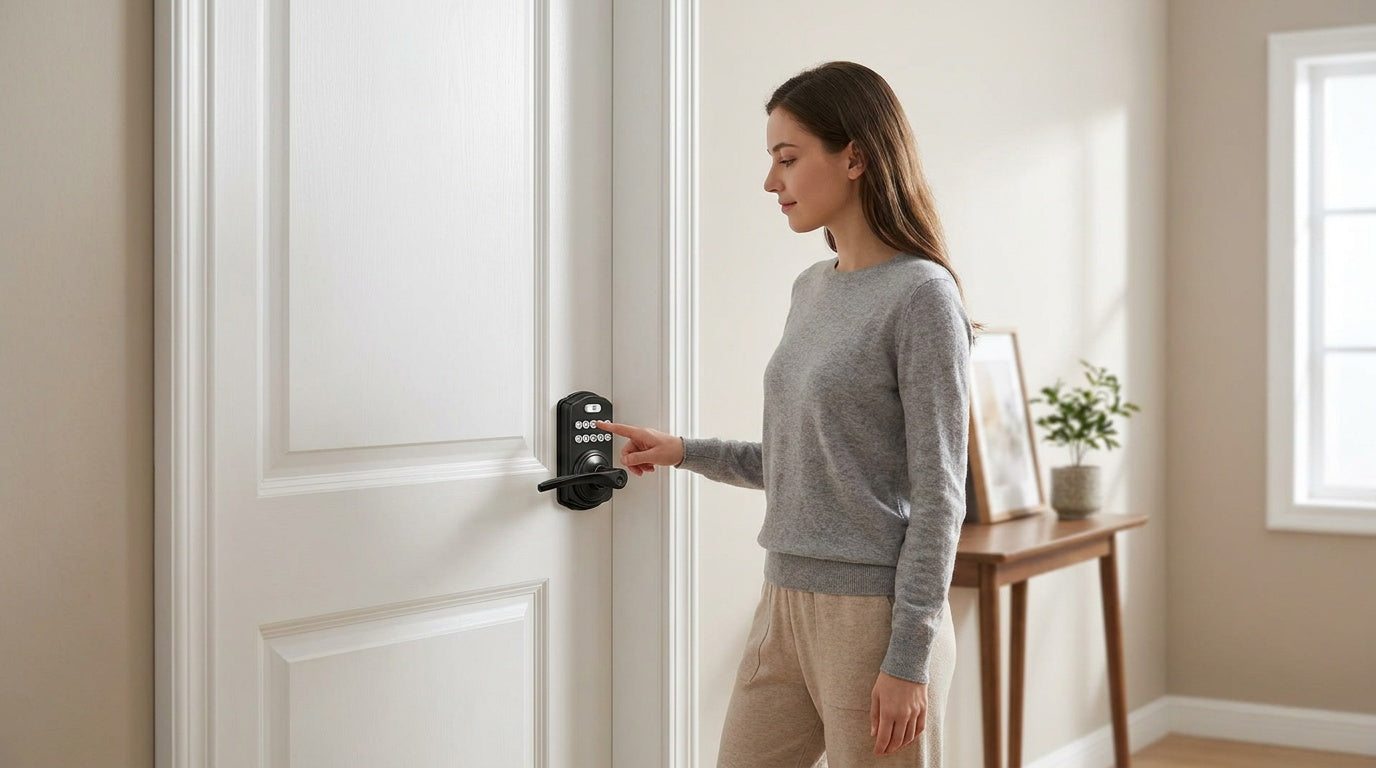

Leave a comment
This site is protected by hCaptcha and the hCaptcha Privacy Policy and Terms of Service apply.