
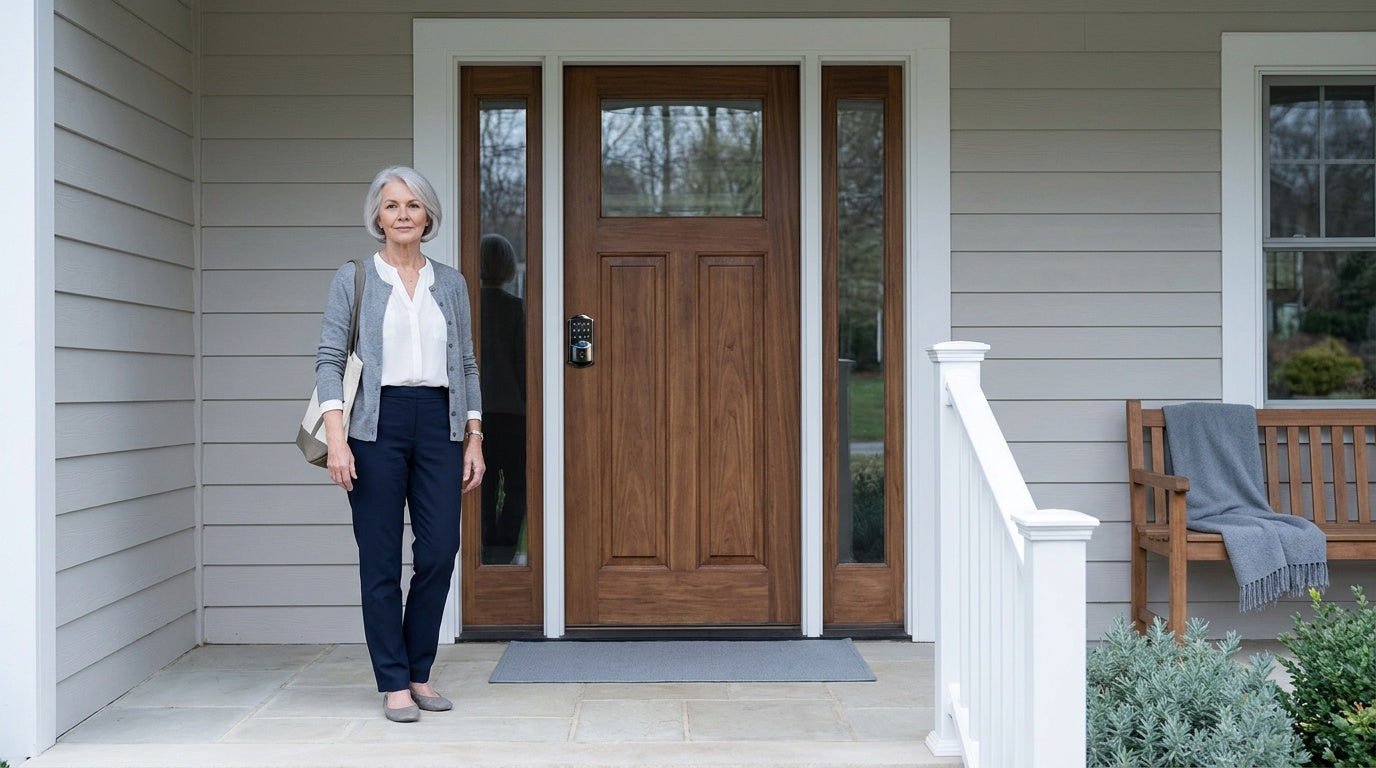
Most seniors want to stay in the home they know and love. According to a 2025 survey, 84% of older Americans consider aging in place a priority, with more than half describing it as extremely important. Yet only about 10% of U.S. homes are considered truly "aging ready" — meaning most homes still have barriers that quietly chip away at confidence and independence every single day.
The front door is one of those barriers. Fumbling for keys with arthritic hands, squinting at a lock in low light, or simply worrying about whether you left the house unlocked — these are everyday friction points that add up. The good news is that making home access easier and safer for seniors doesn't require a full renovation or a large budget. The right door hardware and smart entry solutions can make an enormous difference, and many of them take under 15 minutes to install.
In this guide, we'll walk through the most practical, effective upgrades for senior home entry — covering door hardware basics, electronic and smart lock options, family monitoring features, and how to choose the right solution for your specific situation. Whether you're a senior planning ahead, an adult child helping a parent stay home longer, or a caregiver coordinating daily access, this guide has you covered.
Why Home Access Is the Foundation of Independent Living
When we talk about aging in place, conversations often jump straight to bathroom grab bars or stair lifts — and those matter. But the front door deserves equal attention. It's the first and last point of contact every time a senior enters or exits their home, greets a caregiver, or lets in a family member in an emergency. If that interaction is difficult, uncomfortable, or unreliable, it erodes the sense of control that makes independent living feel meaningful.
Falls are the leading cause of injury among adults over 65, and the risk doesn't stop indoors. Struggling with a stiff deadbolt on an icy morning, reaching awkwardly for a key at the bottom of a bag, or rushing to unlock a door before a caregiver leaves — each of these moments creates a real fall risk. The practical goal is to remove friction from daily routines so that coming and going feels natural, not stressful. Small, smart changes to door hardware are among the most affordable and impactful upgrades a home can get.
Common Door Entry Challenges Seniors Face
Understanding the specific challenges makes it easier to choose the right solutions. Most entry difficulties faced by seniors fall into a few predictable categories:
- Reduced grip strength and dexterity: Arthritis, which affects more than half of adults over 65, makes gripping and turning a round doorknob painful and unreliable. Traditional keyed knobs require precise finger control that becomes harder over time.
- Key management: Misplacing keys is stressful at any age, but for seniors — especially those with early cognitive changes — it can become a recurring problem that undermines confidence and creates security risks when keys are hidden under doormats as a backup.
- Low-light visibility: Vision changes with age, and a dim entryway or poorly lit keyhole becomes a genuine barrier after dark or during early mornings.
- Caregiver and family coordination: When multiple people need access — a home health aide, a visiting family member, a neighbor checking in — managing copies of keys becomes complicated, expensive, and risky if a key is lost or not returned.
- Emergency access: If a senior experiences a health event indoors, emergency responders or family members need to get in quickly. Traditional key-only locks make this harder and slower.
Each of these challenges has a practical hardware solution — and many of them are solved by the same upgrade.
Practical Door Hardware Upgrades for Safer Access
Switch from Round Knobs to Lever Handles
This is the single easiest upgrade with the broadest impact. Lever-style door handles require far less grip strength than round knobs — a push or pull with an open palm is enough to operate them, even for hands affected by arthritis or reduced strength. For interior doors throughout the home, privacy door levers and keyed entry door levers are practical, affordable replacements that can be installed without professional help. If a coordinated set is preferred for an exterior entry door, the Keyed Entry Handleset bundles a deadbolt with a keyed lever or a keyed knob in one easy-to-operate package.
Upgrade to a Keypad Lock and Eliminate Key Dependence
For many seniors, the single most liberating upgrade is removing the physical key from the daily equation. A keypad deadbolt lets you enter your home with a memorized code — no fumbling through a bag, no worrying about a key left in the wrong coat pocket. Keypad deadbolt locks are the most common choice for exterior doors, combining the security of a deadbolt with the convenience of push-button entry. Across the KS02 series, fingerprint recognition adds a second layer of convenience — a quick touch of a finger is read in under 0.3 seconds, with no code to remember at all.
For interior doors — a home office, a side entry, or a garage door — a keypad latch lock offers the same keyless benefit in a simpler format. These are integrated units with the handle and latch built together, making installation clean and straightforward. Every Veise keypad lock also includes a physical key as a backup, so there's always a fallback in place — but most users find they rarely need it once keypad entry becomes habit.
Consider a Deadbolt for Doors That Need Standalone Security
Some exterior doors already have lever or knob hardware that works fine, but the deadbolt is outdated or hard to operate. In those cases, replacing just the deadbolt — without touching the handle — is a targeted and economical fix. A standalone deadbolt upgrade can improve both security and ease of use without a full hardware overhaul. For seniors who prefer the familiarity of a keyed entry but want better hardware quality, keyed entry door knobs and keyed entry levers are worth considering as a mid-step before going fully keyless.
How Smart Locks Support Senior Independence
Beyond keypad entry, smart locks bring an additional layer of convenience that directly addresses some of the most common senior concerns: caregiver coordination, emergency access, and family peace of mind. A smart lock connects to a mobile app, allowing remote control, entry history monitoring, and flexible access management from anywhere with an Internet connection.
Veise smart locks are built on Kaadas Group's 38 years of lock industry expertise and backed by 711 patents — the world's largest smart lock patent portfolio. That's not marketing language; it means that every mechanism, every circuit board, and every user interaction has been engineered with real-world reliability in mind. With 10M+ smart locks sold across 41+ countries, and recognition by Frost & Sullivan as the global No.1 high-end smart lock brand by sales, Veise brings a level of engineering depth that goes far beyond what most residential lock brands offer. Easy from Day One.
For seniors and their families, the practical benefits of a smart lock come down to a few core features worth understanding:
- Multiple ways to enter: A good smart lock doesn't force you to rely on any single method. Depending on the model, entry options include a keypad code, fingerprint, key fob, physical key backup, app control, and voice commands via Alexa or Google Assistant.
- Shared access without shared keys: Caregivers, family members, and trusted neighbors can each be given their own unique access code — and those codes can be changed or removed instantly from the app, without ever touching the lock.
- Auto lock: No more worrying about whether the door was locked. The lock re-engages on its own once the interval you set has elapsed — configurable between 10 and 99 seconds on Keypad Deadbolt and Keypad Latch locks, and between 10 and 180 seconds on connected models. The countdown runs on the timer rather than a door sensor, so the door just needs to be shut before it expires.
- Emergency entry options: When caregivers or family need to get in urgently, they can use their own code, a key fob, or app access — no need to break in or search for a hidden key.
Choosing the Right Lock for Your Situation
Not every senior has the same needs, and Veise's product lineup reflects that. Here's how to think through the right choice based on your specific priorities. Note that all Veise locks are designed for wood doors (standard thickness 1-3/8" to 2") and require full lock replacement — making them the right fit for homeowners or property managers with authority to modify door hardware.
For Simplicity: Keypad Deadbolt
If the goal is simply to eliminate keys and make entry easier, a keypad deadbolt is the most straightforward choice. Entry works with a keypad code on all models, and the KS02 series adds fingerprint recognition on every SKU for those who prefer not to remember a number. There's no app, no Wi-Fi, and no subscription required — just reliable, everyday keyless entry. Sitting at the accessible end of Veise's $30–$180 lineup, these are among the most affordable upgrades a senior homeowner can make. All Veise keypad deadbolts are ANSI/BHMA Grade 3 certified, which is the recognized standard for residential security.
For Connected Families: Smart Lock w/ Gateway 1/2
When family members or caregivers want remote visibility into who's coming and going, a smart lock paired with a gateway is the right step up. Smart Locks w/ G1 represent Veise's most complete all-in-one connected lock line — the entire G1 line is one series (the VE017), and every unit in it includes fingerprint recognition, multilingual voice prompts in English, Spanish, and French, a USB-C emergency power port (useful if batteries run low unexpectedly), and a key fob alongside the physical key backup. All Smart Locks w/ G1 connect through a paired gateway — a separate device, sold separately on nearly all SKUs and positioned within wireless range of the lock — to a first-party Veise-developed app, enabling remote lock/unlock and entry log monitoring. For multilingual households or families where Spanish or French is spoken at home, Smart Lock w/ G1's built-in language support is a concrete advantage.
Smart Locks w/ G2 offer broader SKU variety, including both fingerprint and non-fingerprint models in standalone or handleset bundle configurations. A standout feature is Apple Watch unlock — a genuinely useful hands-free option for seniors who already wear one — alongside web portal control, with English voice prompts. Both Smart Lock w/ G1 and Smart Lock w/ G2 provide remote app control, key fob backup, and auto lock. Note that remote locking and off-site alerts require an active Internet connection. The keypad code and physical key work regardless of connectivity, and on both Smart Lock w/ Gateway 1/2 and Wi-Fi smart locks app control also continues to work locally when Wi-Fi is down, as long as you're within short-range wireless distance of the lock.
For Maximum Convenience: Wi-Fi Smart Lock
Veise's Wi-Fi Smart Locks build the connectivity directly into the lock — no separate gateway needed. Both series (the touchscreen VE027 and the push-button VE012W) support fingerprint, keypad code, app control, Alexa and Google Assistant voice commands, and a physical key backup. The VE027 series adds four things the VE012W series doesn't have: a touchscreen interface that many users find more intuitive than a traditional keypad, a USB-C emergency power port on every SKU, key fob support, and on-device voice prompts in English, Spanish, and French. Wi-Fi smart locks use 8 AA/LR6 alkaline batteries instead of the more common 4 AA setup, delivering stronger signal, more stable connections, and a longer-lasting power reserve — a meaningful advantage for seniors who don't want to think about battery management.
For families with adult children keeping an eye on a parent living alone, the Wi-Fi smart lock's built-in remote access and entry history monitoring through the app — available anywhere with an Internet connection — provides the kind of daily reassurance that's hard to put a price on.
Remote Access and Family Peace of Mind
One of the most underappreciated benefits of a smart lock for senior households is what it gives to the people who care about them. Adult children, spouses managing health challenges, or neighbors keeping tabs on an elderly parent don't want to worry every time a call goes unanswered. A smart lock with remote access provides a quiet, non-intrusive way to check in: a quick look at the app shows the last time the door was opened, whether it's currently locked, and who has entered using which access method.
Remote access requires a smart lock — gateway-paired or Wi-Fi. An electronic lock, while excellent for daily ease of use, does not connect to an app or support remote monitoring. When the decision is between an electronic lock and a connected smart lock, it often comes down to how much the family's peace of mind is worth versus the slightly higher investment. Veise's connected smart locks sit within the same $30–$180 lineup, making the upgrade more accessible than most families expect. The Effortless Home Improvement™ Experience is exactly this: meaningful technology upgrades that don't require a contractor, a monthly fee, or a technology degree to use.
Easy Installation: No Contractor Required
One concern that stops many homeowners from upgrading their door hardware is the assumption that it requires professional installation. With Veise locks, that's not the case. Every Veise lock is designed to install in about 15 minutes with a screwdriver — no wiring, no professional help, no special tools. Because Veise is vertically integrated with its own manufacturing facilities, the engineering precision that goes into each lock means the components align correctly and fit standard door preparations reliably the first time.
The process is straightforward: remove the existing lock hardware, then fit the latch, the exterior assembly, and the interior assembly in that order, securing everything with the provided screws. Every Veise product ships with a step-by-step user manual and an installation video — follow those for the exact, model-specific sequence. The lock arrives with a preset default master code, so you can test it as soon as the batteries are in. For seniors installing a lock themselves or with the help of a family member on a weekend visit, this is a genuinely achievable project. For those managing a rental property or a short-term rental where tenant turnovers make rekeying costly, smart locks with unique code management are an especially practical long-term investment.
With 400+ global R&D professionals — including AI specialists — supported by four worldwide R&D centers, Veise doesn't just design locks that look good on paper. They build hardware that holds up in the real world, through thousands of daily cycles, across decades of use. That level of engineering investment matters when the goal is a lock that a senior can depend on every single day without thinking about it.
Browse the full Veise product lineup to compare options side by side, or explore the Mechanical Locks collection for the lever and knob hardware that complements a keyless entry door.
The Right Entry Solution Makes Every Day Easier
Independent living for seniors isn't just about preventing falls or installing grab bars — it's about removing the small daily friction points that quietly erode confidence. The front door is one of those points, and it's one of the easiest to fix. Whether the priority is eliminating key dependence, giving caregivers reliable access, letting family monitor remotely, or simply making the home feel more manageable, there is a Veise solution that fits the need without requiring a major renovation or ongoing subscription costs.
From keypad deadbolts that replace keys with a simple code, to Wi-Fi smart locks that keep families connected and informed, Veise's range covers every level of need at an accessible price point. Built on 38 years of lock industry expertise, backed by 711 patents — the world's largest smart lock patent portfolio — and with 10M+ smart locks sold across 41+ countries, Veise brings the reliability and simplicity that independent living deserves. Easy from Day One.
FAQ: Smart Locks and Home Access for Seniors
Are smart locks easy enough for seniors to use?
Yes — and that's precisely what makes them such a good fit for seniors. Rather than requiring a single skill (like remembering a code), the best smart locks offer multiple ways to enter. Veise keypad deadbolts, for example, support both a keypad code and a physical key backup on all models, with fingerprint recognition on every SKU in the KS02 series. Fingerprint entry on Veise locks registers in under 0.3 seconds — a quick touch is all it takes. There's no app required if you don't want one, but the option is there for family members who want to help manage access.
What happens if the battery dies on a smart lock?
Every Veise lock includes a physical key as a backup entry method. Additionally, a USB-C emergency power port is standard on the VE017 series (Smart Lock w/ G1) and the VE027 series (Touchscreen Wi-Fi Smart Lock) — every SKU in both series has it — so you can connect a portable power bank to temporarily power the lock and enter with your code, even if the battery is fully depleted. Veise Wi-Fi smart locks use 8 AA/LR6 alkaline batteries, which provides a stronger, more stable power reserve than the 4 AA configuration found in most competing locks.
Can a caregiver or family member get their own access code?
Absolutely. Veise keypad locks support multiple user codes, and connected smart locks allow you to manage these codes remotely through the app — adding, editing, or removing access at any time without touching the lock. This makes coordinating caregiver schedules, family visits, or emergency access straightforward and secure. There's no need to make or collect copies of physical keys.
Do I need a subscription to use a Veise smart lock?
No. Veise smart locks do not require a monthly subscription. Keypad and fingerprint functions work entirely offline and on-device with no account needed. Remote app features (for connected smart locks) use your existing home Wi-Fi or gateway connection, but there's no additional service fee to access them.
Are Veise locks compatible with any door?
Veise locks are designed for wood doors with a standard thickness of 1-3/8" to 2". They are not compatible with fiberglass, metal, storm, or sliding doors. Because Veise locks are full replacements (not overlays), the installer needs to be the homeowner or have authority to modify the door hardware. Installation takes about 15 minutes with a screwdriver — no wiring or professional help required.
What is the best Veise lock for a senior living alone?
It depends on how connected the household wants to be. For simplicity without app connectivity, a keypad deadbolt with fingerprint is a great starting point — easy entry, no keys, auto lock included. For families who want remote monitoring and entry history, a Wi-Fi smart lock or a Smart Lock w/ G1 offers that visibility along with all the same everyday convenience features.
Not Sure Which Lock Is Right for Your Home?
Our team is happy to help you find the best fit — whether it's a simple keypad upgrade or a fully connected smart lock. Reach out and we'll walk you through the options.
Contact Us

Leave a comment
This site is protected by hCaptcha and the hCaptcha Privacy Policy and Terms of Service apply.