
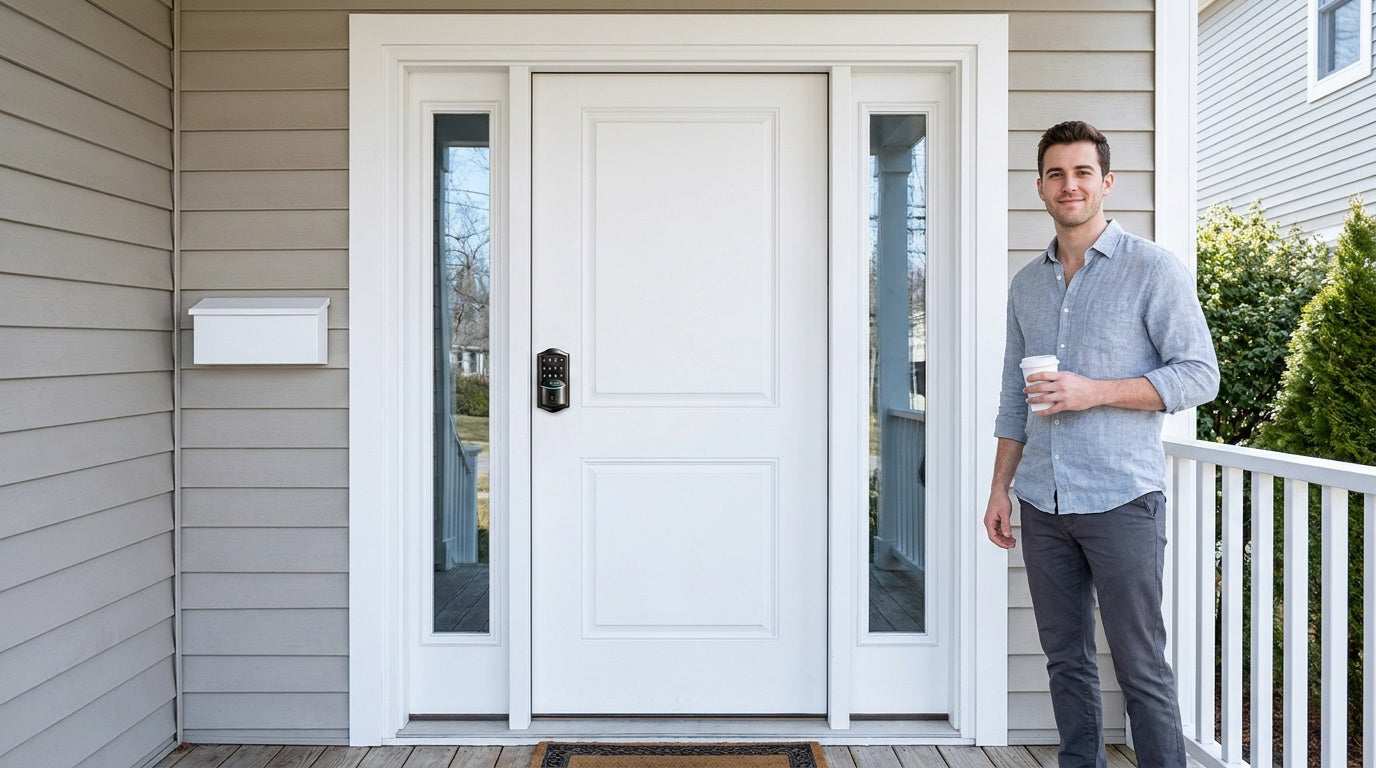
You set the grocery bags down, reach into your pocket, and your stomach drops. The key is not there. Maybe it's on the kitchen counter, maybe it's in last night's jacket, or maybe it's simply lost — but right now, you are standing outside a locked door with no obvious way in. It happens to nearly everyone at some point, and the frustration is real.
The good news is that you have options. Some are surprisingly simple, some require a little patience, and one — the permanent fix — means you will never have to scramble for a key again. This guide walks you through four realistic methods to unlock a door without a key, explains exactly which situations each method works for, and then shows you how the right smart lock upgrade keeps the problem from coming back. Read through before you start prying at anything, because choosing the right method for your lock type will save you time, money, and a damaged door frame.
Why Lockouts Happen (and Why They're So Stressful)
Lockouts are almost never the result of carelessness. Life moves fast: you grab a bag in one hand, wrangle a kid with the other, and the key never makes it to your pocket. Other times a key breaks in the lock, a spare goes missing, or a family member leaves home without realizing they have the only copy. Whatever the cause, the moment you realize you cannot get in carries a specific, sinking kind of stress — especially late at night, in bad weather, or with young children involved.
Understanding that lockouts are common helps, but knowing what to do about them helps more. The methods below are ranked roughly from least-invasive to most-involved, so you can work through them logically rather than reaching for the most forceful option first. A little patience at step one can save a trip to the hardware store or locksmith.
Important: Before You Try Anything
Before you attempt any of the methods below, take a moment to confirm two things. First, make sure you have the legal right to enter. Unlocking your own home is perfectly legal; attempting to unlock any property you do not own or have permission to access is not, regardless of the technique used. Second, check every possible entry point — back door, garage side door, unlocked window — before putting any stress on the front lock. You may save yourself a lot of effort.
It is also worth noting that some DIY methods work only on specific lock types. A spring-latch lock (the kind built into a door knob that snaps shut automatically) behaves very differently from a deadbolt. Knowing which type of lock you are dealing with will steer you toward the method most likely to work without causing damage.
Method 1: The Credit Card Trick
Best for: Spring-latch locks on interior or light-duty exterior door knobs. Does not work on: deadbolts or high-security locks.
This is the method most people have seen in movies, and it genuinely works — but only on the right type of lock. A spring latch has an angled bolt that automatically retracts when the door closes. The card exploits that angle by sliding in and pushing the bolt back. Use a loyalty card or an old gift card rather than an actual credit card, because the card may bend or scratch in the process.
- Choose the right gap – Find the spot where the door frame meets the latch bolt, usually about waist height. There needs to be a small gap between the door and the frame for the card to fit through.
- Insert the card – Slide the card into the gap at a slight downward angle, so one edge sits against the angled face of the latch bolt.
- Wiggle and push – Apply steady pressure toward the door while bending the card slightly away from the hinges. The goal is to guide the latch bolt backward into the door.
- Turn the handle – Once you feel the bolt give way, push the door open while turning the handle simultaneously.
If the door opens outward toward you, this technique is much harder because the stop molding on the frame blocks card access. In that case, move on to a different method rather than forcing it.
Method 2: Coat Hanger for Interior Latches
Best for: Simple interior latch mechanisms, particularly privacy knobs on bathroom or bedroom doors. Does not work on: deadbolts or high-security exterior locks.
Many interior privacy locks — the kind on bathroom doors — have a small emergency release hole on the outside knob. A straightened coat hanger or a thin, rigid wire can reach through that hole and push the release button directly. This is actually the intended emergency access method for those locks, so it is fast and causes zero damage.
- Straighten the hanger – Unwind a wire coat hanger until you have a long, mostly straight length of wire with a small hook or point at one end.
- Locate the release hole – Look at the center of the outside door knob. Most privacy knobs have a small hole (about the diameter of a pencil tip) that leads directly to the release mechanism.
- Insert and press – Slide the straight wire into the hole and feel for the button or tab inside. Apply firm, steady pressure to push or turn it.
- Turn the knob – Once the release engages, the knob will turn freely and the door will open.
If the door does not have a release hole — or if it is a full exterior-grade lock rather than a privacy knob — the coat hanger approach will not help and you should move to the next option.
Method 3: Improvised Tools — Picks, Wrenches, and Hinge Pins
Best for: Pin-tumbler knobs and some deadbolts, when you have time, patience, and no gentler option left. Use carefully: these are the most invasive DIY approaches, and each one carries a real risk of damaging the lock.
Three improvised techniques belong together here because they share the same trade-off — they can work, but they are slow, fiddly, and easy to get wrong:
- Bobby pin or paperclip picking – Mimics what a key does by aligning the internal pins at the shear line. You need two tools: a tension wrench (one pin bent into a tight L-shape, inserted at the bottom of the keyhole under light rotational pressure) and a pick (a second pin straightened with a small upward hook) to push each pin up until it sets. Without practice this takes a long time and can shear the pins.
- Screwdriver or Allen wrench – Some very basic interior locks use a single-slot mechanism that a flat-tipped screwdriver can rotate directly. On a standard key-shaped keyway, a small Allen wrench works better than a bent bobby pin as the tension tool alongside a pick, because it fits the bottom of the keyway more precisely.
- Removing hinge pins – Only an option on a door that swings outward with its hinges visible from outside. Tap each pin up and out with a screwdriver and a hammer (bottom hinge first), lift the door away from the frame, then tap the pins back in once you are inside. Most modern exterior doors are hung with interior hinges precisely to prevent this.
Never force any of these. If you feel strong resistance, stop — you are far more likely to break a pin inside the cylinder than to open the lock, which turns a temporary inconvenience into a full lock replacement. If you are in a hurry or have never picked a lock before, it is completely reasonable to skip straight to a locksmith — no shame in that at all.
Method 4: Call a Professional Locksmith
If none of the above methods apply to your situation, or if you have tried them and the lock is not budging, a professional locksmith is the right call. Locksmiths carry specialized tools and have the training to open most residential locks quickly and without causing damage to the door or the lock itself. The cost is real — a typical residential lockout service runs anywhere from $75 to $150 depending on your location, time of day, and lock complexity — but that is almost always less expensive than replacing a damaged lock or door frame.
When you call, describe your lock type if you can (deadbolt, knob, lever), give your address clearly, and ask for an estimated arrival time and a rough price quote before they come out. A reputable locksmith will give you a ballpark figure over the phone. If someone refuses to quote even a range, consider calling a different service.
The Permanent Fix: Stop Lockouts Before They Start
Getting back inside today is the immediate problem. But if you are honest with yourself, this probably is not the first time a key has caused stress — and it will not be the last, unless you change something. Keeping a spare key with a trusted neighbor or in a secure key safe outside your home helps. So does developing a habit of checking for your keys before pulling the door shut behind you. These are practical short-term habits that genuinely reduce lockout frequency.
The longer-term solution, though, is making the key something you no longer need for daily entry. A smart lock replaces your existing lock hardware and gives you multiple ways to enter your home — keypad code, fingerprint, app, or voice command — so the key you happen to be carrying stops being the only way in, and a physical key cylinder stays on the lock as backup. Even a straightforward keypad deadbolt means that as long as you remember a 4-to-10 digit code, the front door is open to you. Add smart connectivity and you can let yourself in remotely or grant family members access without ever cutting another key.
Beyond convenience, auto lock re-engages the lock after a configurable window — 10 to 99 seconds on Veise's Keypad Deadbolt and Keypad Latch locks, and 10 to 180 seconds on connected models — so you are also protected against the other classic scenario: leaving the house in a rush and wondering for the rest of the day whether you remembered to lock up.
Veise Smart Lock Options Worth Considering
At Veise, we built our entire product line around one idea: your home's entry should work for your family, not against it. Backed by Kaadas Group's 38 years of lock industry expertise and 711 patents — the world's largest smart lock patent portfolio — every Veise lock is engineered and manufactured in our own facility, not assembled from third-party parts. That matters because it means every component, from the keypad membrane to the bolt mechanism, is designed to work together from the start. All Veise locks are compatible with standard wood doors (1-3/8" to 2" thick) and install in about 15 minutes with a screwdriver — no wiring, no locksmith, no special tools. Every Veise product also ships with a step-by-step user manual and an installation video, so you can follow the exact sequence for your model rather than guessing.
Here is a practical look at the four lock categories and what each one does to eliminate the lockout problem:
Keypad Deadbolt Locks
The most straightforward upgrade from a traditional deadbolt. Every Veise keypad deadbolt supports keypad code entry plus a physical key backup, so even if you forget the code, you have a fallback. The KS02 series adds a fingerprint reader on every SKU — with a scan time under 0.3 seconds and enrollment that captures your finger eight times for maximum accuracy — making entry genuinely hands-free. If you mostly want a reliable, no-subscription keypad solution for your front door without adding app connectivity, this is the category to start with.
Keypad Latch Locks
The Veise keypad latch lock is a good fit for interior doors, side entries, garage-to-house passages, or any door where a full deadbolt feels like more hardware than the situation calls for. The latch and handle are integrated into a single unit — available with either a top knob (KS03) or top lever (KS04) depending on your preference. Entry is by keypad code or physical key backup. It is a clean, simple solution for spaces where daily code-based access matters but app connectivity is not a priority.
Smart Locks w/ Gateway 1/2 (G1 and G2)
If you want remote app access — the ability to check your lock status, unlock the door for a guest, or review who came and went while you were at work — you need a smart lock, not just a keypad lock. The Smart Lock w/ G1 is built on a single product series (VE017) and comes as a complete package: fingerprint, keypad code, key fob, and physical key backup all included, plus multilingual voice prompts in English, Spanish, and French — a useful detail for multilingual households. Remote app control works via the paired gateway; even when Wi-Fi is down, app control continues to work locally as long as you are within short-range wireless distance. G1 line also includes a USB-C emergency power port, so a dead battery never means a lockout. The Smart Lock w/ G2 supports Apple Watch unlock and web portal control, and offers both fingerprint and non-fingerprint SKUs in a wider range of form factors — a strong pick if Apple Watch integration is important to you or if you prefer a non-fingerprint configuration.
Wi-Fi Smart Locks
The Wi-Fi Smart Lock line offers the most seamless remote experience because the Wi-Fi connection is built directly into the lock — no separate gateway device needed. Both available series support fingerprint, keypad code, app control, and Alexa or Google Assistant voice commands. The Touchscreen Wi-Fi Smart Lock (VE027 Series) adds a touchscreen interface and a USB-C emergency power port; the Push-Button Wi-Fi Smart Lock (VE012W Series) uses a traditional press-button keypad. Both use an 8 AA/LR6 alkaline battery design (versus the standard 4 AA found in most competing locks), providing stronger signal stability and a more generous power reserve. For families with children, the Wi-Fi smart lock is particularly useful — parents can check the entry log remotely and confirm that kids made it home safely, without needing to call or text. This is the Effortless Home Entry™ experience that Veise is built around: multiple reliable ways in, full visibility from anywhere, and no key needed for daily entry.
Built-In Features That Keep a Lockout From Happening
Picking a category is only half the picture. Several features are built into the Veise lineup specifically so the everyday situations that cause lockouts stop turning into emergencies:
- A physical key cylinder on every lock. Every Veise keypad deadbolt, keypad latch, Smart Lock w/ Gateway 1/2, and Wi-Fi smart lock ships with a visible physical key slot as backup. The keypad or fingerprint reader is added alongside that cylinder, never in place of it — so there is always a fallback route in.
- One-time codes on every model. One-time codes — codes that delete themselves after a single use — work on every Veise lock, including the app-free Keypad Deadbolt and Keypad Latch categories. That is how you let a neighbour in while you are out, without leaving a spare key under a mat. On Smart Lock w/ G1 and Wi-Fi smart locks you can also set Recurring codes (active during set hours on a weekly schedule) and Duration codes (active for a defined period); both expire on their own, so there is no cleanup step to forget.
- Anti-peep code entry. You can pad your real PIN with extra random digits before or after it, and the lock still opens as long as the correct sequence appears somewhere in what you typed — so an onlooker cannot read your code off the keypad.
- Lockout protection. Veise locks automatically pause for 3 minutes after 10 wrong attempts. It is on by default on every model, so nobody can stand at your door guessing.
- Away Mode on the VE017 series (Smart Lock w/ G1). For travel or an extended absence, Away Mode disables PIN code and fingerprint entry, allows only app, master code, or physical key, and flags abnormal unlock attempts.
- Power you can plan around. Veise locks run on AA/LR6 alkaline batteries and warn you well before they run out — a voice or beep prompt at the lock plus an indicator light, and on Smart Lock w/ Gateway 1/2 and Wi-Fi smart locks, a push notification through the app as well. Every VE017 series and VE027 series model also includes a USB-C emergency power port, so a flat battery never becomes a lockout. Note that Veise locks do not ship with batteries — pick up a fresh set of alkaline AA cells before you install.
The Veise lineup is priced in the $30–$180 range, positioning it as a genuinely affordable upgrade rather than a luxury purchase. There is no subscription required to use the core features. Recognized by Frost & Sullivan as the global No.1 high-end smart lock brand by sales, with over 10M smart locks sold across 41+ countries, Veise brings enterprise-grade reliability to residential doors at everyday prices. Easy from Day One.
Final Thoughts
Being locked out is stressful, but it is solvable. The credit card trick handles spring-latch knobs in seconds. A coat hanger gets you through most interior privacy doors immediately. Improvised tools — a bobby pin pick, an Allen wrench, or hinge pin removal on an outward-swinging door — can work if you have patience and the right touch, though each carries some risk to the lock. And when all else fails, a locksmith is a reasonable and reliable option that protects your lock and your door frame.
More importantly, the next lockout does not have to happen. A keypad, fingerprint, or smart lock means daily entry no longer depends on the one key you happen to be carrying — you get in with your fingerprint, your phone, or a code you remember, while the physical key stays in a drawer as backup. Veise makes that upgrade approachable: straightforward installation, no subscription fees, and hardware built on 38 years of lock industry expertise. Browse the full Veise lineup to find the right fit for your door and your family's routine.
Frequently Asked Questions
Is it legal to unlock a door without a key?
Yes, as long as you own the property or have explicit permission from the owner to enter. Using any of these techniques on a door you do not have authority to access is illegal regardless of the method used. If you are a tenant locked out of your rental, contact your landlord or property manager rather than attempting forced entry, as you typically do not have authority to modify or bypass the installed lock hardware.
Which method works best on a deadbolt?
Deadbolts cannot be opened with a credit card or coat hanger — those methods only work on spring latches. For a deadbolt, your realistic options are the improvised-tool approaches — bobby pin or Allen wrench picking (which requires skill and time), or hinge pin removal (only if the hinges are exterior-facing) — or calling a locksmith. The most practical answer for most people is the locksmith.
Can I damage my lock by trying these methods?
Yes, particularly with lock picking and screwdriver techniques. Applying too much torque can shear internal pins, and forcing a credit card on a lock with no gap can damage the door stop molding or warp the card into the latch area. Start with the gentlest method appropriate for your lock type, and stop if you feel strong resistance. If in doubt, a locksmith visit is almost always cheaper than replacing a damaged lock.
How do smart locks prevent lockouts?
Smart locks add entry methods alongside the physical key — keypad code, fingerprint, app control, key fob, and voice commands, depending on the model. Because daily entry no longer depends on a single physical key, losing or forgetting the key stops being a lockout event, and the key cylinder stays on the lock as backup. Features like auto lock also protect against the other common scenario: leaving the house unlocked by mistake.
Do Veise smart locks work if the Wi-Fi goes down?
Yes. Keypad code entry, the physical key, and fingerprint on the models that include it all work independently of any Internet connection. For Smart Lock w/ Gateway 1/2 and Wi-Fi smart locks, even when Wi-Fi is down, app control continues to work locally as long as you are within short-range wireless distance. Only long-distance remote features — such as unlocking the door from across town — require an active Internet connection.
How difficult is it to install a Veise smart lock?
Veise smart locks replace your existing lock hardware entirely and install in roughly 15 minutes with a screwdriver — no wiring and no professional help needed. They are compatible with standard wood doors between 1-3/8" and 2" thick. Because installation involves replacing existing hardware, you should be the property owner or have the owner's authorization before proceeding.
Ready to Make Lockouts a Thing of the Past?
Browse Veise's full range of keypad and smart lock solutions — from simple keypad deadbolts to fully connected Wi-Fi smart locks — and find the right fit for your door in minutes. No subscription required. Installs in about 15 minutes with a screwdriver.
Shop All LocksContact Us

Leave a comment
This site is protected by hCaptcha and the hCaptcha Privacy Policy and Terms of Service apply.