
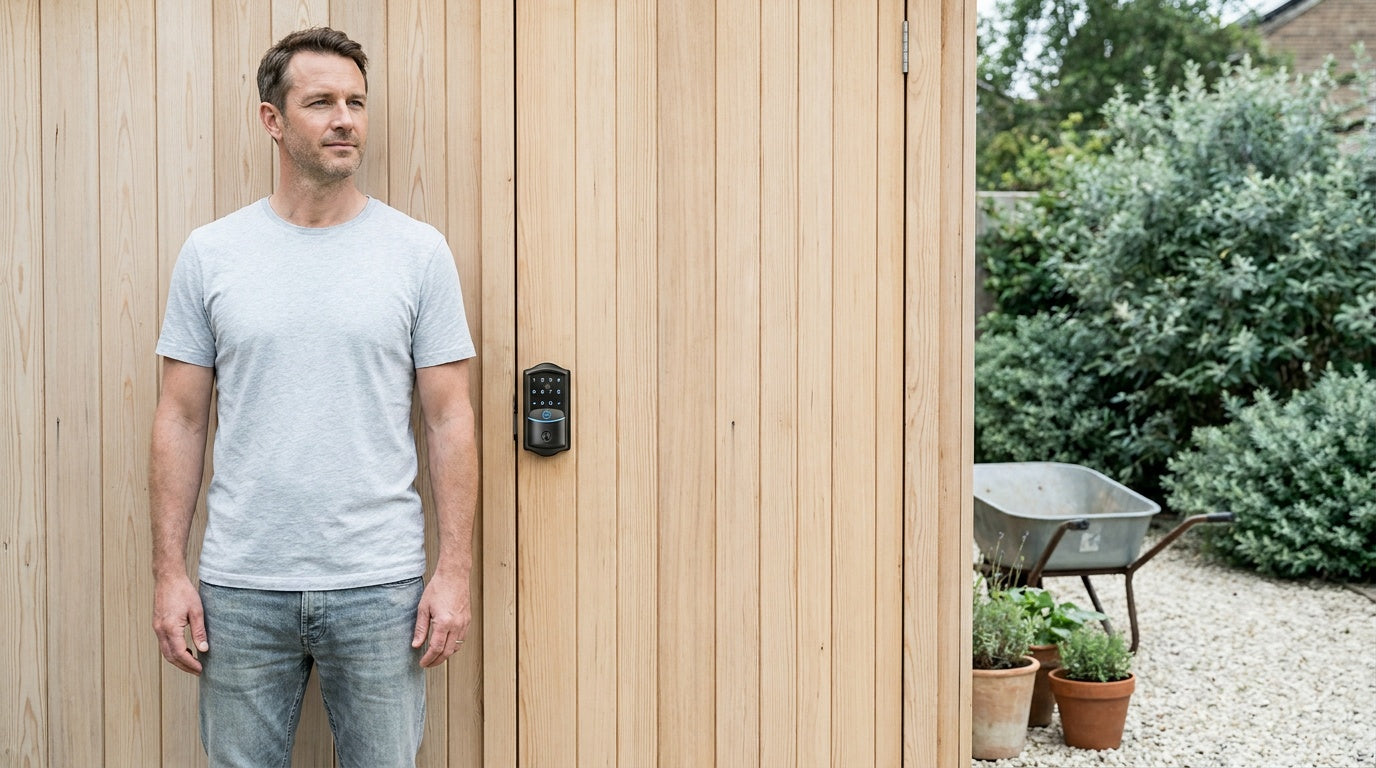
Most sheds get a cheap padlock and a prayer. You snap it on, lose the key once, find it behind a flowerpot, and repeat the cycle for years — all while your lawnmower, power tools, and seasonal gear sit behind hardware that a determined person could defeat in seconds. It's a frustrating situation, and for homeowners with a proper wood-frame workshop, backyard studio, or outbuilding, it's also completely avoidable.
Smart locks for sheds and outbuildings have come a long way. Today, the right lock can give you keypad entry, fingerprint recognition, remote app control, and auto lock — all without a monthly subscription or an electrician. The challenge is knowing which type of smart lock actually fits a shed door, which features you genuinely need, and which options are built to last in an outdoor environment. This guide walks through all of it, with clear recommendations for every kind of shed owner — from the weekend hobbyist who wants a simple keypad to the property manager who needs to monitor access remotely.
Why Your Shed Deserves More Than a Padlock
A padlock on a hasp is the default choice for sheds, and it has real advantages: it's cheap, portable, and requires no door prep. But it also has meaningful weaknesses. A standard padlock exposes the shackle to bolt cutters, and budget-quality hasps can often be pried off with basic tools — the fastener hardware is frequently the weakest link, not the padlock itself. Beyond physical security, a padlock gives you zero access flexibility. Everyone needs a physical key. There's no way to grant temporary access to a neighbor while you're away, no record of who entered and when, and no way to lock up remotely if you walk out and forget.
For sheds that hold real value — a workshop full of power tools, a backyard studio, a storage building with a riding mower or generator — these limitations matter. A keypad smart lock changes the equation entirely. You get a strong deadbolt throw (not an exposed shackle), keyless entry so there's no key to lose, multiple ways to enter for different household members, auto lock so the door secures itself, and on connected models, full remote visibility. The upgrade is practical, not just techy.
The First Rule: Your Shed Door Needs to Be Wood
Before picking a smart lock, check your door material. Veise smart locks — like most residential keypad deadbolts — are designed for wood doors between 1-3/8" and 2" thick. They are not compatible with fiberglass, metal, storm, or sliding doors. This matters more for sheds than for homes, because sheds come in every construction type: timber-frame outbuildings with real wood doors, metal storage sheds, vinyl or plastic prefab units, and everything in between.
If your shed has a solid wood door with a proper frame, you're in great shape — a full deadbolt smart lock installs just like it would on a house entry door, with the same 15-minute process and no professional help required. If your shed has a metal or plastic door, a keypad deadbolt isn't the right fit. In that case, a combination padlock or a mechanical keypad latch designed for non-wood surfaces would be the better path. The rest of this guide assumes a wood-frame shed door, since that's where smart lock upgrades deliver the best results.
The Four Smart Lock Types — and Which Fits Your Shed
Veise makes four categories of smart lock, and each one maps to a different type of shed owner. Understanding the category first makes picking the right model straightforward. Here's how each one works and where it fits.
1. Keypad Deadbolt: Solid Security, No App Required
A keypad deadbolt replaces your existing door lock with a full deadbolt that opens via keypad code, with a physical key as backup. There's no app, no Wi-Fi, no gateway — just reliable, standalone keyless entry. For most sheds and outbuildings, this is the simplest and most practical upgrade. You punch in your code, the deadbolt retracts, and the door opens. When you close up, auto lock engages and the deadbolt extends automatically after a configurable interval (typically between 10 and 99 seconds).
Veise's keypad deadbolt line splits into two groups: models with fingerprint (the KS02 series) and models without (the RZ and KS01 series). The fingerprint models add biometric entry via an on-device AI chip — fingerprints are stored and processed directly on the lock, not in the cloud, and recognition happens in under 0.3 seconds. Both groups support keypad code and physical key backup on every SKU. Handle-set bundles (lever or knob included) are available if your shed door currently has no hardware at all. One practical note: keypad deadbolts do not support key fob entry — that's exclusive to the gateway and Wi-Fi smart lock categories.
Best fit: A dedicated workshop, garden studio, or timber outbuilding where you want strong physical security and simple code-based entry for the household, but don't need remote access or app monitoring.
2. Keypad Latch Lock: Everyday Side-Entry Made Simple
A keypad latch lock is an integrated unit — the handle and the lock mechanism are built into one body — and it uses a spring latch bolt rather than a deadbolt. Veise currently offers two SKUs in this category: the KS03 (integrated top knob) and the KS04 (integrated top lever). Both support keypad code and physical key only — no fingerprint, no app, no key fob. They're a clean, simple choice for lighter-duty access points.
For shed use, a latch lock is a good fit for a secondary outbuilding, a garden shed where you're going in and out frequently throughout the day, or a utility space where you want quick code-based entry. If the door in question also has a separate deadbolt for primary security, a latch lock handles the daily in-and-out while the deadbolt handles the overnight or away-from-home lock-up. These are not the pick for high-value storage — a deadbolt or connected smart lock provides stronger protection for a workshop or equipment storage building.
Best fit: A garden shed or utility outbuilding used multiple times daily where simple, fast keypad access is the priority and heavy security isn't the top concern.
3. Smart Lock w/ Gateway 1/2: Full App Control Without Built-In Wi-Fi
This category steps up to full smart home connectivity. A Smart Lock w/ G1 or Smart Lock w/ G2 pairs with a compact gateway device (plugged in indoors) to deliver remote app control, real-time access logs, and voice assistant support — without putting Wi-Fi hardware inside the lock itself. The gateway handles the Internet connection; the lock handles the access. Every model in both lines supports multiple ways to enter: keypad code, key fob, physical key, and remote app control via the paired gateway. Many models also include fingerprint.
The G1 and G2 lines have a few meaningful differences. Smart Lock w/ G1 is built on a single product series — the VE017 — and every SKU in that line includes fingerprint, multilingual voice prompts (English, Spanish, and French), and a USB-C emergency power port as standard features. It also pairs with the Veise-developed first-party app. If your household includes non-English-speaking family members, the G1 line's multilingual voice support is a concrete, practical advantage. Smart Lock w/ G2 offers more SKU variety — including non-fingerprint options and handle-set bundles — and its unique features include Apple Watch unlock and a web portal for access management. The G2 line's voice prompts are English only.
For a shed or outbuilding, the gateway-paired category is the right call if you want to monitor who entered and when, lock or unlock remotely from your phone, or share temporary access codes with a contractor or neighbor without cutting a key. Remote access requires a smart lock in this category (or the Wi-Fi category below) — a keypad deadbolt or keypad latch lock cannot be paired with a gateway. Even when your home Wi-Fi is down, app control continues to work locally as long as you're within short-range wireless distance of the lock.
Best fit: A valuable workshop, a backyard studio you rent out, a property owner managing a vacation cabin, or any shed where access history and remote control from a smartphone genuinely matter.
4. Wi-Fi Smart Lock: The Most Connected Option
The Wi-Fi Smart Lock is Veise's most connected lock category. Instead of a separate gateway device, the Wi-Fi connection is built directly into the lock itself, so it connects to your home router without any additional hardware. You get real-time push notifications, access history, remote locking and unlocking, and direct Alexa or Google Assistant voice commands — all with no hub to buy or place separately.
Veise offers two series in this category. They share Wi-Fi connectivity, fingerprint, keypad code, physical key backup, app control, and Alexa/Google voice control via built-in Wi-Fi, but differ in four concrete ways — interface, USB-C emergency power, key fob, and on-device voice prompts. The Touchscreen Wi-Fi Smart Lock (VE027 Series) uses a full touchscreen interface and includes a USB-C emergency power port on every model — useful if you're ever caught with a drained battery and no nearby outlet — plus key fob support and three-language on-device voice prompts (English, Spanish, and French). The Push-Button Wi-Fi Smart Lock (VE012W Series) uses a traditional press-button keypad and does not include USB-C emergency power, key fob support, or on-device voice prompts. Both series use 8 AA/LR6 alkaline batteries — more than the standard 4 AA setup found in many competing locks — delivering stronger signal and a more stable connection.
For a shed, the Wi-Fi smart lock makes the most sense if the outbuilding is close enough to your home router to get a reliable signal, and you want the full real-time notification experience without any extra hardware. Parents who want to know the moment a teenager gets into the backyard workshop, or property owners who want live alerts when someone accesses their tool storage, will find the Wi-Fi smart lock's push notification system genuinely useful day to day.
Best fit: A high-value outbuilding within reliable Wi-Fi range of the house, for owners who want real-time monitoring, instant alerts, and direct Alexa/Google voice control without a separate gateway.
Matching the Lock to Your Real-Life Situation
Knowing the lock categories is useful — but real purchasing decisions usually start with a situation, not a spec sheet. Here's how the categories map to the most common shed and outbuilding scenarios:
- Backyard workshop with power tools and equipment: A keypad deadbolt with fingerprint (KS02 series) is a strong, practical choice — solid bolt, biometric entry for speed, and code backup for guests. If you also want to check remotely whether you left it unlocked, step up to a Smart Lock w/ Gateway 1/2 or a Wi-Fi Smart Lock.
- Garden shed you access daily: A keypad deadbolt or keypad latch lock covers most needs. Fast code entry, auto lock when you're done, and a physical key backup for peace of mind. No subscription, no app required.
- Vacation cabin or short-term rental outbuilding: Remote access is the priority here. A Smart Lock w/ G1 or G2 (or a Wi-Fi Smart Lock if signal is available) lets you unlock for guests remotely, set time-limited codes, view the access log, and lock up from anywhere — without mailing keys or waiting on a neighbor.
- Shared family property where multiple people need access: Gateway-paired or Wi-Fi smart locks give you the ability to create individual codes for each person, see exactly who entered and when, and revoke access without changing the lock. A keypad deadbolt works well too if individual code tracking isn't needed.
- Families with kids: A Wi-Fi smart lock or gateway-paired smart lock is the better choice over a keypad deadbolt or keypad latch lock — parents can receive push notifications and review entry history to confirm when kids arrived at the shed, workshop, or detached garage.
What to Look For When Choosing a Shed Smart Lock
With the categories clear, a few practical criteria help narrow things down further. These apply across all lock types and are especially relevant for shed and outbuilding use.
Door compatibility. As covered above, the door must be wood, between 1-3/8" and 2" thick, with a standard pre-drilled bore. Veise locks fit most US-standard left- and right-handed doors. If the door has no bore yet, a standard drill bit and a door lock installation kit handles it quickly.
ANSI/BHMA Grade 3 certification. All Veise smart locks are ANSI/BHMA Grade 3 certified, which is the recognized residential standard — tested for security, durability, and finish. Grades 1 and 2 target high-traffic commercial settings like office buildings and hotels, not home or outbuilding use. Grade 3 means the lock has passed independent testing appropriate for residential applications.
No subscription fees. Many smart lock ecosystems charge monthly fees for features like extended access logs or remote monitoring. Veise charges nothing beyond the lock itself — no cloud subscription, no premium tier. Fingerprint data is stored locally on the lock's AI chip, not in an external database, which is both a privacy and a reliability advantage.
Weather resistance. Outbuildings expose locks to more weather variability than a covered front door — morning dew, direct sun, temperature swings, and occasional rain. Veise's keypad deadbolts are rated IP54 and function in all standard outdoor weather conditions. For the harshest exposure scenarios (a shed in a very wet climate, for example), position the lock under an overhang if possible.
Backup entry options. Every Veise smart lock includes a physical key backup, so a dead battery never locks you out permanently. On select Veise models (the VE017 series in the G1 line, and the VE027 series in the Wi-Fi category), a USB-C emergency power port lets you power the lock temporarily with a portable charger if the batteries run low before you can replace them.
Price range. Veise locks run from $30 to $180 depending on the category and features — an affordable to mid-range span that covers everything from a simple keypad latch to a fully connected Wi-Fi smart lock with touchscreen. There's no need to overspend on a commercial-grade product for a residential shed.
Installation: Easier Than You Think
One of the more common hesitations about upgrading a shed lock is the assumption that installation is complicated. For Veise locks on wood doors, it isn't. Every lock in the lineup is designed for DIY installation — no wiring, no special tools, no locksmith. You need a screwdriver and about 15 minutes. If the door already has a standard bore from a previous lock, the new lock slides right in. If the bore needs to be drilled fresh, a standard door installation kit from any hardware store handles it.
Because Veise locks are full lock replacements — not overlay devices that sit on top of an existing lock — the buyer does need to be the property owner or have the authority to modify the door hardware. For a shed, workshop, or outbuilding on your own property, this is rarely a concern. The installation process is the same regardless of lock category: install the latch first, then the exterior assembly, then the interior assembly, connecting them with the provided hardware, and test — following the included installation guide and video for the exact, model-specific sequence. For gateway-paired and Wi-Fi models, pairing to the app takes another few minutes.
Sheds and outbuildings hold real value — tools, equipment, seasonal gear, sometimes vehicles — and they deserve real security. The right smart lock for your shed depends on two things: whether you have a wood door that can accept a standard deadbolt, and how much access control and connectivity you actually want. A keypad deadbolt covers most homeowners well, with strong physical security, simple code entry, auto lock, and no subscription or app required. A Smart Lock w/ Gateway or Wi-Fi Smart Lock steps up to full remote access, real-time notifications, and access history for property owners who need that visibility.
Veise builds every lock it sells — designing, manufacturing, and supporting products from its own factory, backed by over 35 years of lock-making experience and a track record as the #1 smart lock brand on Amazon North America. The lineup covers every scenario from a simple garden shed to a managed vacation property, with prices from $30 to $180 and a 15-minute install that requires nothing more than a screwdriver. Easy from Day One.
Frequently Asked Questions
Can I use a Veise smart lock on my shed door?
Yes, if your shed door is made of wood and is between 1-3/8" and 2" thick with a standard US bore, a Veise keypad deadbolt or smart lock installs the same way it would on a home entry door. Veise locks are not compatible with metal, fiberglass, or plastic shed doors.
Do I need Wi-Fi in my shed to use a smart lock?
Not necessarily. A keypad deadbolt works entirely offline with no Wi-Fi required. A Smart Lock w/ Gateway 1/2 connects through a gateway device plugged in inside your house — the lock itself doesn't need a Wi-Fi signal at the shed, only your gateway does. A Wi-Fi Smart Lock does require a stable Wi-Fi signal at the shed's location for full remote functionality, though local app control still works even when Wi-Fi is down, as long as you're within short-range wireless distance.
How do I give temporary access to a contractor or neighbor using a Veise smart lock?
On keypad deadbolt models, you can program a one-time code that deletes automatically after a single use — useful for a pet sitter, delivery, or contractor visit. On gateway-paired and Wi-Fi smart locks, you can generate time-limited or one-time codes remotely through the app and revoke them at any time, even after the person has already used it.
What happens if the batteries die on a shed smart lock?
Every Veise smart lock includes a physical key backup as standard, so a dead battery never means being locked out permanently. On select Veise models — every lock in the VE017 series (Smart Lock w/ G1) and VE027 series (Touchscreen Wi-Fi Smart Lock) — a USB-C emergency power port lets you temporarily power the lock with a portable charger so you can enter and then change the batteries. The lock also warns you with a voice or beep prompt before the batteries run out — and on connected models, a push notification through the app — giving you time to replace them before they're fully depleted.
Is a keypad deadbolt more secure than a padlock for a shed?
For a wood-frame shed with a proper door and frame, a deadbolt generally offers stronger forced-entry resistance than a padlock on a hasp, because there's no exposed shackle to attack and the bolt engages directly with the door frame. That said, the overall security of either option depends heavily on the quality of the surrounding hardware — hinges, the door frame itself, and the strike plate. A good lock on a weak frame still has limitations; reinforce the frame and use security screws in the strike plate for the strongest result.
Do Veise smart locks work with Alexa or Google Assistant?
Voice control availability depends on the lock type. Wi-Fi Smart Locks (VE027 and VE012W series) support Alexa and Google Assistant directly through their built-in Wi-Fi. Smart Locks w/ Gateway 1/2 support voice control when the paired gateway is in place — the gateway bridges the lock to the voice assistant. Keypad deadbolts and keypad latch locks do not support voice control, as they have no network connectivity.
Is there a monthly fee to use Veise smart lock features?
No. Veise charges no subscription fees. All features — including access logs, remote control, and fingerprint storage — are available through the app without any ongoing cost. Fingerprint data is stored locally on the lock's on-device AI chip, not in an external cloud database, so there's no account dependency for the biometric features to function.
Ready to Upgrade Your Shed Security?
Browse the full Veise lineup — from simple keypad deadbolts to fully connected Wi-Fi smart locks — and find the right fit for your outbuilding. Every lock ships with lifetime US-based support. No subscriptions. No complicated setup. Just reliable security from a company that makes every lock it sells.
Shop All Veise LocksContact Us

Leave a comment
This site is protected by hCaptcha and the hCaptcha Privacy Policy and Terms of Service apply.