
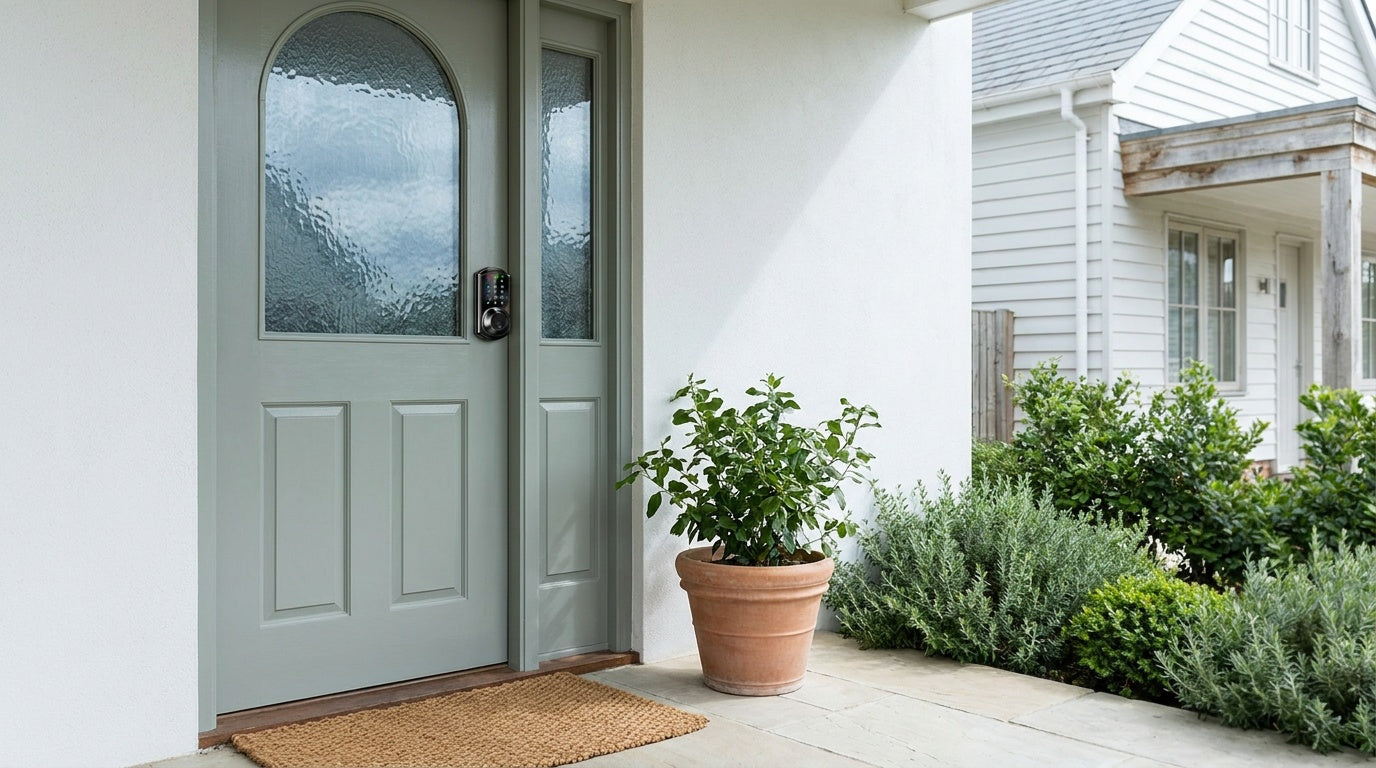
There's a particular kind of frustration that comes from a smart lock that simply gives up when the weather turns. Rain seeps into the keypad, cold stiffens the bolt, and what was supposed to be a convenience becomes a liability. If you're shopping for an outdoor smart lock — whether it's for a front door that takes full sun, a side entry exposed to rain, or a wood-framed gate on a backyard fence — weatherproofing isn't a bonus feature. It's the baseline.
The good news is that the right outdoor smart lock doesn't just survive the elements — it handles them without complaint while giving everyone in your household a simple, reliable way to get in and out. This guide walks through what "weatherproof" actually means in the context of smart locks, how to match a lock type to your specific entry point, and which Veise options hold up best in real outdoor conditions. Whether you're a homeowner replacing an old deadbolt on a wood exterior door or managing access for a short-term rental, you'll find a practical recommendation here.
What Makes a Smart Lock Truly Weatherproof?
Not every lock described as "weather-resistant" is built the same way, and the difference matters enormously once a lock is installed on an exterior door. The most reliable indicator of outdoor performance is an IP (Ingress Protection) rating — a two-digit number that tells you how well a device is sealed against solid particles (first digit) and water (second digit). For an outdoor smart lock exposed to regular rain, you want at least an IP54 rating, which provides solid resistance against dust and splashing water from any direction. An IP55 rating raises that to protection against low-pressure water jets, while IP65 adds full dust-tight sealing.
Beyond the IP rating, the materials matter just as much as the seal. Zinc alloy and stainless steel hold up far better than plastic housings under UV exposure, temperature swings, and humidity. A lock's keypad should have a coated or sealed membrane that prevents water from creeping behind the buttons — one of the most common failure points in cheaper outdoor models. Internal battery contacts should also be isolated from moisture, because corrosion on those contacts is often what ends a lock's usable life long before the mechanism wears out.
Temperature range is the other spec worth checking. A quality outdoor smart lock should operate reliably well below freezing and well into summer heat. Veise locks, for instance, are rated to perform between -35°F and 160°F — a range that covers the vast majority of North American climates from Minnesota winters to Arizona summers. That wide operating range isn't just marketing language; it reflects the quality of the battery chemistry, the seals, and the electronic components inside.
Outdoor vs. Indoor Smart Locks: Key Differences
A smart lock designed for an interior bedroom door has very different engineering priorities than one meant for a front door or a gate. Indoor locks focus on convenience and access control — they rarely need to contend with standing water, freeze-thaw cycles, or direct sun. Outdoor locks, on the other hand, have to manage all of that while still delivering fast, reliable unlocking every single time.
One important distinction that often gets overlooked: most standard smart locks are designed so that the interior half of the assembly (which contains the battery compartment and much of the electronics) stays inside the home, sheltered from the elements. When a lock goes on a gate or a freestanding exterior door, both sides of the lock face outdoor conditions. That's why purpose-built outdoor-rated models matter — their electronics are sealed on both sides, not just the exterior face. For homeowners installing on a standard wood exterior door where the interior remains climate-controlled, an IP54 or IP55 rating is typically sufficient. For a fully exposed gate with no interior shelter, you'll want to look for the highest IP rating available and prioritize locks specifically designed for that use case.
It's also worth noting that Veise smart locks are designed for wood doors and are compatible with standard US door thicknesses of 1-3/8" to 2". They are not compatible with fiberglass, metal, storm, or sliding doors. If your gate or exterior entry is a wood-framed door, Veise is a strong fit. If it's a metal gate frame or fiberglass panel, you'll need a lock specifically engineered for that material.
Choosing the Right Lock by Door and Entry Type
The first question to answer before picking a lock isn't "which features do I want?" — it's "what door am I putting this on?" Different entry points have different security needs, different use patterns, and different installation considerations. Here's how to think through the most common outdoor scenarios:
- Front Door (primary entry): This is where most families want their most capable lock. It sees the most daily use, is most visible to guests and service providers, and is typically the entry you most want to monitor remotely. A keypad deadbolt or a connected smart lock (gateway-paired or Wi-Fi) is typically the right fit here.
- Side Door or Back Door: Often used by family members throughout the day — kids coming home from school, a spouse arriving from the garage. A keypad deadbolt gives simple, code-based access without needing a key. If parents want to monitor when kids arrive home, a Wi-Fi smart lock or a gateway-paired smart lock enables remote entry history review.
- Wood-Framed Gate (backyard, garden, pool area): Gates introduce a unique challenge because both sides of the lock are exposed to weather. Look for the highest available IP rating and a lock designed to handle full outdoor exposure. Check that the gate door is wood-framed and within the compatible thickness range before purchasing any lock.
- Short-Term Rental or Vacation Property: Property managers and Airbnb hosts need the ability to create and revoke access codes remotely, without being on-site. This is a job for a connected smart lock — either a Wi-Fi model or a gateway-paired lock. Keypad-only locks cannot be connected to a gateway and do not support remote access.
Understanding your entry point upfront saves a lot of frustration. A keypad deadbolt is a reliable, affordable solution for many exterior doors — but if you need remote app monitoring, that requires a smart lock (gateway-paired or Wi-Fi), not just any keypad lock paired with additional hardware.
Veise Outdoor Smart Lock Picks by Use Case
Veise designs, engineers, and manufactures its own locks — not reselling third-party hardware under a different label. That vertical integration matters for outdoor performance because the weatherproofing, the electronics, and the mechanical bolt are all engineered together as a system. Every lock in the Veise lineup is ANSI/BHMA Grade 3 certified, which is the standard for residential door hardware in the US. (Grades 1 and 2 target high-traffic commercial environments — Grade 3 is the right fit for home use.) Priced between $30 and $180, there's a Veise option for nearly every outdoor entry scenario.
Best for Front Doors: Keypad Deadbolt
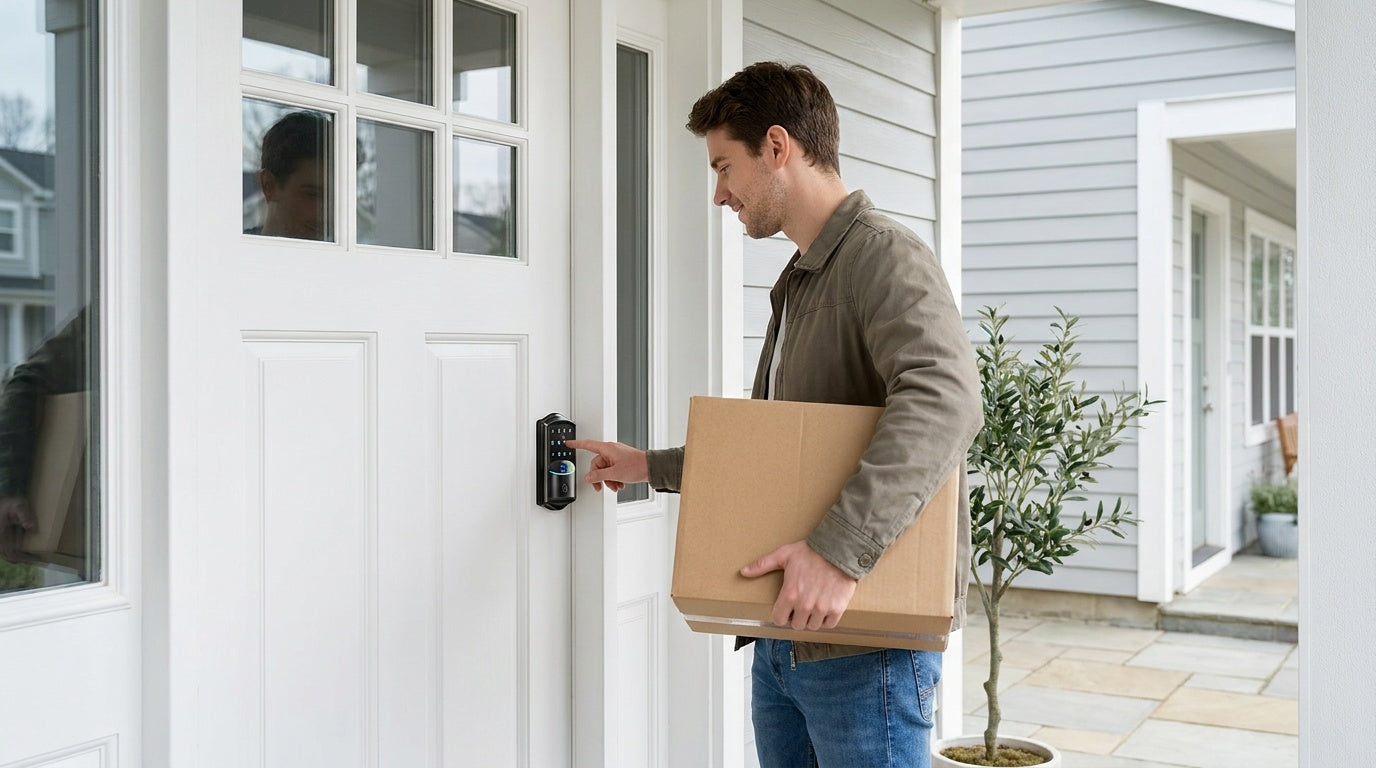
For homeowners who want reliable keyless entry on a wood exterior door without app connectivity, the Veise Keypad Deadbolt is the practical starting point. All models in this category support keypad code entry and include a physical key backup — so you're never locked out. Select Veise models add fingerprint recognition, scanning in under 0.3 seconds with an AI chip that processes and stores fingerprint data locally on the device (no cloud account, no Internet dependency). The fingerprint data never leaves the lock.
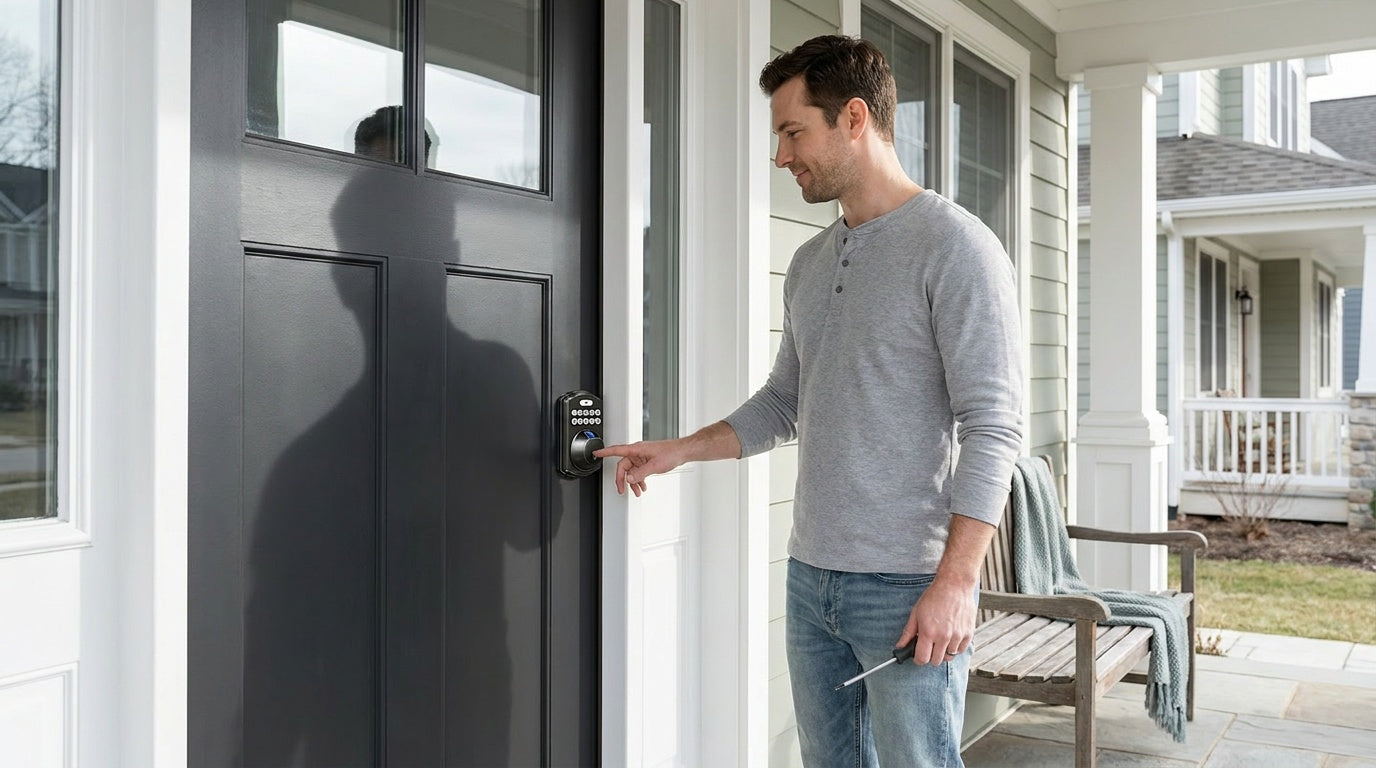
Veise keypad deadbolts carry an IP54 weatherproof rating — well-suited to a covered or semi-covered front door entry, where an overhang shelters the lock from direct, sustained weather. Auto lock is configurable between 10 and 99 seconds, so the door locks itself after you leave without any manual step. Installation takes about 15 minutes with a screwdriver and requires no wiring or professional help, making this the easiest entry point into keyless home security. The non-fingerprint line (RZ and KS01 series) is available as a standalone deadbolt or as a handle-set bundle with lever or knob; the fingerprint line (KS02 series) adds biometric access in similar configurations.
Best for Remote Monitoring: Wi-Fi Smart Lock
When parents want to know the moment their child arrives home, or when a property manager needs to grant a cleaner access from across town, a Veise Wi-Fi Smart Lock delivers that capability without a separate gateway device. Built-in 2.4GHz Wi-Fi connects directly to your home network, and the app gives you remote lock/unlock, access log review, and code management from anywhere with an active Internet connection.
Veise offers two Wi-Fi Smart Lock series. The Touchscreen Wi-Fi Smart Lock (VE027 Series) features a touchscreen interface and adds key fob support, three-language on-device voice prompts (English, Spanish, and French), and a Type-C emergency power port — useful in situations where batteries run low and you need to power the lock temporarily from a USB-C power bank to gain entry. The Push-Button Wi-Fi Smart Lock (VE012W Series) uses a traditional press-button keypad and does not include those extras. Both series share the same core feature set: fingerprint recognition (under 0.3 seconds), keypad code, app control, Alexa and Google Assistant voice control via built-in Wi-Fi, and an 8 AA battery design that delivers stronger signal stability and a longer power reserve than the standard 4 AA setup found in most competitors. Physical key backup is included on all models. Both series carry an IP65 weatherproof rating — the highest in the Veise lineup, which makes them the strongest fit for open, fully exposed exterior doors on wood frames.
Voice control works directly via the lock's built-in Wi-Fi — no gateway required. And even when Wi-Fi is down, app control continues to work locally as long as you're within short-range wireless distance of the lock. Long-distance remote features like off-site alerts and remote locking do require an active Internet connection.
Best All-in-One Connected Lock: Smart Lock w/ G1
The Smart Lock w/ G1 is built on a single product series — the VE017 — and every model in that line ships with the same feature set: fingerprint recognition, multilingual voice prompts (English, Spanish, and French), a USB-C emergency power port, and remote app control through the Veise-developed app when paired with the included G1 gateway. For multilingual households or families where not everyone reads English fluently, the three-language support is a concrete, practical advantage over alternatives that offer English only.
Unlock methods across the Smart Lock w/ G1 include keypad code, key fob, physical key, fingerprint, and remote app control via the paired gateway. Voice control via Alexa or Google Assistant is also supported — with the gateway in place bridging the lock to the voice assistant. All fingerprint data is stored on the lock itself using an AI chip, with no cloud dependency. The IP55 weatherproof rating handles rain, dust, and temperature extremes down to -35°F. If battery runs out entirely, the USB-C emergency power port (available on all VE017 models) lets you power the lock temporarily from a standard USB-C charger or power bank to regain access — a meaningful safety net for exterior doors where being locked out in bad weather is a real concern.
Because this line uses a first-party Veise-developed app, the connectivity experience is tightly controlled and consistent. If you want the most reliable all-in-one connected lock from Veise — with fingerprint, multilingual prompts, USB-C backup, and app integration all standard — the Smart Lock w/ G1 is the recommendation to start with.
Best for Apple Watch Users: Smart Lock w/ G2
The Smart Lock w/ G2 line covers more SKU variety than G1 — both fingerprint and non-fingerprint options, available as standalone deadbolts or handle-set bundles with lever, vertical handle, or knob configurations. All G2 models share the core connected unlock methods: keypad code, key fob, physical key, and remote app control via the paired G2 gateway. Where G2 stands apart is in two unique features not available on any other Veise line: Apple Watch unlock and web portal control directly from a browser. For households where someone wears an Apple Watch and wants to unlock the door with a tap on their wrist, G2 is the only option in the Veise lineup that supports it.
G2 voice prompts are available in English only (vs. English, Spanish, and French on G1), and G2 does not include the USB-C emergency power port as a standard feature. G2 is also a good fit when the buyer wants a non-fingerprint connected lock at a more accessible price point — the non-fingerprint SKUs within G2 offer solid remote app access without the biometric hardware cost. For buyers comfortable with those trade-offs, G2 delivers a well-featured connected lock experience with that standout Apple Watch convenience.
Key Features to Look for in an Outdoor Smart Lock
Shopping for an outdoor smart lock involves balancing several priorities that don't always come up in generic smart lock guides. Here's what to prioritize specifically for outdoor and exterior door installations:
- IP Rating: For a covered or semi-covered exterior door on a wood frame, IP54 is functional and IP55 provides a meaningful step up. Higher ratings (IP65+) matter most for fully exposed installations with no roof or overhang. Don't accept vague "weather-resistant" marketing language — ask for the actual IP number.
- Operating Temperature Range: Make sure the lock is rated for your local climate. Wide-range ratings (-35°F to 160°F) cover virtually all US residential environments without issue.
- Multiple Unlock Methods: Outdoor doors often have varied users — family members, service providers, guests. A lock that supports keypad code, fingerprint, physical key backup, and (optionally) remote app or voice control gives everyone a reliable way in regardless of what they have in hand.
- Auto Lock: A configurable auto lock interval (10 to 99 seconds on keypad locks; 10 to 180 seconds on connected models) is especially valuable on exterior doors where someone might forget to re-lock after stepping out briefly.
- Remote Access (for connected locks): If you want to grant or revoke access without being on-site, you need a smart lock — gateway-paired or Wi-Fi. A keypad-only lock cannot be connected to a gateway after the fact.
- Emergency Power Backup: On select Veise models (VE017 and VE027 series), a Type-C emergency power port allows you to power the lock from a USB-C charger if batteries run completely flat — so a dead battery on an exterior door doesn't mean a lockout.
- No Subscription Fees: Veise locks charge no monthly cloud fees for the keypad, fingerprint, or app features, and fingerprint data is stored locally on the device. This is especially relevant for long-term outdoor installations where ongoing costs add up.
- Easy DIY Installation: All Veise locks install in about 15 minutes with a screwdriver — no drilling, no wiring, and no need to hire a locksmith. Note that installation requires replacing the existing lock hardware entirely, so the buyer should be the property owner or have authority to modify the door.
Outdoor Installation Tips
Even a well-rated outdoor smart lock benefits from thoughtful installation. A few practical steps make a real difference in long-term performance. First, confirm your door material and thickness before purchasing — Veise locks are compatible with wood doors between 1-3/8" and 2" thick. Measure your door before ordering, especially on older homes where non-standard thicknesses are more common.
If possible, choose an entry point with some degree of overhead coverage — even a shallow overhang or porch roof dramatically reduces the direct weather exposure the lock faces day to day. For fully exposed doors with no coverage, prioritize the highest IP rating available and consider adding an aftermarket weatherproof cover as an extra layer of protection for the keypad. Use fresh, name-brand AA/LR6 alkaline batteries — Veise locks are spec'd for alkaline cells, so don't substitute lithium or rechargeable chemistries. In very cold climates, plan to swap in fresh alkaline cells more often through the coldest months, and never mix old and new batteries or batteries from different brands. Veise's 8 AA battery design (on Wi-Fi smart locks) provides a stronger reserve, but battery quality still matters.
After installation, test the auto lock timing and all unlock methods before relying on them as your primary entry. For connected locks, confirm gateway placement — the gateway should be close enough to the lock for a stable connection. With the Smart Lock w/ G1, the gateway pairs to your home's 2.4GHz Wi-Fi and bridges that connection to the lock; placement near the entry point and near your router signal improves reliability. Finally, keep the physical key backup in a safe, accessible location — not hidden under the doormat, but somewhere you can reach it if a battery change is needed unexpectedly.
The Bottom Line
The best outdoor smart lock is the one that handles your climate, fits your wood door, supports everyone in your household, and doesn't require a tech degree to manage. Weatherproofing is table stakes — but beyond that, matching the lock type to your actual use case is what makes the difference between a lock you trust and one that creates more friction than it solves. For simple exterior code access, a Keypad Deadbolt does the job reliably and affordably. For remote monitoring and connected features, the Wi-Fi Smart Lock or Smart Lock w/ G1 brings the full picture — entry history, remote access, voice control, and fingerprint recognition — all from a brand that designs and builds its own hardware. Easy from Day One.
Frequently Asked Questions
- What IP rating should an outdoor smart lock have?
-
For exterior doors with some overhead coverage (a porch or overhang), IP54 provides solid rain and dust resistance for everyday outdoor conditions. IP55 adds protection against low-pressure water jets and is a better choice for more exposed entries. For fully exposed gates or doors with no overhead shelter, look for IP65 or higher, which provides dust-tight sealing plus resistance to sustained water jets. Always look for an actual IP number rather than vague "weather-resistant" claims.
- Can I install a Veise smart lock on an outdoor gate?
-
Veise smart locks are compatible with wood doors between 1-3/8" and 2" thick. If your gate is a wood-framed door within that thickness range, a Veise lock can work well. Veise locks are not compatible with metal, fiberglass, storm, or sliding doors. For metal gate frames or non-wood materials, you'll need a lock specifically designed for that door type.
- Do I need a gateway for remote access, or does a keypad lock support it?
-
Remote access requires a smart lock — either a gateway-paired model or a Wi-Fi model. A keypad-only lock (like a Keypad Deadbolt or Keypad Latch Lock) cannot be connected to a gateway after purchase and does not support remote app control. If remote monitoring, off-site code management, or entry history review matter to you, choose a Wi-Fi Smart Lock or a Smart Lock w/ Gateway (G1 or G2) from the start.
- What happens if the battery dies on an outdoor smart lock?
-
All Veise smart locks include a physical key backup so you can always get in with a key if batteries run flat. On select Veise models — specifically the VE017 series (Smart Lock w/ G1) and VE027 series (Touchscreen Wi-Fi Smart Lock) — a Type-C emergency power port allows you to temporarily power the lock from a USB-C charger or power bank, which lets you enter your code or use the app without replacing batteries first.
- Can a Wi-Fi smart lock still be used if the Internet goes down?
-
Yes. Keypad code, fingerprint, physical key, and key fob (on supported models) all work locally without any Internet connection. Even when Wi-Fi is down, app control continues to work locally as long as you're within short-range wireless distance of the lock. Only long-distance remote features — like unlocking from across town or receiving off-site alerts — require an active Internet connection.
- Is ANSI/BHMA Grade 3 strong enough for an exterior door?
-
Yes. ANSI/BHMA Grade 3 is the standard certification for residential door hardware in the United States. All Veise smart locks meet Grade 3. Grades 1 and 2 are designed for high-traffic commercial environments — not a higher quality tier for home use, just a different durability spec for different usage volumes. For a residential exterior door, Grade 3 is the appropriate and expected standard.
- What's the difference between the Smart Lock w/ G1 and Smart Lock w/ G2?
-
Both lines offer keypad code, key fob, physical key, fingerprint (on most models), and remote app control via their respective paired gateways. The main differences: G1 (VE017 series) includes multilingual voice prompts (English, Spanish, and French), a USB-C emergency power port, and fingerprint as standard on every model, and uses a Veise-developed app. G2 offers Apple Watch unlock and web portal control — features unique to that line — but voice prompts are English only and USB-C emergency power is not standard. G2 also has more SKU variety, including non-fingerprint options.
Not Sure Which Lock Is Right for Your Door?
Our US-based support team is available by phone and email to help you find the right fit — whether it's a covered front door, a wood-framed back entry, or a short-term rental you manage remotely. We're here to make sure you get the right lock the first time.

Leave a comment
This site is protected by hCaptcha and the hCaptcha Privacy Policy and Terms of Service apply.