
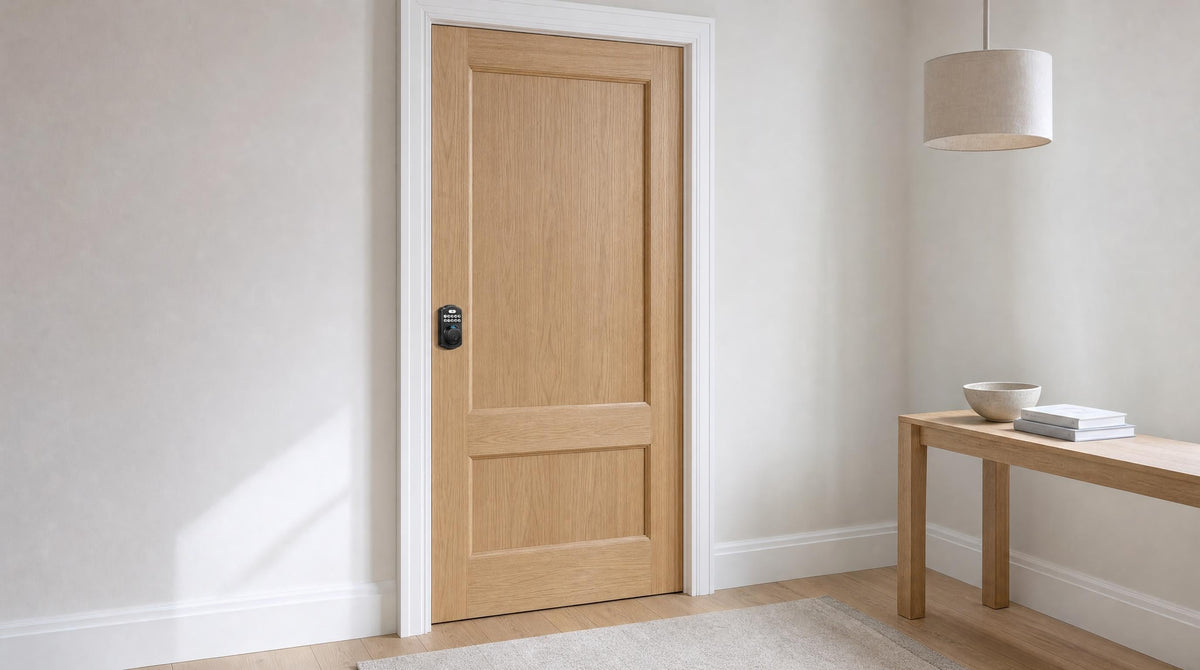
You don't need to live in a high-security building to want a lock on your bedroom door that actually works for your household. Maybe you work from home and need uninterrupted focus during calls. Maybe your teenager wants real privacy, not just a privacy knob whose emergency release is there so nobody gets shut in. Maybe you manage a rental room and need to change access without rekeying every time a guest leaves. In all of these situations, a keypad lock for a bedroom door solves the problem quietly and practically — no key needed for daily entry, no locksmith calls, no fumbling in the dark.
This guide walks through exactly how bedroom keypad locks work, how to pick the right lock type for an interior door, and which Veise options fit which household situation. Whether you need something simple and affordable or a connected lock that lets you monitor who enters from your phone, there's a straightforward path to the right answer.
Why Bedroom Door Privacy Matters More Than You Think
Most people think of door locks as a front-door concern, but privacy inside the home is just as real a need. A bedroom is where people sleep, keep their most personal belongings, change clothes, and — increasingly — work. The standard privacy knob that comes with most interior doors locks from the inside with a turn knob and carries an emergency release on the outside — a deliberate child-safety feature, but one that means the knob is not built to control access from the hallway. It signals "please knock" rather than "this space is genuinely controlled."
The shift toward keypad locks for bedroom doors reflects a broader change in how families think about personal space at home. Adults who work from home need to secure a room during video calls and keep sensitive documents away from curious visitors. Teenagers in shared households want boundaries that are actually respected. Property owners managing a rental room need a way to grant and revoke access without touching a physical key. In each case, a keypad lock delivers what a standard privacy knob never could: a real, code-based barrier with no key needed for daily entry and no access granted accidentally.
The good news is that bedroom door keypad locks have come down significantly in price and complexity over the last few years. A reliable, well-built option from a brand with real manufacturing depth — not a generic OEM resell — sits inside Veise's $30–$180 lineup, installs with a screwdriver in about 15 minutes, and requires no wiring or subscription. Easy from Day One.
How a Keypad Lock Works on a Bedroom Door
A keypad lock adds an electronic keypad alongside the mechanical key cylinder. You enter a PIN code — four to ten digits on Veise locks — and the lock's electronics verify the input on the device. Depending on the lock type, the mechanism then releases the deadbolt or allows the latch to be operated so the door can open. Every Veise keypad lock also includes a physical key backup, so you're never permanently locked out if a battery runs low unexpectedly.
On Veise fingerprint keypad locks, the keypad is paired with a fingerprint reader that scans and authenticates in under 0.3 seconds — faster than turning a key. Fingerprint data is processed and stored entirely on the lock itself, with no cloud account required and no biometric data leaving the device. That's a meaningful privacy benefit for a bedroom specifically, where the whole point is keeping things personal.
Battery life is a common question. Keypad locks run on AA/LR6 alkaline batteries and warn you well before power runs out with a voice or beep prompt at the lock plus an indicator light. There's no wiring involved and no dependence on your home's electrical system, which means the lock works even during a power outage. Every model in the VE017 and VE027 series adds a USB-C emergency power port as an extra safety net if batteries are ever completely depleted.
Auto lock is a feature worth calling out for bedroom use specifically. Once enabled, the lock re-engages automatically when the countdown elapses — configurable between 10 and 99 seconds on Keypad Deadbolt and Keypad Latch locks, and between 10 and 180 seconds on connected smart locks. It fires on the timer regardless of door position, so make sure the door is closed before the interval expires. For parents who want a bedroom to re-lock after a child leaves, or for anyone who regularly forgets to lock up behind them, auto lock handles it without any manual step.
Keypad Deadbolt or Keypad Latch Lock: Which One Belongs on a Bedroom Door?
This is the most important practical question for a bedroom installation, and it's one that most buying guides gloss over entirely. The short answer: a keypad latch lock is typically the right fit for a standard bedroom door, while a keypad deadbolt makes sense when the bedroom stores genuinely high-value items or when you want that extra layer of bolt-based security.
Keypad Latch Lock: The Natural Bedroom Fit
A keypad latch lock uses a spring-loaded latch mechanism rather than a solid bolt. The latch retracts automatically when the door closes, meaning the door stays shut without any manual action. You enter your code to open it, and it re-latches the moment it swings shut. This is the same convenience logic behind the privacy knobs already on most bedroom doors — except the access is now code-controlled instead of open to anyone who turns the handle. Veise currently offers two keypad latch models: the KS03 (integrated knob top) and the KS04 (integrated lever top), both supporting keypad code and physical key backup. Both are intentionally simple — no app, no fingerprint, no key fob — which keeps the price accessible and the setup quick.
The integrated design of a keypad latch lock is also practical for a bedroom: the handle and the lock body are one unit, so replacing the existing doorknob or lever is a clean, single-piece swap. You're not drilling extra holes or installing separate hardware above and below the handle.
Keypad Deadbolt: When You Need Maximum Security
A keypad deadbolt extends a solid steel bolt into the door frame, offering stronger forced-entry resistance than a spring latch. It's the go-to choice for exterior entry doors and, inside the home, for rooms where valuables, sensitive documents, or medication need to be genuinely secured. If your bedroom doubles as a home office where you store client files, or if it holds a firearm safe and you want belt-and-suspenders protection, a keypad deadbolt adds a meaningful security layer. Veise's keypad deadbolt lineup includes models with and without fingerprint recognition, with handleset bundles available in knob, lever, and vertical handle configurations. Every model in the KS02 series includes fingerprint scanning, storing biometric data on-device with no cloud dependency. All models include a physical key backup.
One practical note: a keypad deadbolt on a bedroom door is typically paired with a separate handle for the latch function. Many bedrooms don't already have a deadbolt-sized bore hole in the door, so check your door prep before ordering. For most standard bedroom doors, a keypad latch lock is the simpler path to a clean, finished installation.
Who Actually Needs a Keypad Lock on a Bedroom Door?
The honest answer is: more households than you'd expect. Below are the situations where a keypad bedroom lock moves from "nice to have" to genuinely useful.
Work-From-Home Professionals
A home office in the bedroom — or a bedroom used as a dedicated workspace — benefits enormously from a code-controlled door. During client calls, focus sessions, or when sensitive materials are on screen or on the desk, a keypad lock keeps interruptions from happening and ensures the room is secured when you step out. There's no need to carry a key around the house; your code is always with you.
Families with Teenagers
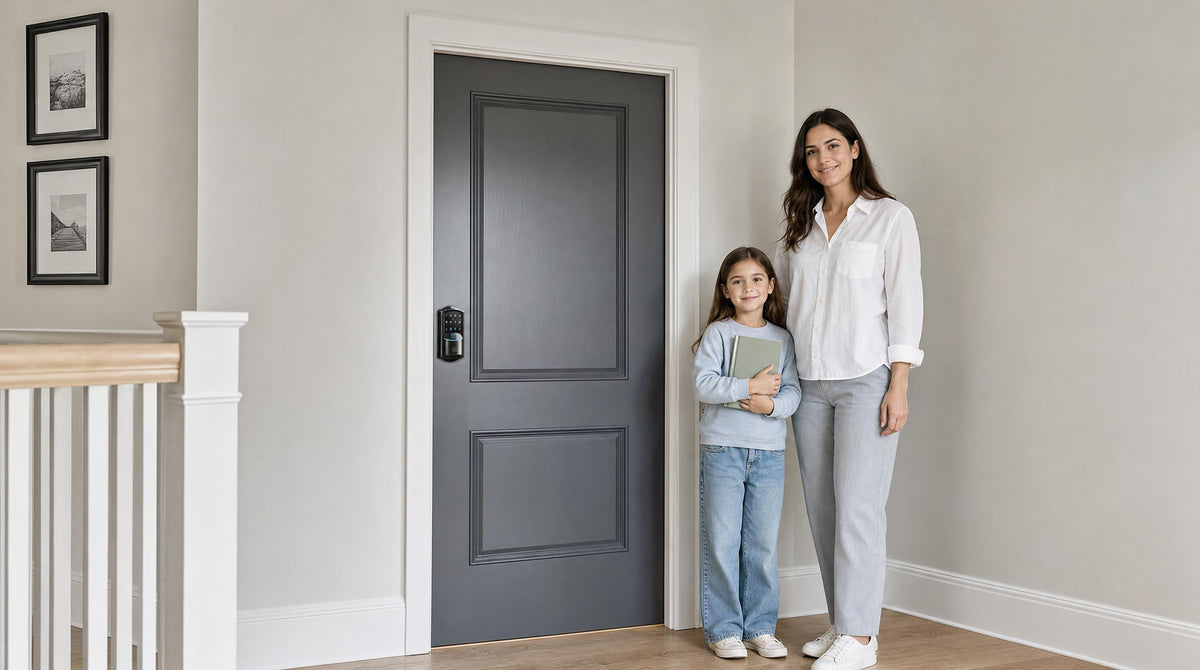
A teenager's request for a bedroom lock is a normal part of growing up, and a keypad lock is a practical, parent-approved solution. Unlike a keyed lock (where a lost key becomes a household event), a keypad lets you set a code, update it when needed, and keep a physical key backup in a known location for emergencies. Parents retain a master code option, so access in a genuine emergency is never blocked. For families who also want to know when a teenager arrives home after school, a Wi-Fi smart lock or a Smart Lock w/ G1 on a different door of the home provides app-based entry history — something an electronic keypad lock cannot offer on its own.
Shared Living Arrangements
When multiple unrelated adults share a home, clear personal boundaries matter. A keypad lock on a bedroom door gives each resident genuine control over their own space without involving a landlord for every key change. Access codes can be updated instantly — no rekeying, no waiting, no cost. If a living situation changes and someone moves out, the code changes in under a minute, and access is cleanly revoked.
Property Owners Managing Rental Rooms
For a property owner renting out one or more bedrooms — whether as a long-term arrangement or a short-term rental — keypad locks make access management genuinely simple. Each guest or tenant gets their own code for the duration of their stay. When they leave, that code is deleted and a new one is created for the next arrival. No key handoff, no locksmith, and far fewer keys in circulation. This is one of the most common real-world reasons homeowners upgrade a bedroom door to a keypad lock.
Storing Valuables or Medications
A bedroom that doubles as a secure storage location — for jewelry, cash, prescription medication, or important documents — benefits from a code-controlled door that limits access to authorized household members only. This is one scenario where stepping up from a keypad latch to a keypad deadbolt is worth considering, since the deadbolt's solid bolt mechanism offers stronger resistance than a spring latch.
How to Choose the Right Keypad Lock for Your Bedroom
Before you browse, a few quick checks will save you from ordering the wrong product.
- Door material and thickness: Veise keypad locks are compatible with wood doors between 1-3/8" and 2" thick. They are not compatible with fiberglass, metal, storm, or sliding doors. Check your door before ordering.
- Existing door prep: A keypad latch lock fits the standard bore hole used by existing knobs and levers — a direct swap into the existing bore in most cases. A keypad deadbolt fits the standard deadbolt bore hole. If your bedroom door doesn't already have a deadbolt hole, factor in that extra step.
- Privacy only vs. real security: For most bedrooms, a keypad latch lock delivers all the privacy you need at a lower price point. A keypad deadbolt makes sense for rooms storing high-value items.
- Do you need remote access or activity logs? An electronic keypad lock does not connect to your phone. If you want to remotely check whether the door is locked, review entry history, or receive alerts, you need a smart lock — either a Smart Lock w/ G1 or Smart Lock w/ G2, or a Wi-Fi Smart Lock. Remote access requires a smart lock (gateway-paired or Wi-Fi) — electronic keypad locks cannot be paired with a gateway after the fact.
- Fingerprint preference: If you want touch-based entry without typing a code every time, look for models in the KS02 series (keypad deadbolt with fingerprint) or the VE017 series (Smart Lock w/ G1, which includes fingerprint on every SKU).
- Budget: The Veise lineup runs from approximately $30 to $180 depending on the category and features, with no subscription fees. All features work out of the box, and fingerprint data is processed and stored on the lock itself.
Veise Keypad Lock Picks for Bedroom Doors
Veise is built on 38 years of lock industry expertise through Kaadas Group, backed by 711 patents — the world's largest smart lock patent portfolio — and has sold 10M+ smart locks across 41+ countries. Every Veise lock is designed and built in-house, not sourced from an OEM reseller, which means consistent engineering and direct product support. Here's how the lineup maps to bedroom use cases.
Best for Standard Bedroom Privacy: Keypad Latch Lock
For most bedroom doors in a family home, a Veise Keypad Latch Lock is the cleanest solution. The KS03 (knob-top) and KS04 (lever-top) are integrated units where the handle and lock are one piece — you swap out your existing knob or lever and you're done. Entry is by keypad code, with a physical key backup. No app, no fingerprint, no extras — just reliable, code-based privacy that installs in about 15 minutes with a screwdriver. Priced at the lower end of the Veise range, these are the affordable everyday choice for bedroom privacy.
Best for Rooms Storing Valuables: Keypad Deadbolt
When a bedroom needs more than privacy — when it genuinely secures valuables or sensitive documents — a Veise Keypad Deadbolt raises the bar. The KS02 series adds fingerprint recognition to the keypad code and physical key backup, scanning in under 0.3 seconds with biometric data stored entirely on the lock. The RZ and KS01 series offer code-plus-key models in standalone or handleset configurations for households that prefer pure keypad entry. All are ANSI/BHMA Grade 3 certified — the standard for residential door security.
Best for Parents Who Want Visibility: Wi-Fi Smart Lock or Smart Lock w/ G1
If the bedroom door in question is one a parent wants to monitor remotely — knowing when a teenager gets home, checking whether the door was left unlocked, or receiving alerts about unusual activity — a smart lock is the right tool. The Veise Wi-Fi Smart Lock connects directly to your home's Wi-Fi (no separate gateway required), supports Alexa and Google Assistant, and gives remote app control and entry history through the app. It's available in the Touchscreen Wi-Fi Smart Lock (VE027 Series) and the Push-Button Wi-Fi Smart Lock (VE012W Series) — both include fingerprint, keypad code, and a physical key backup. The VE027 series adds a touchscreen interface, a USB-C emergency power port, key fob support, and on-device EN/ES/FR voice prompts; the VE012W series has none of those four. These locks use 8 AA batteries instead of the more common 4 AA setup, giving a stronger signal and a longer-lasting power reserve.
The Veise Smart Lock w/ G1 is a strong alternative in this category — the entire G1 line is one series (the VE017), and every SKU ships with fingerprint, multilingual voice prompts (English, Spanish, and French), a USB-C emergency power port, and remote app control via the paired gateway. The Veise-developed first-party app keeps the experience seamless. For multilingual households or homes where a Spanish- or French-speaking family member needs to use voice prompts, G1 line's language support is a concrete selection advantage over the G2 line (English only). Even when Wi-Fi is down, app control continues to work locally as long as you're within short-range wireless distance of the gateway — only long-distance remote features require an active Internet connection.
The Veise Smart Lock w/ G2 is worth considering when Apple Watch unlock or web portal control is a priority. G2 line also offers non-fingerprint and budget-friendly connected options for households that want smart access without the fingerprint hardware.
Best for Property Owners Managing Rental Rooms: Keypad Latch Lock or Keypad Deadbolt
For a property owner managing a rental bedroom, a keypad latch lock or keypad deadbolt is typically the right level of complexity. The ability to set unique codes for each guest and delete them at checkout handles the access management need cleanly. No app is required for this use case — the lock's onboard programming is enough. If monitoring check-in times or managing multiple rooms remotely matters, step up to a Wi-Fi smart lock or a gateway-paired smart lock for the added visibility.
Installing a Keypad Lock on a Bedroom Door: What to Expect
Installing a Veise keypad lock on a bedroom door is a straightforward DIY project for most homeowners. The process follows the same basic steps regardless of whether you're installing a latch lock or a deadbolt. Veise locks are designed as full replacements — you remove the existing hardware and swap in the new lock — which means the door prep is already done as long as you're replacing an existing knob, lever, or deadbolt in a standard bore hole.
Here's the general process:
- Remove the existing hardware — Unscrew and pull out the current knob, lever, or deadbolt from both sides of the door. Set the old hardware aside — the new lock ships with its own latch and strike plate.
- Insert the new latch — Slide the included latch mechanism into the edge bore. For an angled latch, face the angled edge toward the direction the door closes. For a deadbolt, make sure it is fully retracted during installation. Then secure it with the provided screws.
- Mount the exterior keypad — Place the keypad component on the outside of the door, feeding the connector cable through the bore hole to the interior side.
- Connect and secure the interior assembly — Connect the cable to the interior unit, align it with the mounting holes, and fasten with the provided screws.
- Insert batteries — Slide the interior battery cover off and fit fresh AA/LR6 alkaline cells — Veise locks don't ship with batteries, and you shouldn't mix old with new or brands with each other. The lock powers on ready to test.
- Program your code — Follow the instructions to set your master code and any additional user codes. Test the code before closing everything up.
- Test and adjust — Close the door and confirm the latch or bolt engages the strike plate cleanly. Test the physical key backup as well.
The whole process typically takes about 15 minutes with a screwdriver. No wiring, no locksmith, no special tools. Every Veise lock ships with a step-by-step user manual and an installation video — follow those for the exact sequence on your model. Veise locks fit wood doors between 1-3/8" and 2" thick — always verify your door's material and thickness before ordering, as these locks are not compatible with fiberglass, metal, storm, or sliding doors. Because Veise locks are full hardware replacements, installation does require the authority to modify door hardware, so this is a project for the property owner or someone with permission to make changes to the door.
The Effortless Home Improvement™ Experience is the philosophy behind every Veise product: intuitive installation that doesn't require special skills, specialized tools, or a return trip to a hardware store. The goal is that your new lock works exactly as expected the first time, without surprises.
The Right Bedroom Lock Is Simpler Than You Think
A keypad lock for a bedroom door doesn't need to be complicated. For most households, a Veise Keypad Latch Lock delivers exactly what's needed — code-based privacy, a physical key backup, and a clean installation that takes about 15 minutes. When the room stores valuables or genuine security matters, a Keypad Deadbolt adds the bolt-based protection that a latch alone can't match. And when remote monitoring, entry alerts, or app-based visibility are part of the picture, Veise's Wi-Fi Smart Locks and Smart Locks w/ G1 connect the bedroom to your phone without a subscription fee or a complicated setup.
Every Veise lock is designed and manufactured in-house — not sourced from a generic supplier — backed by 38 years of lock industry expertise, 711 patents, and recognition by Frost & Sullivan as the global No.1 high-end smart lock brand by sales. The result is hardware that a family can rely on, at a price that doesn't require a second thought. Easy from Day One.
Frequently Asked Questions
Can I put a keypad lock on a bedroom door?
Yes. Keypad locks work well on bedroom doors, and it's one of the most common interior-door upgrades homeowners make. A keypad latch lock is typically the best fit for a standard bedroom door — it replaces the existing knob or lever as a single integrated unit, uses a code for access, and re-latches automatically when the door closes. If you need stronger security (for a room storing valuables, for example), a keypad deadbolt is also an option. Both are available in Veise's $30–$180 lineup.
What's the difference between a keypad latch lock and a keypad deadbolt for a bedroom?
A keypad latch lock uses a spring-loaded latch that engages automatically when the door closes — it's the same mechanism as a standard knob or lever, but with code-controlled access instead of a freely-turning handle. A keypad deadbolt uses a solid bolt that extends into the door frame and must be actively locked and unlocked, offering stronger forced-entry resistance. For most bedroom privacy needs, a latch lock is sufficient and simpler to install. A deadbolt makes sense when the room needs a higher level of physical security.
Do I need a smart lock for a bedroom, or is a regular keypad lock enough?
It depends on what you need the lock to do. An electronic keypad lock handles code-based access reliably without any app or Internet connection. If you only need privacy — keeping the door locked to household members who don't have the code — a regular keypad is entirely sufficient. If you want remote access, entry history, alerts, or the ability to lock and unlock from your phone, you need a smart lock (Wi-Fi or gateway-paired). Remote access is not available on electronic keypad locks, regardless of whether a gateway is added later.
How many codes can a Veise keypad lock store?
The number of stored codes varies by model. Most Veise keypad locks support multiple user codes, which is enough for a household to give each family member or authorized person their own unique code. For specific capacity figures, refer to the individual product page for the model you're considering.
Will a keypad lock work if the batteries die?
Every Veise keypad lock includes a physical key backup, so you can always enter with the key even if the battery is completely depleted. The lock also warns you before power runs out entirely, with a voice or beep prompt at the lock plus an indicator light. Every model in the VE017 and VE027 series has a USB-C emergency power port, so you can connect external power to enter a code if the batteries drain before you replace them.
Are Veise keypad locks compatible with any bedroom door?
Veise keypad locks are designed for wood doors between 1-3/8" and 2" thick. They are not compatible with fiberglass, metal, storm, or sliding doors. Always check your door material and thickness before purchasing. Most standard interior residential bedroom doors in the U.S. are wood and fall within the compatible thickness range.
Can I install a Veise bedroom lock myself?
Yes. Veise locks are designed for DIY installation and fit the standard bore holes used by existing knobs, levers, and deadbolts in most cases. Installation takes about 15 minutes with a screwdriver — no wiring, no locksmith, no special tools. Because Veise locks are full hardware replacements (not overlays), you do need to be the property owner or have authority to modify the door hardware.
Does a bedroom keypad lock lock automatically?
Yes, when the auto lock feature is enabled. Veise Keypad Deadbolt and Keypad Latch locks support configurable auto lock between 10 and 99 seconds (connected smart locks go up to 180 seconds). The lock re-engages once that countdown elapses — it runs on the timer rather than a door sensor, so close the door before the interval expires.
Find the Right Lock for Your Bedroom Door
Not sure which Veise lock fits your door and situation? Browse the full lineup or reach out — the Veise team is happy to help you find the right match.

Leave a comment
This site is protected by hCaptcha and the hCaptcha Privacy Policy and Terms of Service apply.