

You lock your front door every night without thinking twice. But how much thought have you given to the lock on your bedroom door? Whether you live in a busy family home, manage a short-term rental, or simply want a moment of guaranteed privacy, the right bedroom door lock does more than keep a door shut — it gives you real peace of mind.
The good news is that finding the best lock for your bedroom door doesn't require an engineering degree or a contractor. Today's options range from simple, affordable privacy knobs to intelligent keypad and smart locks that log entry history and auto lock behind you. This guide walks through every major lock type, matches each one to the right room and household, and helps you make a confident decision — whether you're after basic privacy or a fully connected setup.
Why Bedroom Locks Matter More Than You Think
Most people install a lock on the front door and call it a day. Interior doors — including bedroom doors — often get whatever hardware came with the house, even if it's worn, mismatched, or barely functional. Yet the bedroom is the room where you're most vulnerable, most private, and most likely to need a reliable barrier between yourself and the rest of the home.
In a family household, a functional bedroom lock prevents the kind of unannounced entry that disrupts sleep, work-from-home focus, or simply a quiet moment alone. For homeowners who manage short-term rentals, a quality lock on each bedroom adds a layer of accountability and security that guests expect. And for anyone storing valuables, important documents, or medications in a bedroom, a good lock is a practical safeguard — not an overreaction. The right lock is a small investment with an outsized impact on how a home actually feels to live in.
Privacy vs. Security: Understanding What Your Bedroom Actually Needs
These two words — privacy and security — get used interchangeably in lock marketing, but they describe meaningfully different things. A privacy lock is designed to keep a door closed against accidental or unannounced entry. It signals "occupied" and gives the person inside control over their space. It is not designed to resist forced entry, and it carries an emergency release on the outside that opens with a coin or screwdriver, so a household member can open the door if someone is locked in — a deliberate child-safety feature. This is exactly the right level of protection for most interior bedroom doors.
A security lock — which includes keyed entry locks, keypad deadbolts, and smart locks — provides controlled access and meaningful resistance to unauthorized entry. This is the better fit when a bedroom stores valuables, when access needs to be tracked or shared selectively, or when the door separates a private living area in a shared or multi-unit property. Understanding which category your situation falls into is the single most useful thing you can do before shopping for a lock.
The Main Types of Bedroom Door Locks
Privacy Door Knobs and Levers
Privacy door knobs and levers are the standard choice for interior bedrooms in most homes, and for good reason. They're affordable, widely available, easy to install, and do exactly what an interior bedroom lock needs to do. The inside has a turn knob to lock — no key involved; the outside has an emergency release that opens with a coin or screwdriver, which prevents accidental lock-ins. No keys to lose, no codes to remember. Privacy door knobs work well in children's rooms, guest rooms, and any bedroom where simple privacy — not high security — is the goal. Privacy door levers offer the same function with an ergonomic lever handle that's easier to operate, particularly for older family members or anyone with limited hand strength.
The practical difference between a knob and a lever often comes down to your household and your door's existing hardware. Levers have a cleaner, more contemporary look that suits modern interiors. They also require less grip force to operate, which makes them a genuinely better choice in households with young children, elderly occupants, or anyone with arthritis. Both are available in a range of finishes — satin nickel, matte black, brushed brass — so matching your existing hardware is straightforward.
Keyed Entry Door Knobs and Levers
When a bedroom needs actual controlled access — not just a privacy latch — a keyed entry door knob or keyed entry door lever steps up the protection significantly. These use a physical key to lock and unlock from the outside, giving the homeowner or property manager a meaningful level of control. They're a common choice for master bedrooms in shared households, rooms that store valuables, or any space where a privacy lock simply isn't enough. A keyed entry handleset — deadbolt + keyed lever or deadbolt + keyed knob — takes this a step further by pairing the handle with a deadbolt, creating a two-layer defense that's standard in higher-security residential settings.
The trade-off with keyed entry is key management. Physical keys can be lost, copied, or left behind — which is why many homeowners today prefer to step up to a keypad or smart lock rather than add another key to their ring. That said, for the right household and use case, a well-made keyed entry lever in a durable finish remains one of the most reliable bedroom lock options available.
Keypad Deadbolt and Latch Locks
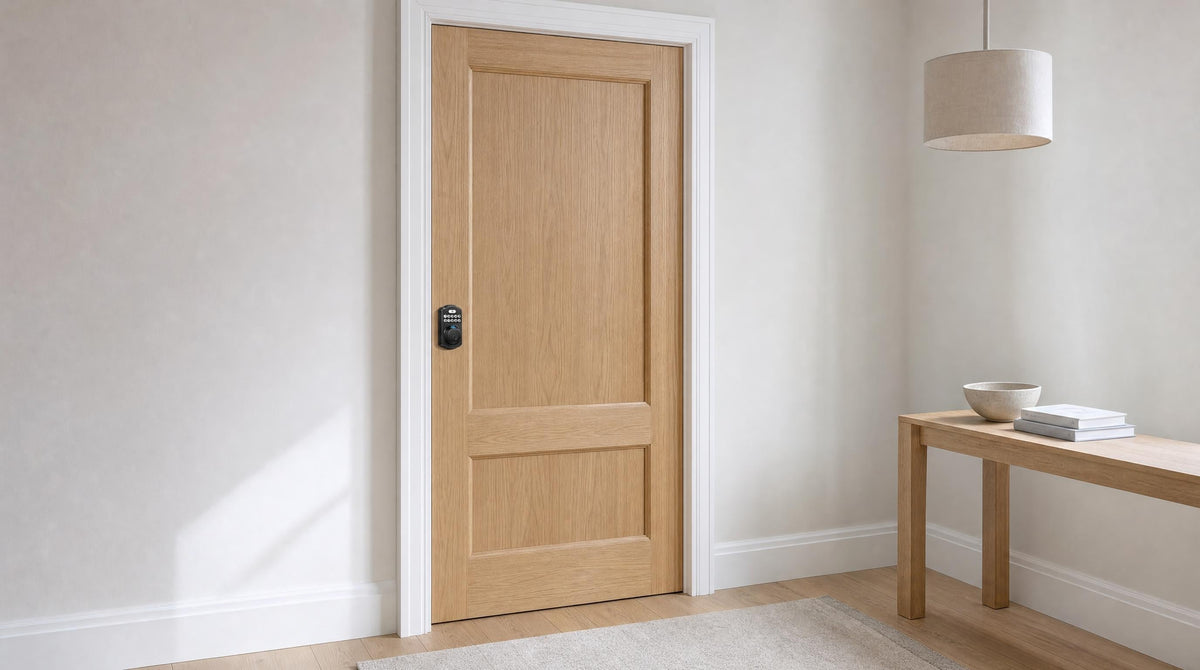
Keypad locks add a code alongside the key cylinder, so daily entry no longer runs on a key. This is a genuinely useful upgrade for most households — no lockouts, far fewer keys in circulation, no need to cut copies for every family member. Keypad deadbolt locks pair the security of a solid deadbolt bolt with the convenience of a digital code entry, making them well-suited to master bedrooms and any interior door where you want real resistance to unauthorized entry alongside everyday ease. The KS02 series includes fingerprint recognition on every model, unlocking in under 0.3 seconds — faster than pulling a key from your pocket. All Veise keypad deadbolts include a physical key backup on every model, so you're never without a way in.
Keypad latch locks offer a simpler, more affordable keypad option built around an integrated handle and latch mechanism. The current lineup uses a keypad code and physical key backup only — no app, no fingerprint, no remote access. This makes them a practical fit for interior doors like a home office, a teen's bedroom, or a storage room where code-based access is the goal without the complexity of a fully connected system. Veise's two keypad latch SKUs differ by handle type: the KS03 uses an integrated top knob, the KS04 uses an integrated top lever — so handle preference is the main factor in choosing between them.
One important note: Veise locks — including all keypad models — are designed for standard wood doors with thickness between 1-3/8" and 2". They are not compatible with fiberglass, metal, storm, or sliding doors. Always verify compatibility before purchasing.
Smart Locks (Gateway-Paired and Wi-Fi)
Smart locks represent the top tier of bedroom door security and convenience. Unlike keypad-only locks, smart locks connect to your home network and allow remote management — checking lock status, viewing entry history, and locking or unlocking from anywhere with an Internet connection. This is a meaningful feature for parents who want to know when a child got home, or for homeowners managing a short-term rental who need to grant access without being physically present. Remote access requires a smart lock — gateway-paired or Wi-Fi — not just any keypad lock connected to a gateway.
Veise offers two smart lock categories for the bedroom. Smart Locks w/ Gateway 1/2 pair the lock with a separate gateway device (sold separately) that bridges the lock to your home network and voice assistants. The Smart Lock w/ G1 is built on a single product series — the VE017 — and the entire line ships standard with multilingual voice prompts (English, Spanish, and French), a USB-C emergency power port, and fingerprint recognition. It pairs with a Veise-developed first-party app, making it the most reliable all-in-one gateway option. The Smart Lock w/ G2 expands the feature set with Apple Watch unlock and web portal control, and offers both fingerprint and non-fingerprint SKUs in standalone or handle-set configurations — a good fit when those specific capabilities matter or when a non-fingerprint connected lock is preferred.
The Wi-Fi Smart Lock takes a different approach: instead of relying on a paired gateway, the lock connects directly to your Wi-Fi network, eliminating the gateway as a dependency. Veise offers two Wi-Fi series: the Touchscreen Wi-Fi Smart Lock (VE027 Series), which features a touchscreen interface, a USB-C emergency power port on every model, key fob support, and on-device voice prompts in English, Spanish, and French; and the Push-Button Wi-Fi Smart Lock (VE012W Series), which uses a traditional press-button keypad and has none of those four extras. Both series support fingerprint recognition, keypad code, app control, and Alexa and Google Assistant voice commands via built-in Wi-Fi, and both use an 8 AA/LR6 alkaline battery design instead of the more common 4 AA setup, delivering a stronger signal and more stable connection. Even when Wi-Fi is down, app control continues to work locally as long as you're within short-range wireless distance of the lock.
All Veise smart locks are ANSI/BHMA Grade 3 certified — the recognized residential standard for interior and residential door locks. Grades 1 and 2 are engineered for high-traffic commercial environments and aren't a relevant benchmark for bedroom doors in a home.
Choosing the Right Lock by Room and Household
The best bedroom door lock isn't universal — it depends on who lives behind the door and what the room actually needs. Here's how to match lock type to real-life situations.
Children's Bedrooms
Young children benefit most from a simple privacy lever or privacy knob with an emergency exterior release. The priority here is preventing accidental self-lockouts while still giving the child a sense of personal space. Levers are generally easier for small hands to operate. Avoid keyed locks in young children's rooms — a child who can't be reached from the outside is a safety concern, not a security upgrade. For parents who want the added ability to check entry history or remotely monitor access, a Wi-Fi smart lock or gateway-paired smart lock lets you see exactly when the door was opened or closed from the app.
Master Bedrooms
The master bedroom is where most homeowners want the best combination of security, privacy, and convenience. A keypad deadbolt — particularly one with fingerprint recognition — delivers all three: no keys to manage, fast entry, and a solid bolt that provides real resistance. For homeowners who want remote access and activity monitoring, a Smart Lock w/ Gateway 1/2 or a Wi-Fi smart lock takes the master bedroom to a fully integrated level. Think of it as the same peace of mind you already have with your front door, applied to the room where you sleep.
Elderly Family Members
Ease of operation is the primary consideration for older users. Privacy levers are the most accessible mechanical option — a smooth downward handle press beats gripping and twisting a knob every time. If technology is comfortable for the occupant, a keypad removes the fine motor coordination that turning a key demands. For elderly users who may worry about battery failure or lockouts, every model in the VE017 and VE027 series includes a USB-C emergency power port that supplies external power to unlock the door if the batteries are low.
Short-Term Rentals and Managed Properties
Property owners managing rentals want two things: easy access for guests and tight control for themselves. A keypad lock on each bedroom removes the key-handoff problem entirely — a new code for each guest stay, no locksmith required if a code needs to be changed. For higher-end short-term rentals, a smart lock with Wi-Fi connectivity provides remote locking, activity logs, and the ability to grant time-limited access without being on-site. The Smart Lock w/ G2's web portal control is particularly useful for property managers who prefer a browser-based interface over a mobile app.
When a Smart Lock Makes Sense for the Bedroom
There's a reasonable question worth asking: is a smart lock overkill for a bedroom door? For many households, a quality privacy lever is all you need. But there are specific scenarios where a smart lock earns its place on an interior door. If you have teenagers who come and go at hours you want to track, a smart lock with app notifications gives you a factual record rather than a guessing game. If you manage a short-term rental and want to audit which rooms were accessed and when, a connected lock is the only practical option at scale. If an elderly family member lives with you and you want peace of mind about their routine from the other side of the house, remote monitoring through the app provides exactly that.
Veise's smart lock lineup is designed to fit into this kind of family-oriented use case without demanding technical expertise. Setup takes about 15 minutes with a screwdriver — no wiring, no locksmith, no special tools. There's no subscription required, and the lock works with multiple unlock methods so every household member can choose what's easiest for them. Fingerprints are processed and stored locally on the lock itself — no cloud account, no data leaving the device — which is a meaningful privacy benefit that many homeowners don't realize to ask about. That engineering philosophy is what Veise's Effortless Home Improvement™ Experience is built around: technology that simplifies daily life rather than adding another thing to manage.
Bedroom Door Lock Buying Checklist
Before adding anything to your cart, run through this quick checklist. It takes five minutes and saves the frustration of a return.
- Door material: Veise locks are compatible with wood doors only (thickness 1-3/8" to 2"). Not suitable for fiberglass, metal, storm, or sliding doors.
- Existing bore holes: Standard US doors have a 2-1/8" bore hole. Confirm before purchasing to avoid extra drilling.
- Backset measurement: Most interior doors use a 2-3/8" or 2-3/4" backset. Measure the distance from the door edge to the center of the bore hole.
- Who will use it: Children and elderly users benefit from levers; tech-comfortable users will appreciate keypad and fingerprint options.
- Privacy or security: Basic bedroom privacy calls for a privacy knob or lever. Access control, activity logging, or remote management calls for a keypad or smart lock.
- Connectivity needs: If you want remote access and monitoring, you need a smart lock (gateway-paired or Wi-Fi). A keypad-only lock cannot be paired with a gateway for remote control.
- Finish: Match to existing hardware — satin nickel, matte black, brushed brass, and oil-rubbed bronze are common options across the Veise lineup.
- Budget: Veise locks range from $30 to $180, covering everything from basic mechanical locks to fully connected Wi-Fi smart locks.
Installation: What to Expect
One of the most common reasons homeowners delay upgrading their locks is the assumption that installation is complicated. For the vast majority of bedroom lock types — including most keypad and smart locks — it isn't. A standard lock swap on an existing pre-bored wood door takes about 15 minutes with a screwdriver. No wiring, no locksmith, and no special tools. Every Veise lock ships with a step-by-step user manual and an installation video — follow those for the exact sequence on your model, and note that Veise locks don't ship with batteries, so pick up fresh AA/LR6 alkaline cells before you start. Veise locks are designed as full lock replacements, which means the entire lock assembly swaps out cleanly without leaving behind partial hardware. Because this is a full replacement rather than an overlay, the door hardware is always the property owner's decision to make.
The most important pre-installation step is measuring your door. Interior doors in the US are typically 1-3/8" thick, though some newer construction uses 1-3/4" doors. The backset — the distance from the door's edge to the center of the bore hole — is most commonly 2-3/8" or 2-3/4". Both measurements take under two minutes to confirm with a tape measure and will determine whether a lock fits your door without modification. When in doubt, check the product specifications before purchasing rather than after — it's the single most reliable way to avoid a return.
For smart locks with gateway functionality, there's one additional setup step: pairing the lock to the gateway device and connecting it to your home network. This typically takes another 10 to 15 minutes and is guided by the app. Wi-Fi smart locks skip the gateway step entirely and connect directly to your home network during setup. Either way, the full process — hardware installation plus digital setup — is realistically a 30-minute project for most homeowners.
The right bedroom door lock isn't about buying the most expensive option on the market — it's about matching the lock to the real needs of the room and the people who use it. A well-chosen privacy lever handles most interior bedrooms flawlessly. A keypad deadbolt with fingerprint recognition transforms a master bedroom into a genuinely secure space with zero key management. And a connected smart lock brings the kind of visibility and control that makes a busy family home significantly easier to manage.
Veise builds every lock in its lineup with one goal in mind: to make home security feel effortless rather than burdensome. Built on Kaadas Group's 38 years of lock industry expertise and 711 patents — the world's largest smart lock patent portfolio — and trusted across 41+ countries, Veise delivers engineering-grade reliability at an accessible price point of $30 to $180. From a basic privacy lever to a fully connected Wi-Fi smart lock, every product in the range is designed to install in about 15 minutes with a screwdriver, with no wiring and no subscription required. Easy from Day One.
Browse the full Veise lock lineup at iveise.com and find the right lock for every door in your home.
Frequently Asked Questions
What is the best type of lock for a bedroom door?
For most bedrooms, a privacy lever or privacy knob is the right answer — it keeps the door secure against unintended entry while allowing emergency access from the outside. For master bedrooms or rooms that store valuables, a keypad deadbolt or smart lock provides stronger access control without the hassle of physical keys. The best type depends on who uses the room and what level of control you need.
Can I put a deadbolt on a bedroom door?
Technically yes, but it's rarely the right choice for most interior bedrooms. A deadbolt on a bedroom door can create safety problems in an emergency — particularly in a child's room — and the added security is typically more than an interior door needs. A keypad deadbolt, which uses a code rather than a mechanical key, is a more practical upgrade for bedrooms that require stronger-than-average protection.
Do smart locks work on bedroom doors?
Yes. Smart locks are available in both deadbolt and latch-style configurations that fit standard interior wood doors. For bedroom use, the biggest advantages are keyless entry, auto lock, access history logging, and remote monitoring via app. Veise's smart lock lineup — including gateway-paired models and Wi-Fi smart locks — is designed to install on standard wood doors with no wiring required.
What happens to a smart lock when Wi-Fi goes down?
Keypad entry, physical key, fingerprint (every Smart Lock w/ G1 and Wi-Fi model; many Smart Lock w/ G2), and key fob (every gateway-paired model and the VE027 series; not on VE012W) all work regardless of Internet connectivity — none of those unlock methods require an active network. For app control specifically: even when Wi-Fi is down, app control continues to work locally as long as you're within short-range wireless distance of the lock. Only long-distance remote features — like locking the door from work or checking status from across town — require an active Internet connection.
How do I choose between a knob and a lever for a bedroom?
For most households, levers are the more practical choice. They require less grip strength, are easier for children and elderly users to operate, and suit contemporary interior design trends. Privacy knobs remain a solid option for rooms where the existing door already has a knob-sized bore hole and the current hardware is being replaced like-for-like. Both are available in matching finishes to coordinate with other door hardware throughout the home.
Are Veise smart locks compatible with Alexa and Google Assistant?
Wi-Fi smart locks (VE027 and VE012W series) support Alexa and Google Assistant voice commands directly via the lock's built-in Wi-Fi. Smart Locks w/ Gateway 1/2 also support voice assistant integration, but require the paired gateway to be in place to bridge the connection. Voice assistant compatibility is not universal across all Veise lock categories — keypad-only locks do not support voice control.
What is the auto lock feature and how does it work?
Auto lock is available on every Veise keypad and smart lock, and re-engages the lock once a set countdown elapses. The interval is configurable between 10 and 99 seconds on Keypad Deadbolt and Keypad Latch locks, and between 10 and 180 seconds on connected smart locks, so you can set it to match your household's pace. It runs on the timer regardless of door position, so make sure the door is closed before the interval expires. It's particularly useful for busy family homes, short-term rentals, and any situation where you want to be confident the door is always locked without checking manually.
Ready to Upgrade Your Bedroom Door Lock?
Whether you need a simple privacy lever or a fully connected smart lock, the Veise team is here to help you find the right fit for your home and your family.
Contact Us

Leave a comment
This site is protected by hCaptcha and the hCaptcha Privacy Policy and Terms of Service apply.