
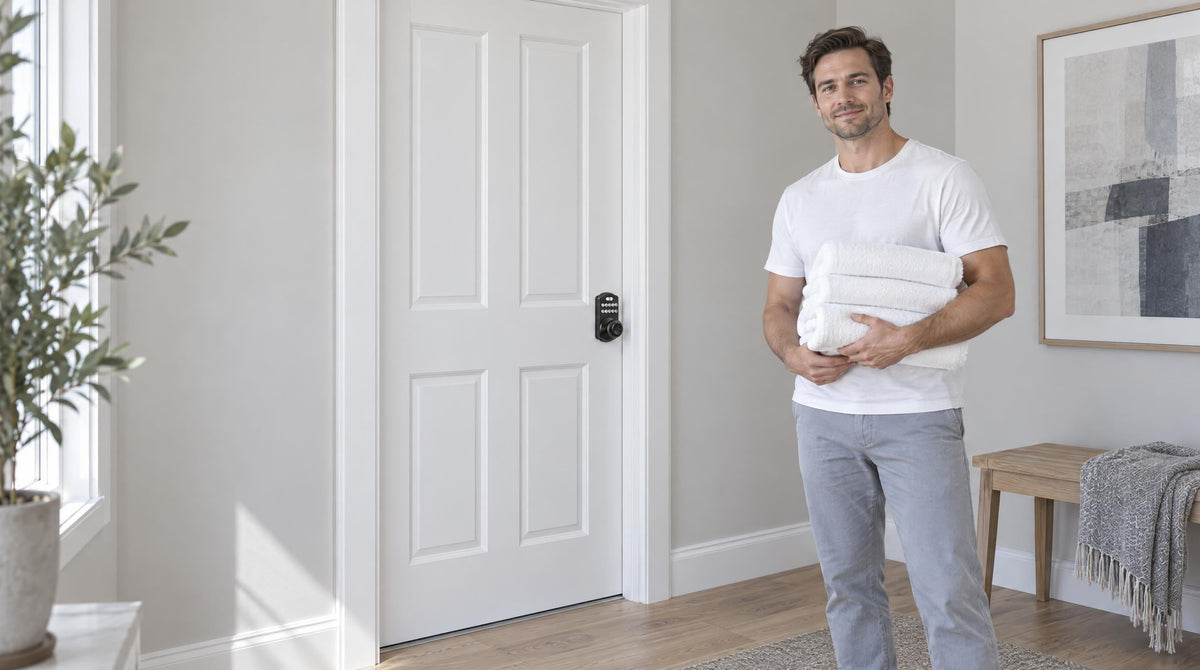
Walk through any home and you'll find a dozen interior doors — bedrooms, bathrooms, a home office, maybe a laundry room or a side door to the garage. Each one has its own job, and the lock on it should match that job exactly. A bathroom door needs privacy but not a deadbolt. A home office shared with kids might genuinely benefit from a keypad. Getting this right isn't complicated, but it does require knowing what the options actually are.
This guide breaks down every common type of interior door lock, explains where each one belongs, and gives you a clear framework for choosing. Whether you're doing a full hardware refresh or just replacing one squeaky knob, you'll find exactly what you need here.
What Is an Interior Door Lock — and How Is It Different from an Exterior Lock?
Interior door locks and exterior door locks serve fundamentally different purposes, and confusing the two leads to both over-spending and under-protecting. Exterior locks — the ones on your front door, back door, or garage entry — are designed to resist forced entry, withstand weather, and keep unauthorized people out. They're built to a higher security standard and typically pair a keyed entry knob or lever with a separate deadbolt.
Interior doors, by contrast, are almost never about keeping intruders out. They're about privacy within the home — the ability for a family member to close the bathroom door and know no one will walk in, or to lock a home office during a call. Because the stakes are different, the hardware is different too: lighter, more affordable, and focused on convenience and privacy rather than brute-force resistance. Understanding that distinction is the first step to buying the right lock.
Types of Interior Door Locks
Interior locks fall into a handful of functional categories. The category tells you what the lock does — whether it latches, locks, requires a key, or can be controlled digitally. From there, you choose the form factor (knob or lever) and the finish. Here's how each category works.
1. Privacy Locks
Privacy locks are the most common type of interior door lock in residential homes, and for good reason. They lock from the inside using a push button or thumb turn, so whoever is in the room can secure the door without a key. On the outside, there's no keyhole — just a small emergency release hole, so a parent can open the door from the hallway with a coin or the included tool if a child gets stuck inside.
This design is intentional. Privacy locks aren't meant to stop forced entry; they're meant to signal that a room is occupied and provide a moment's peace. A bathroom door, a primary bedroom, or a powder room are classic homes for privacy locks. They come in both knob and lever form factors, and Veise offers solid options in both — browse the Privacy Door Knobs and Privacy Door Levers collections to see available styles and finishes.
Best for: Bathrooms, primary bedrooms, powder rooms, dressing rooms.
2. Keyed Entry Locks
Keyed entry locks use a physical key cylinder on the outside and a turn button or thumb turn on the inside. While you'll most often see them on exterior doors — front entries, patio doors, side doors to the garage — they do have legitimate interior applications. A home office in a shared or rental property, a medication storage room, a workshop with valuable tools, or a basement door that connects to a shared space are all situations where a keyed entry lock adds a meaningful layer of control.
For interior use, a keyed entry knob or lever is typically paired with a door that you genuinely want to limit access to with a physical key — as opposed to just keeping closed for privacy. Veise carries both Keyed Entry Door Knobs and Keyed Entry Door Levers, as well as a Deadbolt Lock collection for doors where a bolt provides the primary security layer.
Best for: Home offices in shared spaces, medication or storage rooms, interior garage doors, any room requiring keyed access control.
3. Keypad Deadbolt Locks
A keypad deadbolt adds a numbered keypad alongside the key cylinder, letting you (and anyone you give a code to) unlock the door without needing a key for daily entry. All models include a physical key backup, so you're never truly locked out. On the KS02 series — every SKU in the line — a fingerprint reader is built directly into the lock body, enabling entry in under 0.3 seconds — fast enough that it feels nearly instant. Auto lock is available across the lineup, so the bolt re-engages once a configurable countdown elapses — 10 to 99 seconds on Keypad Deadbolt and Keypad Latch locks, and 10 to 180 seconds on connected smart locks. It runs on the timer rather than a door sensor, so close the door before the interval expires.
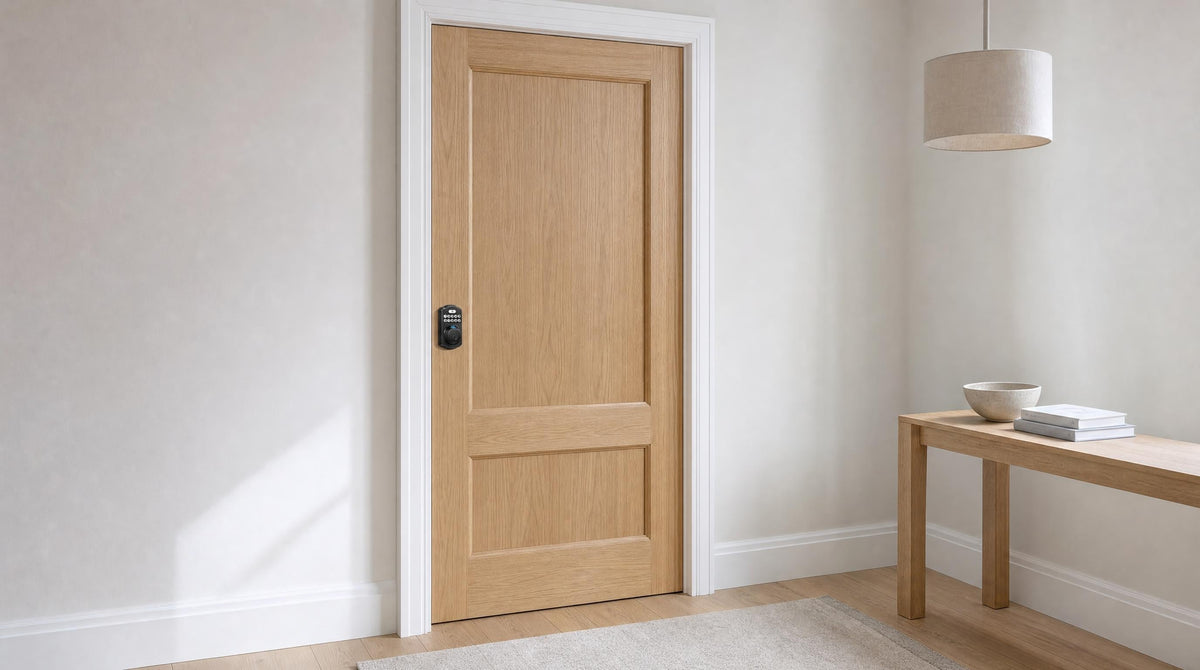
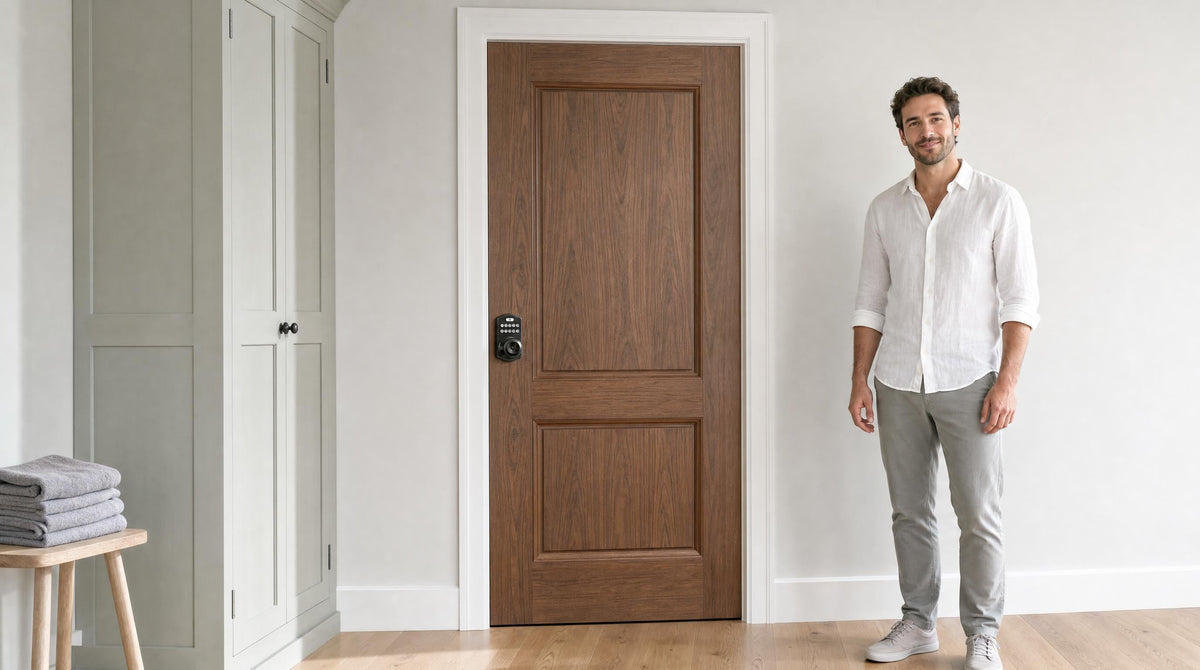
Keypad deadbolts are a genuinely practical upgrade for any interior door that currently uses a traditional keyed lock. They're especially useful on a side door to the garage, a basement entry, a workshop, or any door that sees regular traffic from family members — no more hunting for keys or making copies. The Veise Keypad Deadbolt Locks collection includes models both with and without fingerprint, as well as handle-set bundles that combine the deadbolt and lever in one installation.
Unlock methods: Keypad code on all models; physical key backup on all models; fingerprint on the KS02 series (every SKU).
Best for: Garage entry doors, basement doors, workshop doors, any interior door where keyless access is more convenient than a traditional keyed lock.
4. Keypad Latch Locks
Keypad latch locks combine a handle and a keypad locking mechanism into a single integrated unit. Unlike a keypad deadbolt (which uses a bolt), a keypad latch uses a spring latch — the same latching mechanism you'd find in a standard passage or privacy set. This makes them a natural fit for interior doors that see regular daily traffic, like a home office door, a side entrance, or a storeroom, where a full bolt would feel like overkill but a simple privacy lock isn't enough.
Veise currently offers two SKUs in this category — the KS03 (with an integrated top knob) and the KS04 (with an integrated top lever) — and both support keypad code entry plus a physical key backup. They're straightforward, no-app, no-subscription locks that do exactly what most people need from a code-access interior door. Explore the full lineup in the Keypad Latch Locks collection.
Unlock methods: Keypad code and physical key backup (both SKUs).
Best for: Home offices, side doors, storerooms, short-term rental properties, any interior door where code access is more practical than a key.
5. Smart Locks for Interior Doors
Smart locks bring app control, remote monitoring, and voice assistant integration to your door hardware. For interior applications, this matters most in specific situations: a property owner managing a short-term rental who needs to issue and expire guest codes remotely, a family with school-age kids where parents want to see who came home and when, or a home office setup where locking and unlocking without lifting a hand is a genuine quality-of-life win.
Veise offers two categories of connected smart lock. Smart Locks w/ Gateway 1/2 pair with a gateway device — sold separately — over a local wireless connection, plugged in within range of the lock and connected to your home network. Smart Lock w/ G1 is built on a single product series, the VE017, and is the all-in-one connected pick: every model includes fingerprint, multilingual voice prompts (English, Spanish, and French), and a USB-C emergency power port on the lock body itself — plus multiple entry methods including keypad code, key fob, and physical key backup. It pairs with a Veise-developed first-party app. Smart Lock w/ G2 supports Apple Watch unlock and web portal control, making it a strong pick for Apple-forward households; it also offers non-fingerprint SKUs for buyers who want a simpler connected lock. Both lines deliver remote app control through the paired gateway.
For households that want the simplest connected setup — no separate gateway device — the Wi-Fi Smart Lock connects directly over your home Wi-Fi. Veise offers two series: the Touchscreen Wi-Fi Smart Lock (VE027 Series), which includes a touchscreen interface, a USB-C emergency power port, key fob support, and on-device EN/ES/FR voice prompts; and the Push-Button Wi-Fi Smart Lock (VE012W Series), which uses a traditional press-button keypad and has none of those four extras. Both support fingerprint, keypad code, app control, and Alexa and Google Assistant voice commands, and both run on 8 AA/LR6 alkaline batteries (rather than the standard 4 AA in many competing models), which provides a stronger signal and more stable connection. Remote access — checking the lock status, locking or unlocking from across town — requires active Internet. Even when Wi-Fi is down, app control continues to work locally as long as you're within short-range wireless distance of the lock.
For families with kids, a Wi-Fi smart lock or a gateway-paired smart lock is the better pick over an electronic keypad model, because the app lets parents remotely review entry history and monitor who's coming and going. Explore connected options in the Smart Locks w/ G1, Smart Locks w/ G2, and Wi-Fi Smart Lock collections.
Best for: Short-term rental properties, family homes with kids, home offices, any door where remote access and entry history matter.
Knob vs. Lever: Which Handle Style Is Right for You?
Once you've chosen the lock function — privacy, keyed entry, or keypad — the next decision is handle style: knob or lever. Both work well on interior doors; the choice comes down to your household's needs, your home's design language, and how the door will be used day to day.
Knobs are the classic residential choice. They're compact, available in nearly every finish imaginable, and blend easily into both traditional and transitional interiors. The main consideration is ergonomics: a round knob requires a gripping-and-turning motion that can be difficult for young children, elderly family members, or anyone with arthritis or limited hand strength.
Levers operate with a simple downward push — a much easier motion for most people, regardless of age or hand strength. They're well-suited to high-traffic doors, accessible design requirements, and contemporary interiors where a sleek horizontal handle complements the aesthetic. Levers do have one practical note: in a busy household, they're more likely to catch on bags, clothing, or a child's arm, so placement and clearance matter a little more than with knobs.
Veise offers matching lever and knob options across privacy, and keyed entry functions, so you can keep a consistent finish and style throughout your home. Browse the full range of Privacy Door Knobs, Privacy Door Levers, Keyed Entry Door Knobs, and Keyed Entry Door Levers.
Room-by-Room Interior Lock Guide
Knowing the lock types is half the battle. The other half is knowing which door in your home calls for which type. Here's a practical room-by-room breakdown:
- Primary Bedroom: Privacy lock (knob or lever). Locks from the inside for personal privacy; emergency release keeps it accessible from the hallway.
-
Bathroom / Powder Room: Privacy lock. Standard choice for all bathrooms — lightweight, no key needed, and the exterior release handles any accidental lock-ins.
-
Kids' Bedrooms: A privacy lock is a practical choice for everyday personal space, especially for older children. A keyed entry lock offers more control over access and can be a better fit when parents want to manage who can enter the room.
-
Home Office: A keyed entry lock is a good fit for a private workspace where you want to control access with a physical key. For shared home offices or spaces that others may need to access occasionally, a keypad latch makes it easier to let people in with a code instead of handing out keys.
- Storage Room: A privacy lock works well for general storage when you simply want the room kept closed and private. Choose a keyed entry lock when you want more control over who can access stored items, especially if the room contains valuables or personal belongings.
- Garage Entry Door (Interior Side): Keyed entry lock, keypad deadbolt, or keypad latch lock. This door connects your living space to the garage — it commonly calls for more than a simple passage set, especially if the garage has an exterior entry.
- Basement Door: Keyed entry lock or keypad deadbolt, particularly if the basement has a walkout or is accessed by additional people such as tenants or contractors.
- Short-Term Rental Rooms: Smart lock (gateway-paired or Wi-Fi). Lets property owners issue unique codes per guest, expire codes after checkout, and monitor entry history without being on-site.
How to Choose the Right Interior Door Lock
With the types and room map in hand, a few final considerations help you narrow down the right pick.
1. Start with Function, Not Style
Decide what you need the lock to do — latch only, lock from the inside, lock with a key, or lock with a code — before you think about finish or form factor. Getting the function right is non-negotiable; the style is flexible.
2. Think About Who Uses the Door
Young children and elderly family members do better with lever handles than with round knobs. Households with multilingual members may appreciate smart locks with multilingual voice prompts — Veise's Smart Lock w/ G1 line, for example, supports English, Spanish, and French voice guidance, which is a concrete selection factor if you have family members more comfortable in Spanish or French. For families with kids, a connected smart lock (gateway-paired or Wi-Fi) also lets parents check entry history remotely via the app.
3. Consider the Door Material and Fit
Interior door locks — including all Veise products — are designed for standard wood doors with a thickness of 1-3/8" to 2". If you have non-standard door thickness, confirm compatibility before purchasing. Veise locks are not compatible with fiberglass, metal, storm, or sliding doors.
4. Match the Finish Across Your Home
Hardware finish has a noticeable visual impact, especially in open-concept homes where multiple doors are visible from the same sightline. Satin nickel, matte black, and oil rubbed bronze are the most popular interior finishes. Choosing one finish family across all interior doors — knobs, levers, hinges, and cabinet pulls — creates a cohesive look that makes a home feel intentionally designed.
5. Decide Whether You Need App Control or Remote Access
If you want to check the lock status from your phone, unlock remotely for a visitor, or receive entry notifications, you need a smart lock — gateway-paired or Wi-Fi. An electronic keypad lock cannot be paired with a gateway after the fact; app control requires a purpose-built smart lock. For most interior doors, a keypad or mechanical lock is perfectly sufficient. But if remote access matters for your use case, plan for it from the start rather than trying to add it later.
6. Budget Realistically
Interior lock hardware ranges widely in price. Within Veise's lineup, privacy and keyed sets sit at the accessible end, keypad deadbolts and latch locks land mid-range, and connected smart locks sit at the top of the range. Veise's full interior product lineup spans $30 to $180, with every price point backed by Kaadas Group's 38 years of lock industry expertise and a portfolio of 711 patents — the world's largest smart lock patent portfolio. You can explore the complete lineup at All Products.
Choosing the Right Lock Doesn't Have to Be Complicated
Interior door locks are one of those home hardware decisions that seems small until you get it wrong — and then you're dealing with a bathroom door that won't stay latched, a home office that anyone can walk into, or a garage entry that's more inconvenient than secure. The good news is that once you know the functional categories, the right choice for each door in your home becomes pretty clear.
Privacy lock for the bathroom. Keyed entry lock for the storage room. Keypad deadbolt or latch lock for the home office or garage entry. Smart lock for the doors that need remote access or entry history. And throughout all of it, a lever if accessibility matters, a knob if classic style is the priority.
Veise's interior lock lineup is built to cover every one of these scenarios — from simple door knobs and levers to fully connected smart locks — all designed for straightforward DIY installation in about 15 minutes with just a screwdriver. No wiring, no locksmith, no special tools. That's the Effortless Home Improvement™ Experience in practice. Easy from Day One.
Frequently Asked Questions About Interior Door Locks
What is the difference between a privacy lock and a keyed entry lock?
A privacy lock is designed for interior spaces where you want basic privacy. It typically locks from the inside using a push button or thumb turn and includes an emergency release on the outside. A keyed entry lock uses a key to lock and unlock from the outside, giving you more control over who can enter. Privacy locks are commonly used in bathrooms and bedrooms, while keyed entry locks are a better fit for home offices, storage rooms, and other spaces where you want controlled access.
Can you put a keypad lock on an interior door?
Yes. Keypad deadbolts and keypad latch locks are both well-suited to interior doors like home offices, garage entry doors, and storerooms. They let you create unique codes for family members, contractors, or guests without distributing physical keys — and all Veise keypad models include a physical key backup so you're never locked out.
What type of lock is best for a bathroom door?
A privacy lock — either a privacy knob or privacy lever — is the standard and most practical choice for a bathroom door. It locks from the inside for privacy and includes an emergency release on the outside so someone can open it from the hallway if needed, which is especially important in homes with children or elderly family members.
Is a lever or knob better for interior doors?
Both work well on interior doors. Levers are easier to operate — especially for children, elderly users, or anyone with limited hand strength — because they open with a downward push rather than a gripping-and-turning motion. Knobs are more compact and work naturally in traditional or transitional interiors. For households with accessibility needs, levers are generally the better choice.
Do interior door locks need to be the same brand as exterior locks?
No. Interior and exterior locks don't need to match brands, but they should match in finish and style for a cohesive look. Since interior and exterior hardware are typically different product categories with different security requirements, it's common to mix brands as long as the finishes coordinate.
What is an auto lock on a smart lock, and should I use it on interior doors?
Auto lock automatically re-engages the lock bolt or latch after a set period of time — configurable between 10 and 180 seconds on Veise smart locks — without requiring you to manually lock the door. On interior smart locks, auto lock is useful for home offices (to ensure the door locks after you leave), garage entry doors, or any door you want to ensure is always secured. For high-traffic family doors, you can simply set the timer to the longer end of the range or disable it when it's not needed.
What's the difference between a smart lock and an electronic keypad lock?
An electronic keypad lock uses a numbered keypad for entry and includes a physical key backup, but it has no app connectivity or remote access. A smart lock adds app control, remote locking and unlocking, and entry history — but it requires either a paired gateway device or built-in Wi-Fi. If remote access and entry monitoring matter for your use case, choose a smart lock (gateway-paired or Wi-Fi). If you just want keyless entry on a budget, an electronic keypad lock is a straightforward and reliable choice.
Ready to Upgrade Your Interior Door Hardware?
Browse Veise's full range of interior door locks — from privacy knobs and levers to electronic keypads and Wi-Fi smart locks — all backed by 38 years of lock industry expertise and 711 patents — the world's largest smart lock patent portfolio — and designed for easy DIY installation.
- Shop Privacy Door Knobs
- Shop Privacy Door Levers
- Shop Keypad Deadbolt Locks
- Shop Keypad Latch Locks
- Shop Wi-Fi Smart Locks
- Browse All Products
Not sure which lock is right for your door? Contact Us — our team is happy to help you find the right fit.

Leave a comment
This site is protected by hCaptcha and the hCaptcha Privacy Policy and Terms of Service apply.