
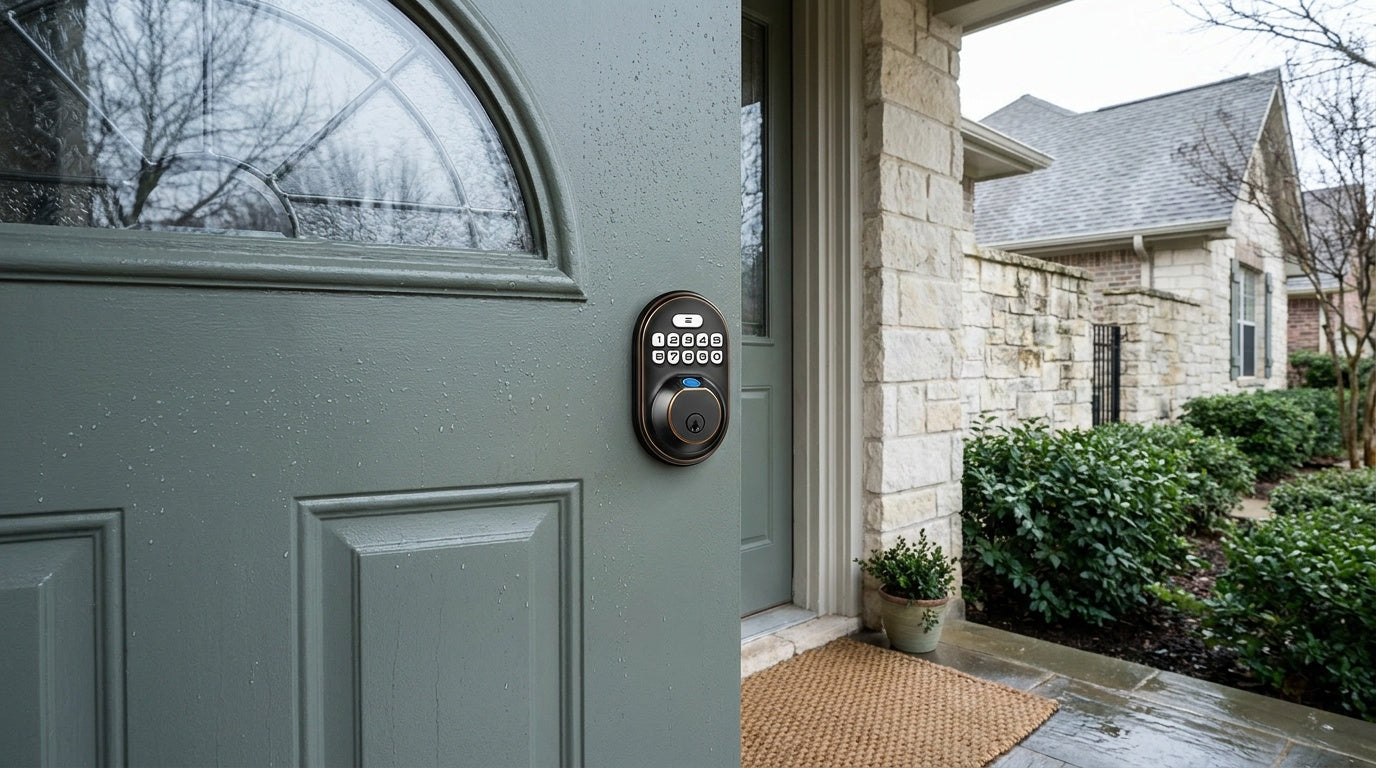
You're shopping for a new outdoor lock and you keep seeing "IP65" on the product page. The manufacturer calls it "waterproof." But what does that actually mean — will your lock survive a Minnesota winter? What about heavy summer thunderstorms or a garden hose that gets a little too close?
IP ratings are the international standard used to measure how well a device is sealed against dust and water, based on IEC 60529. They are not marketing terms — each code represents a defined level of protection.
For outdoor locks in particular, IP ratings help you understand suitability for different environments rather than ranking products from "bad to good." Common residential smart locks are typically rated IP54, IP55, or IP65 — each designed for different levels of exposure. A covered porch door may only need IP54, while a fully exposed front entry benefits from higher protection like IP65.
In this guide, we’ll use IP65 as a reference point to explain how the system works in practice, and then compare it with other common ratings so you can choose the right level of protection for your door.
What Is an IP Rating?
IP stands for Ingress Protection. It's a rating system defined by the International Electrotechnical Commission (IEC) under standard IEC 60529, and it's used to classify how well an enclosure — whether a lock, a camera, a phone, or any electronic device — resists the entry of solid particles and liquids. The standard exists precisely because terms like "waterproof" and "weatherproof" have no universally agreed meaning. An IP rating gives you something measurable instead.
Every IP rating follows the same structure: the letters "IP" followed by two digits. The first digit covers protection against solid particles like dust, dirt, and sand. The second digit covers protection against liquids, primarily water. Each digit sits on its own scale, and the higher the number, the more rigorous the protection. When you see an "X" in place of one digit — like IPX4 or IP6X — it simply means that the product was only tested and rated for one of the two categories, not that it failed the other test.
For outdoor locks, both digits matter. A lock mounted on an exterior door faces dust, pollen, and debris from the environment, while also being exposed to rain, humidity, condensation, and in colder climates, sleet and snow. An IP rating gives you a consistent benchmark to compare products, rather than relying on vague packaging claims.
Decoding IP65: What Each Digit Means
The "6" in IP65 refers to the first digit — solid particle protection — and a 6 is the highest rating on that scale. It means the device is fully dust-tight. No dust or fine particles can enter the enclosure under any tested condition. This isn't "dust resistant" or "minimal dust entry" — it's total protection against ingress of particulates. For a lock installed outdoors, this matters more than most people expect: dust, pollen, fine debris, and even insect activity can work their way into unprotected keypad mechanisms and fingerprint sensors over time, degrading performance.
The "5" is the second digit, covering liquid protection. A rating of 5 means the device is protected against water jets from any direction. Specifically, this is tested by directing a sustained stream of water at the device from a nozzle at any angle, and the device must continue functioning normally. In practical terms, this means a product rated IP65 can handle rain coming from any direction — including wind-driven rain — without water penetrating the housing or affecting the electronics inside.
Put together, IP65 means: completely dust-tight, and able to withstand water jets from all directions. It's a solid, well-rounded rating for products that live outdoors in typical residential environments.
How the Common IP Ratings Compare
Seeing a string of IP ratings on different product pages can be confusing. It helps to remember that the scale isn't "good vs. bad" — each grade describes a specific level of dust and water protection, and the right one depends on how exposed a device is. Here's how the most common ratings stack up in practical terms:
- IPX3: Protected against water spray up to 60 degrees off vertical. This covers light rain falling mostly downward, but not wind-driven rain or a splash from the side. The "X" means dust protection wasn't separately tested — common on indoor-leaning devices.
- IP44: Protected against solid objects larger than 1mm and water splashes from any direction. A step up from IPX3, with splash protection from any angle, though not sealed against fine dust or direct jets.
- IP54 — Veise Keypad Deadbolt: Dust-protected (limited, harmless ingress) and resistant to water splashing from any direction. A dependable grade for covered or sheltered entry doors, where the lock isn't taking driving rain head-on.
- IP55 — Veise Keypad Latch and Smart Lock w/ Gateway 1/2: Dust-protected and sealed against water jets from any direction. A solid all-round outdoor grade; the step up to full dust-tightness (IP65) mainly matters in very dusty or sandy settings.
- IP65 — Veise Wi-Fi Smart Lock: Fully dust-tight and protected against water jets from any angle. The most sealed grade in Veise's lineup, built for open, fully exposed doors in any residential climate.
- IP66: Fully dust-tight and protected against powerful water jets — higher pressure than IP65. Used more often in industrial settings or for products that may be hosed down directly.
- IP67: Fully dust-tight and protected against temporary submersion in water up to 1 meter deep for 30 minutes. Common in outdoor cameras and some high-end locks.
- IP68: Fully dust-tight and protected against continuous submersion beyond 1 meter, at depths specified by the manufacturer. The highest standard, typically reserved for diving equipment or specialized industrial gear.
For a residential door, any of IP54, IP55, or IP65 will keep out the weather a typical entry faces — the right pick depends on how sheltered the door is. The jump to IP67 or IP68 only matters for devices mounted close to ground level where puddles can collect, or fully submerged gear; it's more protection than a front-door lock needs. The following section maps each Veise grade to the series that carries it.
Why Weather Sealing Matters for Outdoor Locks
Outdoor locks are unique among smart home devices because they sit on the boundary between the interior of your home and the outside world — often year-round, through seasonal extremes. A front-door lock in New England might face subfreezing temperatures, heavy snowfall, and icing in winter, then high humidity and afternoon thunderstorms through summer. A lock in the Pacific Northwest might see months of persistent drizzle and overcast moisture. A lock in Arizona faces intense UV exposure and fine dust. An IP rating doesn't solve all of these challenges, but it addresses one of the most universal ones: water.
Inside a smart lock, there are electronic components that can be damaged by moisture — circuit boards, fingerprint sensors, keypad membranes, motor mechanisms, and wireless communication modules. Without an adequate weather seal, moisture can work its way in through small gaps over time, causing corrosion on contacts, ghost keypad inputs, fingerprint sensor failures, and ultimately lock malfunctions. For a device whose job is to reliably let you and your family into your home every single day, that kind of failure isn't just inconvenient — it's a security risk.
An IP rating means the lock's housing has been engineered and tested to keep that moisture out under real outdoor conditions. The higher the grade, the more sealing it provides — but any IP-rated Veise lock, whether IP54, IP55, or IP65, has been validated for outdoor wood doors. It's not a guarantee of immortality, but it is a meaningful, measured commitment from the manufacturer that the product is built for the outdoors.
Real-World Conditions Weather-Rated Locks Handle Well
To make this concrete, here are the conditions that weather-rated outdoor locks — IP54, IP55, and IP65 alike — are well-suited to handle in everyday residential settings:
- Rain and drizzle: Standard and heavy rainfall from any angle, including wind-driven rain on exposed doorways.
- Snow and sleet: Precipitation in frozen or semi-frozen form. The seal prevents moisture from entering even as snow melts on the lock surface.
- Condensation and humidity: Seasonal humidity changes and temperature differentials that cause condensation on lock surfaces.
- Morning dew and fog: Prolonged ambient moisture common in coastal, forested, or high-humidity climates.
- Incidental splashing: Hose overspray, splash from a nearby driveway puddle, or water running off an overhang.
- Dust and debris: Veise's IP-rated seals keep dust and fine particles out of internal sensors and mechanisms — fully dust-tight on the IP65 Wi-Fi line, and dust-protected on the IP54 and IP55 lines.
The common thread is that all three grades handle water contact at the surface level, from any direction — IP54 against splashing, IP55 and IP65 against direct jets. What none of them is built for is immersion in standing water, so if your front door sits at the bottom of a sunken entry or in an area that floods even briefly, that's a situation where a submersion-rated spec (IP67) would be the thing to look for.
Choosing the Right Veise Outdoor Lock (IP54 / IP55 / IP65 by Series)
At Veise, weather protection isn't a single number — it's something we've improved as homeowners asked more of their outdoor locks. As demand grew for locks that could stand up to exposed doorways, dust, and driving rain, we refined the housings and seals across product generations. The result is a lineup that spans three IP grades, each matched to a different level of exposure — and every one of them built for exterior wood doors.
- IP54 — Keypad Deadbolt: dust-protected and resistant to water splashing from any direction. A dependable choice for covered or sheltered entry doors — under a porch, an overhang, or behind a storm door.
- IP55 — Keypad Latch Lock, Smart Lock w/ Gateway 1, and Smart Lock w/ Gateway 2: dust-protected and sealed against water jets from any direction, suited for more exposed entries as well as side and garage doors
- IP65 — Wi-Fi Smart Lock: Wi-Fi Smart Lock: fully dust-tight and protected against water jets from any direction, designed for open, unsheltered doors and harsher climates.
None of these grades is a "lesser" lock. They share the same Veise build quality; the difference is how much sealing a given door actually needs. A covered front door and an open garage side entrance call for different levels of protection, and matching the grade to the door is what keeps a lock reliable and low-maintenance for years. The progression to IP65 simply reflects our ongoing work to give every kind of doorway the right level of defense.
Once you've matched the weather grade to your door — IP54, IP55, or IP65, as covered above — the next decisions are about functionality: how the people in your household will actually use the lock every day.
For a straightforward exterior door where you want keypad entry without a phone or app dependency, a keypad deadbolt is a reliable, low-maintenance choice. Veise's keypad deadbolt locks are rated IP54 — dust-protected and shielded against water splashing from any direction, a dependable match for a covered exterior wood door — and they support keypad code and physical key backup on every model, with fingerprint available on select Veise models in the KS02 series. They're built for exterior wood doors and install in about 15 minutes with a screwdriver, no wiring, no subscription fees, and no professional help required.
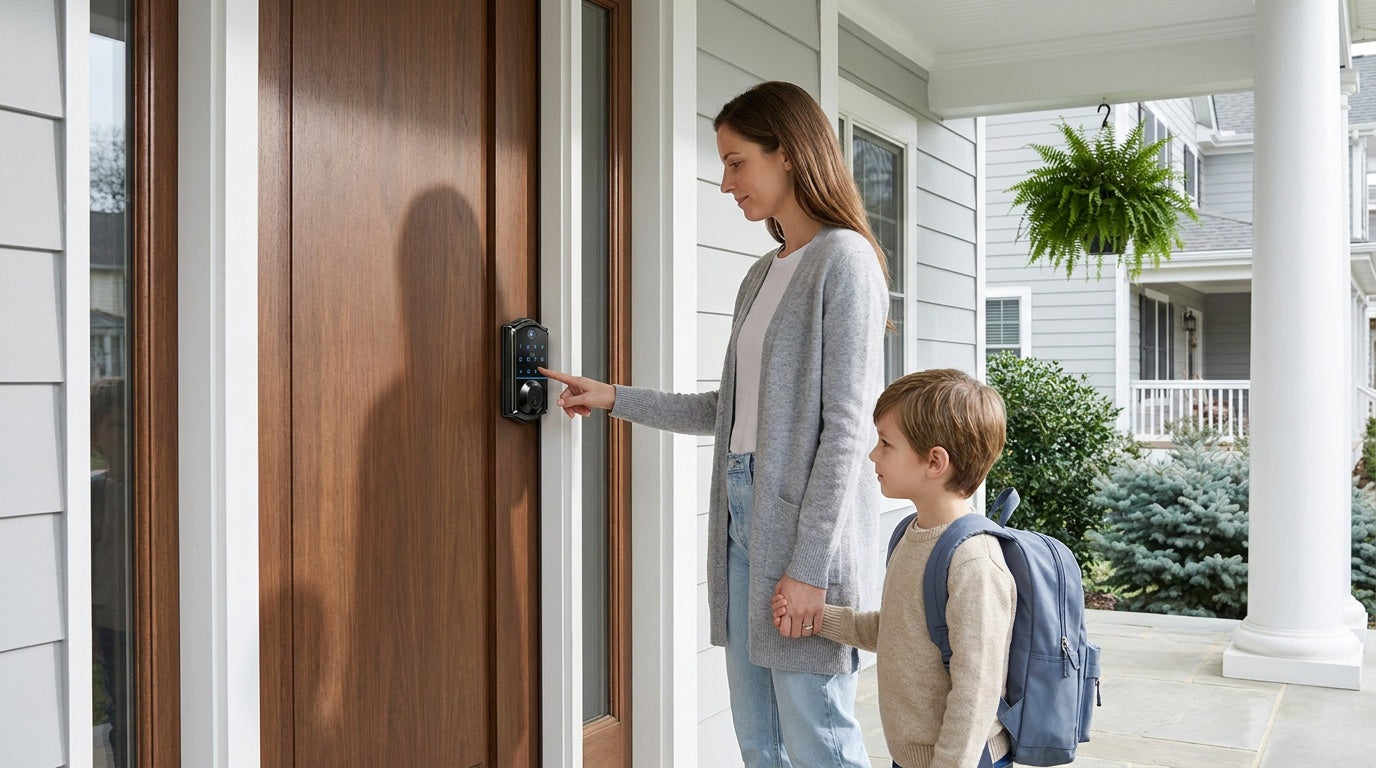
If you want the added convenience of remote access — the ability to check whether your door is locked from across town, let in a delivery, or monitor when your kids arrive home after school — you'll want a smart lock with remote capability. Remote access requires a smart lock, either a Smart Lock w/ G1 or Smart Lock w/ G2 (both of which use a paired gateway to bridge the lock to your home network), or a Wi-Fi smart lock with built-in connectivity. A standard keypad lock, no matter how advanced, cannot be paired with a gateway to gain remote features.
Both the Smart Lock w/ G1 and Smart Lock w/ G2 lines are rated IP55, stepping the liquid protection up to water jets from any direction. The Smart Lock w/ G1 is built on a single product series — the VE017 — and every SKU in that line ships with multilingual voice prompts (English, Spanish, and French), a USB-C emergency power port, and fingerprint as standard features. If your household includes non-English speakers, or if you're managing a short-term rental property where guests speak different languages, G1's multilingual prompts are a concrete practical advantage. Smart Lock w/ G2 offers more SKU variety, including non-fingerprint options and handle-set bundles, and uniquely supports Apple Watch unlock for households already in the Apple ecosystem.
For families who want the simplest possible remote monitoring setup without a separate gateway device, the Wi-Fi Smart Lock connects directly to your home network. It's also Veise's most weather-hardened line, rated IP65 — fully dust-tight and protected against water jets from any direction. The Veise Wi-Fi Smart Lock comes in two series: the VE027 series (touchscreen interface, USB-C emergency power port) and the VE012W series (traditional push-button keypad). Both support fingerprint, keypad code, app control, and voice commands via Alexa or Google Assistant through the lock's built-in Wi-Fi. Both also use an 8 AA battery design — more cells than the standard 4 AA setup common in the category — delivering stronger signal and a more stable, longer-lasting power reserve. Even if your home's Wi-Fi goes down, app control continues to work locally as long as you're within short-range wireless distance of the lock.
Veise locks are designed for standard wood doors with thickness between 1-3/8" and 2", and require full lock replacement (not an overlay). All products are priced between $30 and $180, with no subscription fees, and fingerprint data is processed and stored locally on the device itself. If you have questions about which lock is right for your door, Veise's US-based support team is available by phone and email.
Frequently Asked Questions
What does IP65 mean on a smart lock?
IP65 means the lock's housing is fully dust-tight (the "6" — highest rating on the solids scale) and protected against water jets from any direction (the "5"). In everyday terms, it means the lock can handle rain, snow, wind-driven moisture, and condensation without water or dust entering the internal electronics.
Is IP65 good enough for an outdoor front door lock?
Yes, IP65 is a strong and well-tested standard for residential outdoor door locks. It covers all common weather conditions — rain, snow, humidity, and dust — that a front-door lock typically faces. The only scenario where you might want a higher rating (like IP67) is if the door is in a low-lying area prone to flooding or temporary water pooling at the base of the lock.
What IP rating do Veise locks have?
Veise's lineup spans three grades, matched to product line. The Keypad Deadbolt is rated IP54 (dust-protected and splash-resistant from any direction). The Keypad Latch Lock, Smart Lock w/ G1, and Smart Lock w/ G2 are rated IP55 (dust-protected and sealed against water jets from any direction). The Wi-Fi Smart Lock is rated IP65 (fully dust-tight and water-jet resistant). All are built for exterior wood doors — the right grade depends on how exposed your door is, not on any one line being better than another.
Does IP65 mean a lock is completely waterproof?
Not in the sense of submersion. IP65 protects against sustained water jets from any angle, which covers rain and splashing thoroughly. However, the device was not tested for or rated against immersion in water. "Waterproof" is commonly used as shorthand for IP65, but technically it means "water-jet resistant" rather than submersion-proof.
Can an IP65 lock handle snow and freezing temperatures?
IP65 covers moisture ingress, including snow and sleet. However, the IP rating doesn't specify temperature range — that depends on the lock's operating temperature spec, listed separately by the manufacturer. Most quality outdoor locks are rated for a reasonable temperature range that covers typical residential climates. Check the product specifications for the exact operating temperature range for your specific lock model.
What should I look for beyond IP65 when buying an outdoor lock?
Beyond the IP rating, consider: the lock's housing material (zinc alloy and UV-stabilized materials resist corrosion and UV degradation better than bare plastic), the ANSI/BHMA certification grade (Grade 3 is the residential standard), the unlock methods available (fingerprint, keypad, physical key, app), whether you need remote access (which requires a smart lock, not a keypad-only model), and whether installation on your specific door type is supported.
An IP rating is more than a marketing badge. It's a standardized, independently verified measure of how well a lock keeps dust and water out under real outdoor conditions — the kind your front door faces every single day. Veise's outdoor lineup spans IP54, IP55, and IP65, each grade matched to a different level of exposure, so there's a well-sealed option whether your door sits under a sheltered porch or stands fully open to the weather. From the daily humidity that silently corrodes unprotected electronics to summer thunderstorms and winter snow, a properly rated lock is built to take it.
When you're choosing an outdoor lock, match the IP grade to how exposed your door is, then layer in the features that fit how your household actually lives — whether that's fingerprint speed, remote monitoring via app, voice control, or simple keypad reliability.
Not sure which Veise lock is right for your door? Our US-based support team is here to help you find the right fit — from keypad deadbolts to IP65-rated Wi-Fi smart locks. Contact Us and we'll point you in the right direction. Or browse the full Veise lineup: Keypad Deadbolt Locks, Wi-Fi Smart Locks, Smart Locks w/ G1, and Smart Locks w/ G2.

Leave a comment
This site is protected by hCaptcha and the hCaptcha Privacy Policy and Terms of Service apply.