
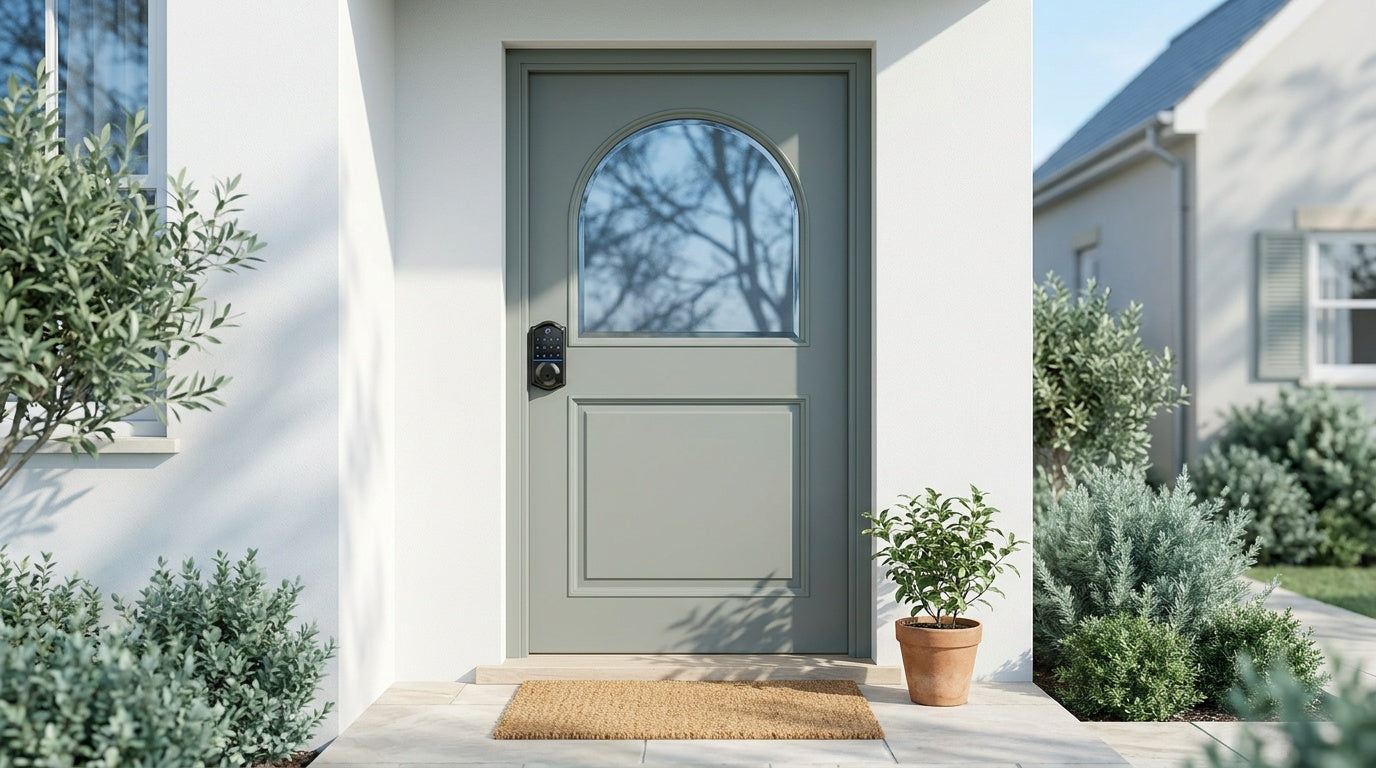
You're replacing the lock on your front door and the box says "ANSI/BHMA Grade 3 Certified." Across the aisle, another lock says Grade 1. One costs significantly more. So which one do you actually need for a home — and does a higher number always mean a better fit?
ANSI lock grades measure a lock's durability and mechanical strength through a standardized battery of laboratory tests. The grades run from 1 (highest performance) to 3 (residential standard), and each one maps to a specific type of door and usage environment. Choosing the wrong grade doesn't just mean spending more than you need to — it can also mean putting the wrong lock in the wrong place. This guide breaks down exactly what each grade means, how locks earn those ratings, and which grade is the right fit for your home's doors.
What Are ANSI Lock Grades?
ANSI stands for the American National Standards Institute, a private non-profit organization that coordinates and oversees voluntary performance standards across many industries, including building hardware. When it comes to locks specifically, ANSI works in partnership with the Builders Hardware Manufacturers Association (BHMA) — the organization that actually writes the test protocols and certifies lock products. Together, they publish the ANSI/BHMA grading system, which divides door locks into three performance tiers: Grade 1, Grade 2, and Grade 3.
The grading system exists to give buyers an objective way to compare locks without relying on marketing language alone. A lock earns its grade by passing standardized laboratory tests that simulate years of real-world wear — the same tests apply whether a lock is made for a hospital corridor or a bedroom door. Each grade sets minimum thresholds for durability, impact resistance, and load strength, with Grade 1 demanding the most and Grade 3 meeting the requirements for standard residential use. Grades indicate performance under test conditions, not brand quality or overall build aesthetics.
How Locks Are Tested: The Three Core Tests
Every ANSI/BHMA-graded lock must pass three fundamental tests, each simulating a different type of real-world stress. Understanding what these tests measure helps explain why Grade 1 locks cost more and why Grade 3 is perfectly appropriate for residential doors.
- Cycle Test: The lock is opened and closed repeatedly, thousands or hundreds of thousands of times, to simulate accumulated daily use over the lock's expected lifespan. A higher grade must survive more cycles, meaning the internal mechanisms hold up longer under continuous operation.
- Strike Impact Test (Door Strikes): A weighted hammer delivers a series of blows to the lock or door assembly to simulate forced-entry attempts. The number and force of those blows increases with each grade tier, testing how well the lock resists being kicked in or beaten open.
- Strength/Weight Test: A load is applied downward or laterally to the knob or lever to test how well the trim and attachment hardware hold under physical stress. This matters most on high-traffic doors where handles are pulled, pushed, and leveraged constantly.
It's worth noting that ANSI grades measure mechanical durability and forced-entry resistance. They do not rate a lock's vulnerability to pick attacks, bump attacks, or other bypass methods. A Grade 1 deadbolt and a Grade 3 deadbolt may use similarly basic pin tumbler cylinders underneath their respective grade certifications. If pick resistance is a priority, look for additional security features like anti-pick pins or high-security cylinders alongside the ANSI grade.
Grade 1: Built for High-Traffic Commercial Use
Grade 1 is the highest performance classification in the ANSI/BHMA system. Locks that achieve this rating are engineered for commercial and institutional environments where doors are used constantly by many different people — think school corridors, hospital wings, government offices, hotels, and apartment building common areas. The test thresholds reflect that reality: a Grade 1 knob or lever must survive 800,000 open/close cycles, withstand 6 door strike impacts, and hold up under a 360-pound load test. A Grade 1 deadbolt must endure 250,000 cycles and 10 hammer strikes.
In practice, Grade 1 hardware is heavier, uses fewer or no plastic internal components, and is built to a tighter dimensional tolerance than lower-grade alternatives. Many building codes require Grade 1 hardware for commercial construction, particularly on exterior entry doors, fire-rated assemblies, and high-traffic corridors. For residential use, Grade 1 is the right call when a home experiences unusually high daily traffic — a large household with multiple comings and goings, a property manager's rental with frequent tenant turnover, or a homeowner who simply wants the highest-rated hardware available. The trade-off is cost and, in some cases, fewer finish and style options compared to residential product lines.
Grade 2: The Mid-Tier for Light Commercial and Higher-Traffic Doors
Grade 2 occupies the middle tier of the ANSI scale, rated for light commercial applications and higher-traffic residential entries where traffic is moderate rather than heavy. A Grade 2 knob or lever must handle 400,000 cycles, 4 door strikes, and a 250-pound weight test. A Grade 2 deadbolt must withstand 150,000 cycles and 5 hammer strikes. For most standard single-family homes, these numbers comfortably exceed the total wear a lock will ever experience across its installed lifespan.
Grade 2 offers a step up in cycle life and impact resistance for doors that see heavier or more frequent use, while remaining widely available in residential styles, finishes, and price points. It's commonly specified for light commercial spaces such as private offices, retail stockrooms, and higher-traffic entries where the extra durability is useful but Grade 1 isn't required by code.
Grade 3: The Certified Residential Standard
Grade 3 is the baseline residential performance rating under the ANSI/BHMA system — and it's important to understand what that actually means. A Grade 3 lock has still passed independent laboratory testing. It has earned a certification. To achieve it, a knob or lever must handle 200,000 cycles, 2 door strike impacts, and a 150-pound weight test. A Grade 3 deadbolt must endure 100,000 cycles and 2 hammer strikes. For a residential door in a typical single-family home with normal daily use, those thresholds are designed to align with expected real-world demand.
The context that matters most here is where you're installing the lock. Grade 3 is the recognized standard for residential interior doors — bedrooms, home offices, bathroom doors, side entries, and storage areas. It is also the grade most commonly certified for consumer smart locks and keypad locks sold through retail channels, where the product's electronic features sit alongside a mechanically certified lock body. Where a higher grade earns its place is in genuinely high-traffic or commercial settings — building entrances, institutional corridors, and doors in constant daily use — where the heavier cycle and impact thresholds of Grade 1 or Grade 2 match the demand.
ANSI Lock Grades at a Glance
The table below summarizes the key test thresholds for each grade across both knob/lever locksets and deadbolts.
| Test | Grade 1 | Grade 2 | Grade 3 |
|---|---|---|---|
| Knob/Lever Cycles | 800,000 | 400,000 | 200,000 |
| Knob/Lever Door Strikes | 6 | 4 | 2 |
| Knob/Lever Weight Test | 360 lbs | 250 lbs | 150 lbs |
| Deadbolt Cycles | 250,000 | 150,000 | 100,000 |
| Deadbolt Hammer Strikes | 10 | 5 | 2 |
| Typical Use Case | Commercial / high-traffic institutional | Light commercial / higher-traffic | Residential / standard home use |
ANSI vs. BHMA: What's the Difference?
You'll often see both "ANSI" and "BHMA" printed on lock packaging, sometimes together (ANSI/BHMA) and sometimes alongside a separate letter grade like AAA, AA, or A. These two names refer to two distinct but interrelated roles. ANSI is the American National Standards Institute, the oversight body that accredits standards-development organizations and ensures the standards they produce are developed through a fair, transparent process. BHMA (Builders Hardware Manufacturers Association) is the organization that actually writes and publishes the specific performance standards for locks and door hardware, then certifies products through independent laboratory testing.
In addition to the 1/2/3 numeric grade, you may also see a BHMA letter-grade system on residential hardware: AAA (best), AA (better), or A (good). The letter system is specific to residential products and breaks performance into three separate scores covering Security, Durability, and Finish — each rated independently. A lock might score an A in Security but an AA in Finish, giving you a more granular picture than the single numeric grade alone. When in doubt, look for the BHMA certification label on the packaging or the manufacturer's product specification sheet, and cross-reference with the BHMA Product Certification Directory to confirm independent testing was completed.
Do Smart Locks Have ANSI Grades?
Yes — and this point is often misunderstood. Having a keypad, a fingerprint reader, or app-based remote access does not exempt a lock from ANSI/BHMA mechanical testing. The lock body, bolt assembly, and latch mechanism of a smart lock must still pass the same cycle, strike, and strength tests as any other lock in its grade category. Electronic features are evaluated separately and do not substitute for mechanical certification. What this means practically is that a smart lock's ANSI grade tells you how its physical hardware will hold up over time and under forced-entry attempts — independent of how convenient or connected its access features are.
Most consumer smart locks sold through retail channels — including keypad deadbolts, fingerprint locks, and app-controlled locks — are designed for residential use and carry ANSI/BHMA Grade 3 mechanical certifications. That aligns correctly with their intended application: home doors used by a household of normal size with typical daily traffic. Where the mismatch occurs is when someone installs a residential-grade smart lock on a door that sees commercial-level traffic or is under institutional management requirements. For those environments, Grade 1 smart locks designed specifically for commercial access control are the appropriate choice.
Which ANSI Lock Grade Do I Actually Need?
The right grade depends on three practical factors: the door's location, the volume of daily traffic it sees, and the security context of the property. Here's a straightforward breakdown:
- Interior doors (bedroom, bathroom, home office): Grade 3 is the appropriate standard. These doors experience low daily traffic from a small number of people, and forced-entry resistance is rarely the primary concern. A certified Grade 3 lock handles the job reliably without over-engineering for demands that don't exist.
- Residential exterior doors (front, back, side entry): Grade 3 is the certified residential standard, and it's the grade most home entry locks — including smart locks — carry. Grade 2's higher cycle and impact thresholds are aimed at heavier-traffic or light-commercial doors rather than a typical household entry.
- Commercial exterior doors, high-traffic entries, institutional buildings: Grade 1 is the standard and is frequently required by building codes. Schools, hospitals, offices, and multi-family building common areas fall into this category.
- Short-term rentals and managed properties: Grade 2 or Grade 1 on exterior entry points, particularly where turnover is high or the property is accessed remotely. The combination of a solid mechanical rating and smart access features (remote lock/unlock, entry history, access code management) is where modern smart locks add the most practical value.
One additional detail worth knowing: pairing any grade of deadbolt with strike plate screws that anchor securely into the door frame stud is one of the highest-impact physical security upgrades you can make, regardless of the lock's grade. The bolt is only as secure as the frame it extends into.
Certified Home Security from Veise
Veise designs, engineers, and manufactures its own locks from the ground up — not an OEM reseller, but a vertically integrated company with roots in the lock industry since 1988. All Veise locks carry ANSI/BHMA Grade 3 certification, which is the recognized residential standard for home door hardware. That certification means the mechanical components in every Veise lock have been independently tested and have passed the cycle, strike, and strength requirements for residential use.
Veise's product lineup covers every door in your home across four categories, all priced between $30 and $180 with DIY installation in about 15 minutes using a screwdriver — no wiring, no professional help needed. All Veise locks are designed for wood doors (standard thickness 1-3/8" to 2") and require no subscription fees. Here's how each category fits within the grade context:
- Keypad Deadbolt Locks: The most common choice for a front or back door where the homeowner wants a code-based entry with a physical key backup. Select Veise models also include fingerprint recognition. Browse the Keypad Deadbolt Locks collection.
- Keypad Latch Locks: An integrated lock-and-handle unit for interior doors, side entries, or garage access doors where a keypad code and physical key backup cover daily needs. Available in two handle styles (knob or lever). Does not include fingerprint or app control.
- Smart Lock w/ Gateway 1/2: For homeowners who want remote app access, entry history, and voice assistant support alongside the keypad, fingerprint, key fob, and physical key options. Smart Lock w/ G1 is built on a single product series, the VE017 — every unit includes multilingual voice prompts (English, Spanish, and French), a USB-C emergency power port, and fingerprint as standard features. Smart Lock w/ G2 adds Apple Watch unlock and web portal control. Remote access and voice control require the paired gateway in place (the gateway connects the lock to the Internet). Even when Wi-Fi is down, app control continues to work locally as long as you're within short-range wireless distance. Browse Smart Locks w/ G1 and Smart Locks w/ G2.
- Wi-Fi Smart Locks: Built-in Wi-Fi for direct app and voice control (Alexa and Google Assistant) without a separate gateway. Ideal for families who want to monitor who's coming and going, manage short-term rental access remotely, or receive entry alerts in real time. Two series are available: the Touchscreen Wi-Fi Smart Lock (VE027 Series) with a touchscreen interface and USB-C emergency power port, and the Push-Button Wi-Fi Smart Lock (VE012W Series) with a traditional keypad. Both use 8 AA/LR6 alkaline batteries for stronger signal and a longer power reserve than the more common 4 AA setup. Browse the full Wi-Fi Smart Lock collection.
For interior doors, Veise also offers a complete range of Mechanical Locks, including Keyed Entry Door Knobs, Keyed Entry Door Levers, Privacy Door Knobs, Privacy Door Levers, the standalone Deadbolt Lock, and Keyed Entry Handlesets. View the full product lineup here.
ANSI lock grades give you an objective, test-backed way to match the right lock to the right door. Grade 1 is engineered for high-traffic commercial environments where durability demands are extreme. Grade 2 adds cycle life and impact resistance for higher-traffic and light-commercial doors. Grade 3 is the certified residential standard — the appropriate, independently tested grade for home use, and the grade carried by most consumer smart locks on the market today. The key is matching the grade to the door's location and traffic level, not simply assuming a higher number is always necessary.
Whether you're replacing a front door lock, upgrading an interior handle, or adding smart access to a short-term rental, Veise offers certified options across every category — all installed in about 15 minutes, with no subscription fees.
Frequently Asked Questions
What does ANSI Grade 3 mean on a lock?
ANSI Grade 3 is the certified residential standard for door locks. It means the lock has passed independent laboratory testing for cycle durability, impact resistance, and load strength at thresholds designed for typical residential use. It is the most common grade for consumer deadbolts, keypad locks, and smart locks sold through retail channels.
Is ANSI Grade 3 safe for a front door?
Yes. Grade 3 is the certified residential standard and is used on millions of front doors across the United States. For standard residential use it is built for the job, having passed the same independent cycle, strike, and strength testing as any graded lock. Grade 1 and Grade 2 are aimed at high-traffic and commercial doors. Pairing any deadbolt with strike plate screws secured into the door frame stud further improves real-world forced-entry resistance.
What is the difference between Grade 1 and Grade 3 locks?
The primary differences are in cycle life, impact resistance, and the environments each grade targets. A Grade 1 deadbolt must survive 250,000 cycles and 10 hammer strikes; a Grade 3 deadbolt must survive 100,000 cycles and 2 hammer strikes. Grade 1 is built for high-traffic commercial and institutional settings; Grade 3 is the certified residential standard for home use.
Do smart locks have ANSI grades?
Yes. A smart lock's electronic features (keypad, fingerprint reader, app control) are separate from its ANSI mechanical certification. The lock body and bolt must still pass the same cycle, strike, and strength tests as any traditional lock. Most residential smart locks carry an ANSI/BHMA Grade 3 certification, which is appropriate for home door applications.
What is the difference between ANSI and BHMA grades?
ANSI (American National Standards Institute) oversees and accredits the standards-development process. BHMA (Builders Hardware Manufacturers Association) writes the specific test protocols for door hardware and certifies products through independent laboratory testing. Together they produce the ANSI/BHMA grading system. BHMA also publishes a separate residential letter-grade system (AAA, AA, A) that scores Security, Durability, and Finish independently for more granular product comparison.
Which ANSI grade do I need for a home office or bedroom door?
Grade 3 is the appropriate standard for interior doors like bedrooms, bathrooms, and home offices. These doors experience low daily traffic and don't face the same forced-entry demands as an exterior entry point. A certified Grade 3 lock — whether a mechanical knob, lever, or keypad latch lock — handles the job without over-engineering for demands that don't exist on interior doors.
Not Sure Which Lock Is Right for Your Door?
The Veise team is here to help. Whether you're matching a grade to a specific door, figuring out which smart lock works for your setup, or just need a straight answer before you buy — reach out and we'll point you in the right direction.

Leave a comment
This site is protected by hCaptcha and the hCaptcha Privacy Policy and Terms of Service apply.