
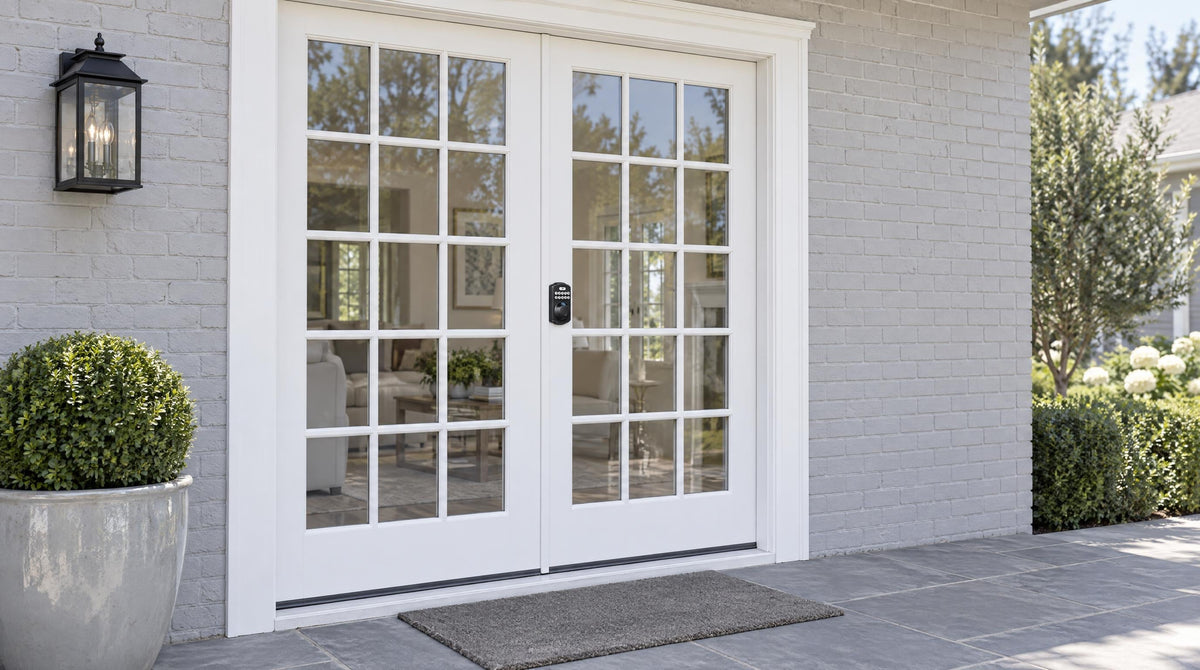
Hinged French doors are one of the most searched — and most misunderstood — door types when it comes to smart lock shopping. Their elegance is undeniable: light floods through the glass panels, the symmetrical frames look stunning, and the wide opening feels genuinely welcoming. But when a homeowner starts researching smart locks, they quickly hit a wall of vague product descriptions, specs that weren't written with French doors in mind, and roundups that lump sliding patio doors and hinged entries together as if they're the same challenge.
They're not. Hinged French doors have a specific set of structural requirements — active and passive panels, narrow stiles, standard deadbolt prep — and a smart lock that works on a regular front door may or may not work here depending on your exact door configuration. This guide cuts through the confusion. We'll walk you through what to measure, what to check, and exactly which lock types from Veise are designed to work with standard wood hinged French doors — so you can upgrade your entry with confidence instead of guesswork.
What Makes Hinged French Doors Different from Standard Doors
A standard front door is a single panel on a single frame — straightforward to measure, straightforward to lock. A hinged French door setup, whether single-panel or double-panel, adds complexity at every level. The tall glass lites running through each panel create visual appeal, but they also mean the structural wood around the lock hardware (called the stile) may be narrower than you'd find on a solid wood or steel entry door. That narrower stile is the first thing to check before buying any lock.
Double-panel hinged French doors — the kind that swing open from the center — also introduce the active/passive panel dynamic. Most smart locks are designed for a single-panel door, so understanding which side they mount on, and what happens to the other side, is essential before you spend a dollar. The good news: if your French door is made of wood and pre-drilled with a standard deadbolt bore, the path to a working smart lock is straightforward. The bad news: not every lock on the market was built with these doors in mind.
Active Door vs. Passive Door: Where the Smart Lock Goes
On a double-panel hinged French door set, one door opens regularly — that's the active panel. The other, the passive panel, stays fixed most of the time, held in place by flush bolts at the top and bottom that shoot into the frame and floor. Your smart lock mounts on the active panel only. The passive panel doesn't need a smart lock; it needs reliable flush bolts or surface bolts to stay anchored when the active door is locked.
This active/passive distinction matters because it changes how you think about security. A deadbolt on the active door extends its bolt into the astragal (the vertical strip at the meeting edge) or into the door frame. But if the passive panel isn't properly anchored, that deadbolt can't do its job — a pushed passive panel creates a gap that undermines everything. Before shopping for a smart lock, confirm that the passive panel's flush bolts are in solid working condition. If they're loose, worn, or missing, fix or replace those first. The smart lock investment only pays off when the whole system is solid.
For single-panel hinged French doors (one door in the frame, swinging in or out), this complexity goes away entirely. The door behaves just like a standard entry door with a deadbolt, and most smart lock installations are as direct as any front door replacement.
What to Measure Before You Buy a Smart Lock
Pulling out a tape measure before buying a smart lock is the single most useful thing you can do. Here are the four measurements that determine compatibility with virtually any smart lock on the market:
- Door thickness: Veise locks fit wood doors between 1-3/8" and 2" thick, which covers most residential French door panels. Confirm yours falls in this range.
- Bore hole diameter: The round hole where your current lock body sits should be 2-1/8" in diameter. This is the North American standard; Veise locks fit either a 2-1/8" or a 1-1/2" bore.
- Backset: This is the distance from the edge of the door to the center of the bore hole. Standard residential backsets are 2-3/8" or 2-3/4". Most modern smart locks accommodate both, but verify before purchasing.
- Stile width: On French doors with glass panels, measure the width of the solid wood stile (the vertical wood strip where the lock hardware mounts). It needs to be wide enough for the lock's mounting plate to sit flat without overlapping the glass or the edge of the door.
If your French door has a mortise lock body (a rectangular pocket cut into the edge of the door, common on older or European-style doors) rather than a standard bored cylindrical deadbolt, most off-the-shelf smart locks won't be a direct fit. In that case, a locksmith consultation before purchasing is worth the investment — a mortise-to-deadbolt conversion is doable, but it's not a 15-minute project.
Door Material Matters: Why Wood Is the Right Match
Not all French doors are made from the same material, and this is one of the most frequently overlooked compatibility factors. Hinged French doors come in wood, fiberglass, and steel — and the material directly affects whether a standard smart lock installation is possible. Veise smart locks are designed for wood doors only. That's not a limitation so much as a deliberate design choice: wood is the material that accepts standard bore holes cleanly, holds screws securely over years of use, and doesn't require specialty drill bits or modified hardware.
Fiberglass and steel doors behave differently during installation, especially around the bore hole and screw anchors, and can void warranties or compromise the lock's structural integrity if the wrong lock is forced into them. If your hinged French doors are wood — which is the majority of traditional and craftsman-style French door installations — you're in the ideal compatibility zone. If you're unsure of the material, knock on the stile: wood has a dull thud; hollow fiberglass or steel sounds different. You can also check the door's original documentation or measure the weight (solid wood French doors are substantially heavier than fiberglass alternatives).
Which Veise Smart Lock Works on a Hinged French Door
Built on Kaadas Group's 38 years of lock industry expertise and 711 patents — the world's largest smart lock patent portfolio — Veise designs its locks around real homeowner needs rather than spec sheets. Every product in the lineup is engineered for standard wood door prep, which means if your hinged French door meets the measurements above, you have multiple strong options. Here's how the Veise lock categories map to hinged French door scenarios:
Keypad Deadbolt — Reliable Entry Without the Complexity
For homeowners who want keyless entry without app connectivity or remote access, a Keypad Deadbolt is a practical, durable starting point. It mounts directly into the standard deadbolt bore on your French door's active panel and replaces the existing deadbolt entirely. Every model supports a keypad code plus a physical key backup. The KS02 series adds a fingerprint sensor for sub-0.3-second entry — useful when you're carrying bags through a wide French door opening. There are no subscriptions, no gateway requirements, and no wiring. Auto lock is built in, configurable between 10 and 99 seconds.
The non-fingerprint models (RZ and KS01 series) are available as standalone deadbolts or as handleset bundles with a lever or knob, which can be a practical fit if your French door's active panel already has a separate lever handle below the deadbolt bore. Fingerprint models (KS02 series) come in keypad-only and handle-set bundle form factors as well, giving you flexibility depending on what your door already has.
Smart Lock w/ Gateway 1/2 — App Control and Remote Access
For families who want to monitor who's coming and going — especially useful on a frequently used back-patio French door — a Smart Lock w/ G1 or Smart Lock w/ G2 adds app control and remote access to the standard deadbolt install. The gateway (sold separately, plugged in within range of the lock and connected to your home network) bridges the lock to your network, enabling remote locking, entry history, and guest access codes you can share with guests or a property manager.
Smart Lock w/ G1 is built on a single product series — the VE017 — and every model ships with fingerprint access, multilingual voice prompts (English, Spanish, and French), and a USB-C emergency power port. This makes it the most all-inclusive option for multilingual households. Smart Lock w/ G2 offers more form factor variety, including non-fingerprint options and handle-set bundles, and supports Apple Watch unlock as a unique feature — useful for homeowners who prefer wrist-based entry as they arrive at a patio French door with arms full. Both Smart Lock w/ G1 and Smart Lock w/ G2 include key fob and physical key backups on all models.
An important note on voice control: Smart Locks w/ Gateway 1/2 do support Alexa and Google Assistant, but the gateway needs to be in place and connected. Voice commands won't work without the paired gateway. Also, if your Wi-Fi goes down but you're within short-range wireless distance, app control continues to work locally — remote features (off-site locking, push alerts) require an active Internet connection.
Wi-Fi Smart Lock — Built-In Remote Access, No Gateway Required
If you want full remote access without buying a separate gateway, a Wi-Fi Smart Lock connects directly to your home Wi-Fi and lets you manage the lock through the app — no gateway or extra hardware required. This can be a convenient option for a hinged French door leading to a back patio or deck, letting you check the lock status from the couch, confirm the door is secured after guests leave, or grant access while you're away from home.
Veise offers two Wi-Fi series. The Touchscreen Wi-Fi Smart Lock (VE027 Series) features a touchscreen keypad interface and includes a USB-C emergency power port — reassuring for older family members who want a tactile backup if batteries ever run low. The Push-Button Wi-Fi Smart Lock (VE012W Series) uses a traditional press-button keypad — a familiar, tactile interface. Both series share fingerprint access with recognition in under 0.3 seconds, built-in Alexa and Google Assistant support, and Veise's 8 AA/LR6 alkaline battery design for a stronger signal and longer power reserve than the standard 4 AA setup common in competitors; the VE027 series adds the touchscreen, USB-C emergency power, key fob, and on-device English, Spanish, and French voice prompts, none of which are on the VE012W series. Auto lock is configurable between 10 and 180 seconds on both.
Keypad Latch Lock — Interior French Door Applications
Interior hinged French doors — between a dining room and living room, for instance, or as an office divider — often don't need a deadbolt at all. They need a latch-based lock that handles everyday privacy and code-based access without the security-grade hardware of an exterior entry. Veise's Keypad Latch Lock is built precisely for this scenario. The KS03 model includes an integrated top knob; the KS04 has an integrated top lever. Both support keypad code entry and a physical key backup. There is no app, no fingerprint sensor, and no key fob — and for most interior French door applications, none of those extras are necessary. Reliable, code-based privacy locking is all you need, and these deliver that cleanly.
Don't Forget the Passive Door: Completing Your Security Setup
A smart lock on the active panel is only part of the security equation for double-panel French doors. The passive panel also needs to be securely fastened, typically with flush bolts recessed into the door edge or surface bolts mounted on the interior face. Flush bolts offer a cleaner look because they stay hidden when the door is closed, while surface bolts can be easier to retrofit when the door isn't designed for flush bolts.
Don't overlook the passive door's strike points, either. The top and bottom bolts typically engage with the door frame and threshold or floor. Make sure these engagement points are securely reinforced, with strike plates or other appropriate hardware fastened to solid framing or structural material rather than relying only on the door casing or trim.
Securing both panels helps strengthen the entire door assembly. A smart lock can control access through the active panel, but the passive panel is still part of the overall security of a double-panel French door.
Installation: What to Expect on a French Door
If your active panel meets the standard wood door measurements (1-3/8" to 2" thick, 2-1/8" bore hole, 2-3/8" or 2-3/4" backset), installing a Veise smart lock is the same process as installing it on any front door: remove the old deadbolt, slide in the new latch, mount the exterior assembly, attach the interior assembly, and insert the batteries (AA/LR6 alkaline — not included), following the included installation guide and video. No wiring. No professional help required. A screwdriver is the only tool you need, and the job typically takes about 15 minutes.
A few French-door-specific tips to keep in mind: Check the stile width first to confirm the exterior keypad plate sits entirely on wood without overlapping the glass. On some older or narrower French door panels, the stile may be just wide enough — not a problem, but worth confirming before you mount anything permanently. Also verify the door swings freely and the latch engages the strike plate cleanly with the new hardware in place before fully tightening all screws. Minor alignment adjustments are much easier before the lock is fully torqued down.
Because Veise locks are full replacements — not overlay devices that sit on top of your existing hardware — the buyer should be the property owner or have authority to modify the door hardware. For landlords managing a short-term rental property or a vacation cabin, that's typically straightforward.
The Right Lock for the Right Door
Hinged French doors are genuinely compatible with smart lock technology — as long as you match the lock to the door's actual structure rather than buying on looks or brand alone. Wood doors with standard deadbolt prep are the ideal starting point, and Veise's lineup covers every scenario from simple interior latch locks on interior dividers to fully connected Wi-Fi smart locks on exterior patio entries. The Effortless Home Improvement™ Experience isn't just a phrase — it describes what happens when you take 15 minutes, a screwdriver, and the right lock to a door that was ready for it all along.
Measure your door, confirm your panel is wood, check whether your passive door is properly secured, and then pick the Veise category that matches how you want to enter and manage your home. Recognized by Frost & Sullivan as the global No.1 high-end smart lock brand by sales, and backed by 10M+ smart locks sold across 41+ countries, Veise brings the kind of proven reliability that a frequently used French door entry genuinely deserves.
Frequently Asked Questions
Can you put a smart lock on a hinged French door?
Yes — if the active panel of your hinged French door is wood, has a standard deadbolt bore (2-1/8" diameter), a backset of 2-3/8" or 2-3/4", and a thickness between 1-3/8" and 2", most standard smart locks will install just as they would on a front door. Measure your stile width to confirm the lock's mounting plate will sit flush on wood without overlapping the glass panel.
Do Veise smart locks work on French doors?
Veise smart locks are compatible with standard wood doors, which includes the active panel of most hinged wood French doors. They are not compatible with fiberglass, metal, storm, or sliding doors. If your French door panel is wood and pre-drilled to standard US deadbolt prep, any Veise keypad deadbolt, Smart Lock w/ Gateway 1/2, or Wi-Fi smart lock will install in about 15 minutes with a screwdriver.
Where does the smart lock go on a double French door?
The smart lock mounts on the active panel — the door that opens and closes in daily use. The passive panel is secured separately using flush bolts or surface bolts at the top and bottom. No smart lock is needed on the passive panel; it just needs to be firmly anchored so the active door's deadbolt has a solid surface to lock against.
What is the difference between a Veise Electronic Keypad and a Veise Smart Lock for a French door?
An electronic keypad provides local keyless entry via a code (and fingerprint on the KS02 series) but does not include remote access or app control — it's fully self-contained. A smart lock connects directly to your home network and lets you lock, unlock, check status, and review entry history from anywhere through the app, with built-in Alexa and Google Assistant support. If remote access matters for a patio French door entry, a Wi-Fi Smart Lock or a Smart Lock w/ Gateway 1/2 is the right category. Remote access requires a smart lock (Smart Lock w/ Gateway 1/2 or Wi-Fi) — a Keypad Deadbolt or Keypad Latch lock cannot be paired with a gateway.
Do I need to hire a locksmith to install a smart lock on my French door?
Not if your door is standard wood prep. Veise smart locks are full lock replacements that install with a screwdriver in about 15 minutes — no wiring, no professional help needed. If your French door has a mortise lock body instead of a standard cylindrical deadbolt, or if the bore hole needs modification, a locksmith consultation before purchasing is worthwhile to avoid compatibility surprises.
Who can install a Veise smart lock on a French door?
Veise smart locks require full lock replacement, which means the door hardware is permanently modified, so the buyer should be the property owner or have authority to modify the door hardware. Property owners and landlords managing short-term rentals or vacation properties can install freely, and a Smart Lock w/ Gateway 1/2 or Wi-Fi smart lock is especially practical for managing guest access codes remotely.
Ready to Upgrade Your French Door Entry?
Browse the full Veise smart lock lineup to find the right fit for your door — or reach out directly if you have questions about compatibility, measurement, or which category is right for your setup.

Leave a comment
This site is protected by hCaptcha and the hCaptcha Privacy Policy and Terms of Service apply.