

Double entry doors make a strong first impression — two matching panels, a grand opening, and a sense of permanence that a single door simply can't match. But when it's time to upgrade the lock, a lot of homeowners hit a wall. Which door gets the smart lock? What measurements actually matter? Will a standard deadbolt even engage correctly when there's no fixed door frame in the middle?
The good news is that most double entry doors in North American homes are built around the same standard prep dimensions that smart locks are designed for. The fitment question is almost always a matter of understanding your door's configuration — not a compatibility dead end. This guide walks through exactly how a double entry door is structured, which measurements to confirm before you buy, and which Veise smart lock category is the right fit for each part of the setup.
How a Double Entry Door Actually Works
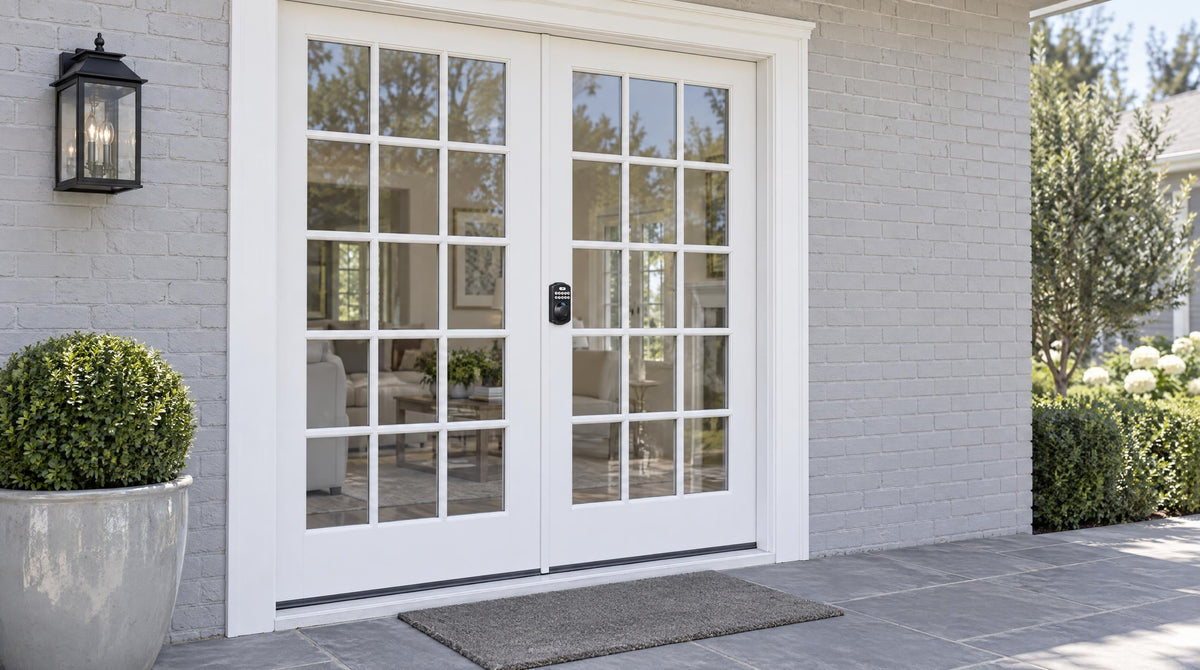
Before any conversation about fitment, it helps to understand what a double entry door actually is at a mechanical level. A double door is made up of two panels — called leaves — that meet in the center of the opening. The two leaves are not equal partners. One panel, the active leaf, is the door you open every day. It carries the handle, the latch, and the deadbolt. The second panel, the passive leaf, stays closed most of the time. It is held in place by flush bolts at the top and bottom that shoot into the door frame header above and the sill threshold below.
Between the two panels, running vertically along the meeting edge, is a component called the astragal. The astragal serves two functions: it seals the gap between the two doors against weather and drafts, and it provides the strike surface that the active door's deadbolt engages when it throws. Think of it as a floating door frame built into the passive leaf. When the passive leaf is properly secured by its flush bolts, the astragal becomes a solid anchor point — and your smart lock's deadbolt can extend into it cleanly, just as it would into a conventional door jamb.
This active/passive dynamic is the most important thing to grasp before shopping for a smart lock. Your smart lock lives entirely on the active door. Everything on the passive side — the flush bolts, the astragal, the strike plate embedded in the astragal — must already be in good working order for your smart lock to function securely. A smart lock cannot compensate for a passive leaf that flexes, has loose flush bolts, or has a misaligned astragal strike. The technology only works as well as the foundation under it.
The Three Measurements You Need Before You Shop
Standard double entry doors in North American homes are almost always built to the same preparation specs as single entry doors. That means a smart lock designed for a standard residential door prep will fit the active leaf of a double door without any modification in most cases. Three numbers tell you everything you need to know.
1. Door Thickness
Measure the thickness of the active door panel at the edge where the latch sits. Most residential exterior doors — including double door panels — fall in the range of 1-3/8 inches to 1-3/4 inches. Veise smart locks are designed for doors between 1-3/8 inches and 2 inches thick, which covers the vast majority of residential wood double-door installations. If your panel is thicker than 2 inches, confirm with the specific product listing before purchasing.
2. Backset
The backset is the distance from the edge of the door to the center of the large bore hole where the lock body sits. In North America, two backset measurements are standard for residential doors: 2-3/8 inches and 2-3/4 inches. The 2-3/8-inch backset is the most common residential standard. Most modern smart locks — including the full Veise lineup — include an adjustable latch that accommodates both backset sizes without modification. To measure, simply use a tape measure from the door edge to the center of your existing lock cylinder.
3. Bore Hole Diameter
The bore hole is the large circular hole drilled through the face of the door where the lock body passes. The standard diameter is 2-1/8 inches (54mm). Virtually all modern residential doors are pre-drilled to this spec, and Veise locks also fit a 1-1/2-inch bore. There is also a smaller 1-inch edge bore on the door's side edge where the latch bolt sits. If your existing lock was installed in a standard prep, both of these holes are already correct for any Veise replacement.
Taking these three measurements before you shop takes less than five minutes and eliminates the guesswork entirely. If all three match the standard specs above, your active door is ready for a direct smart lock swap — no wiring, no professional help required.
Where Does the Smart Lock Go on a Double Door?
The smart lock installs on the active leaf only — specifically, it replaces the existing deadbolt on that door. The lock body goes through the 2-1/8-inch bore hole, the latch slides into the 1-inch edge bore, and the interior and exterior assemblies sandwich the door and are secured with the mounting screws. All of this is identical to installing a smart lock on a single entry door. There is no special double-door mounting hardware required, and no additional drilling on the passive leaf.
What changes on a double door is where the deadbolt throws. On a single door, the bolt extends into a strike plate mortised into the door jamb. On a double door with an astragal, the bolt extends into a strike plate that is set into the astragal on the passive leaf. As long as the astragal's strike plate is properly positioned and the passive leaf is locked in place with its flush bolts, the bolt engages just as solidly as on a jamb-mounted strike. The smart lock's motor simply needs to throw the bolt cleanly — which it will, provided the strike alignment is good.
One practical note: because the active door on a double entry set swings and closes against the astragal rather than against a fixed jamb, there can be slightly more door movement over time as the astragal compresses weatherstripping and the passive leaf shifts seasonally. If the bolt ever stops engaging the astragal strike smoothly, door alignment — not the lock — is the place to look. This is a door maintenance point, not a smart lock limitation.
Get the Passive Door Right First
Installing a smart lock on a double entry door without first checking the passive leaf is one of the most common mistakes homeowners make. The passive leaf is the hidden foundation of the entire locking system. If the flush bolts at the top and bottom of the passive door are stiff, loose, or not fully engaging into the header and sill, the passive leaf will flex when the active door closes — and that flex is transferred directly to the astragal strike, making it difficult for the deadbolt motor to throw cleanly every time.
Before installation day, do a quick passive leaf inspection:
- Engage the top and bottom flush bolts — they should slide smoothly and lock firmly with no play
- With the flush bolts engaged, try to push or pull the passive leaf at the center — it should feel solid, not springy
- Check the astragal strike plate for the deadbolt — it should be flush, not raised or recessed, and the strike pocket should be clean and clear of paint or debris
- Look at the gap between the two doors at the astragal — it should be consistent top to bottom, with no visible lean or twist in the passive panel
If everything checks out, you are ready to install. If the passive leaf has issues, address them first — tighten or replace the flush bolts, realign the astragal strike plate, or plane the door if it has warped. Thirty minutes of prep work here will keep your smart lock performing reliably for years.
Which Veise Lock Category Fits a Double Entry Door?
Veise — built on Kaadas Group's 38 years of lock industry expertise and 711 patents, the world's largest smart lock patent portfolio — designs its locks as full replacements for standard residential door prep. Every lock in the lineup is compatible with wood doors in the 1-3/8-inch to 2-inch thickness range with standard 2-1/8-inch bore holes, which means all four Veise lock categories can fit the active leaf of a standard double entry door. The right category depends on how much connectivity you want.
Keypad Deadbolt — The Standalone Upgrade
A keypad deadbolt is the most direct swap for the existing deadbolt on the active leaf. You get keypad code entry and a physical key backup on every model, with fingerprint access on the KS02 series. There is no gateway, no app, and no Internet connection required — the lock operates completely independently. This is an excellent choice if you primarily want to stop carrying a key for daily entry and want a clean, reliable upgrade for a double door without adding any smart home complexity.
Keypad Latch Lock — For the Handle Position
Many double entry doors have both a deadbolt above and a handle lockset at the standard lower position. If you want to add keypad convenience to the lower handle position rather than (or in addition to) the deadbolt position, a keypad latch lock is the right tool. The two current Veise SKUs — KS03 with an integrated knob and KS04 with an integrated lever — replace a standard latch lockset and offer keypad code plus physical key access. They are compact, straightforward, and install directly into standard prep without any gateway or app pairing.
Smart Lock w/ Gateway 1/2 — Connected Control
If you want remote access — the ability to lock your double entry door from your phone while you're away — you need a smart lock, not a Keypad Deadbolt or Keypad Latch lock. Smart Locks w/ G1 are built on a single product series (the VE017) and ship with fingerprint access, multilingual voice prompts (English, Spanish, and French), a USB-C emergency power port, and a first-party app. Smart Locks w/ G2 support Apple Watch unlock and web portal control, with both fingerprint and non-fingerprint SKUs available in standalone or handleset bundle form factors. Both lines include keypad code, key fob, and physical key as standard backups. The gateway (sold separately) plugs in within range of the lock, connects to your home network, and bridges the lock to the app — once in place, you can lock and unlock your front double door from anywhere with an active Internet connection. Even if Wi-Fi goes down, app control continues to work locally as long as you're within short-range wireless distance of the lock.
Wi-Fi Smart Lock — The All-in-One Solution
For families who want the most complete feature set without a separate gateway, a Wi-Fi smart lock connects directly to your home Wi-Fi network. Veise offers two Wi-Fi series: the Touchscreen Wi-Fi Smart Lock (VE027 Series) and the Push-Button Wi-Fi Smart Lock (VE012W Series). Both support remote app control, fingerprint access, keypad code, Alexa and Google Assistant voice commands, and a physical key backup. The VE027 series also adds the touchscreen, a USB-C emergency power port, key fob support, and on-device English, Spanish, and French voice prompts — none of which are on the VE012W series. Both series run on 8 AA/LR6 alkaline batteries — more than the standard 4 AA setup found in most competing locks — providing a stronger signal and a more substantial power reserve. This category is particularly well-suited for families with kids, since parents can remotely review entry history and monitor lock activity through the app even when they're not home.
Pre-Purchase Fitment Checklist
Before placing your order, run through this quick checklist on your active door panel. Every item should be a "yes" for a standard screwdriver-only installation.
- Door material is wood — Veise locks are designed for wood doors only
- Door thickness is between 1-3/8" and 2" — measure at the edge near the existing lock
- Bore hole diameter is 2-1/8" — this is standard on virtually all residential wood doors
- Backset is 2-3/8" or 2-3/4" — measure from the door edge to the center of the existing cylinder
- Passive leaf flush bolts engage fully and hold the panel solid — no flex or play when bolted
- Astragal strike plate is clean, flush, and aligned with the active door's bolt path
- No storm door or screen door is mounted in front of the active leaf — these can block keypad access
If every item checks out, you are looking at a 15-minute installation with a screwdriver — no wiring, no professional locksmith, no special tools. That is the Effortless Home Improvement™ Experience Veise was built to deliver. Easy from Day One.
The Bottom Line
Smart locks and double entry doors are a natural pairing — and fitment is almost never the obstacle it appears to be. Standard double door panels in North American homes share the same 2-1/8-inch bore, 2-3/8-inch or 2-3/4-inch backset, and 1-3/8-inch to 2-inch thickness that Veise smart locks are designed around. The smart lock goes on the active leaf; the passive leaf and its flush bolts provide the anchor. Confirm your three measurements, check your passive door is solid, and you are ready to install.
Veise's lineup — from simple keypad deadbolts to fully connected Wi-Fi smart locks — is engineered around standard residential door prep precisely so that homeowners can upgrade their entry without calling a professional or modifying their door. Browse the full Veise product lineup to find the right fit for your double entry door.
Frequently Asked Questions
Can you put a smart lock on a double entry door?
Yes. A smart lock installs on the active leaf (the door panel you open daily) using the same standard door prep as a single entry door. The deadbolt extends into a strike plate set in the astragal on the passive leaf. As long as the passive leaf's flush bolts are secure and the astragal strike is properly aligned, the installation is straightforward.
What measurements do I need for a smart lock on a double door?
Confirm three things on the active door panel: door thickness (standard range is 1-3/8" to 2"), backset (2-3/8" or 2-3/4"), and bore hole diameter (2-1/8" is standard on nearly all residential wood doors). If all three match, no modification is needed.
Does the smart lock go on both doors of a double entry set?
No. The smart lock goes on the active leaf only — the door you use for daily entry. The passive leaf uses flush bolts (top and bottom) to stay fixed in place. The active door's deadbolt engages a strike plate in the astragal, securing the full door pair when locked.
What is an astragal and why does it matter for smart lock fitment?
An astragal is a vertical strip attached to the meeting edge of the passive door. It seals the gap between the two panels and houses the strike plate that the active door's deadbolt engages. For a smart lock to work securely on a double door, the astragal's strike plate must be properly positioned and the passive leaf must be firmly held by its flush bolts — otherwise the deadbolt motor may struggle to throw cleanly.
Do Veise smart locks work on double entry doors?
Yes, on the active leaf of wood double entry doors that meet standard residential prep specs (1-3/8" to 2" thick, 2-1/8" bore hole, 2-3/8" or 2-3/4" backset). Veise locks are not compatible with fiberglass, metal, storm, or sliding doors. The full lineup — keypad deadbolts, keypad latch locks, Smart Locks w/ G1 and G2, and Wi-Fi smart locks — all install into standard door prep without modification.
Do I need a special smart lock for a double door, or will a standard model work?
In most cases, a standard smart lock deadbolt works perfectly on the active leaf of a double entry door. No special double-door model is required. The key prerequisite is that the passive leaf is in good condition — flush bolts engage fully, astragal strike is aligned, and there is no significant flex or play in the passive panel. The lock itself installs exactly as it would on a single door.
What is the difference between an electronic keypad and a smart lock for a double entry door?
An electronic keypad operates standalone — keypad code and physical key access, no app or Internet required. A smart lock adds remote access, entry history monitoring, and voice control via Alexa or Google Assistant. For families who want to check whether the front double door is locked while away from home, or receive alerts when someone enters, a Wi-Fi smart lock or a Smart Lock w/ Gateway 1/2 is the right choice. An electronic keypad is ideal when you simply want keyless convenience without any connectivity.
Not Sure Which Lock Fits Your Double Door?
The Veise team is here to help. Whether you're matching backset measurements, choosing between a keypad deadbolt and a connected smart lock, or confirming compatibility for your specific door setup — we'll point you to the right product with no guesswork.

Leave a comment
This site is protected by hCaptcha and the hCaptcha Privacy Policy and Terms of Service apply.