
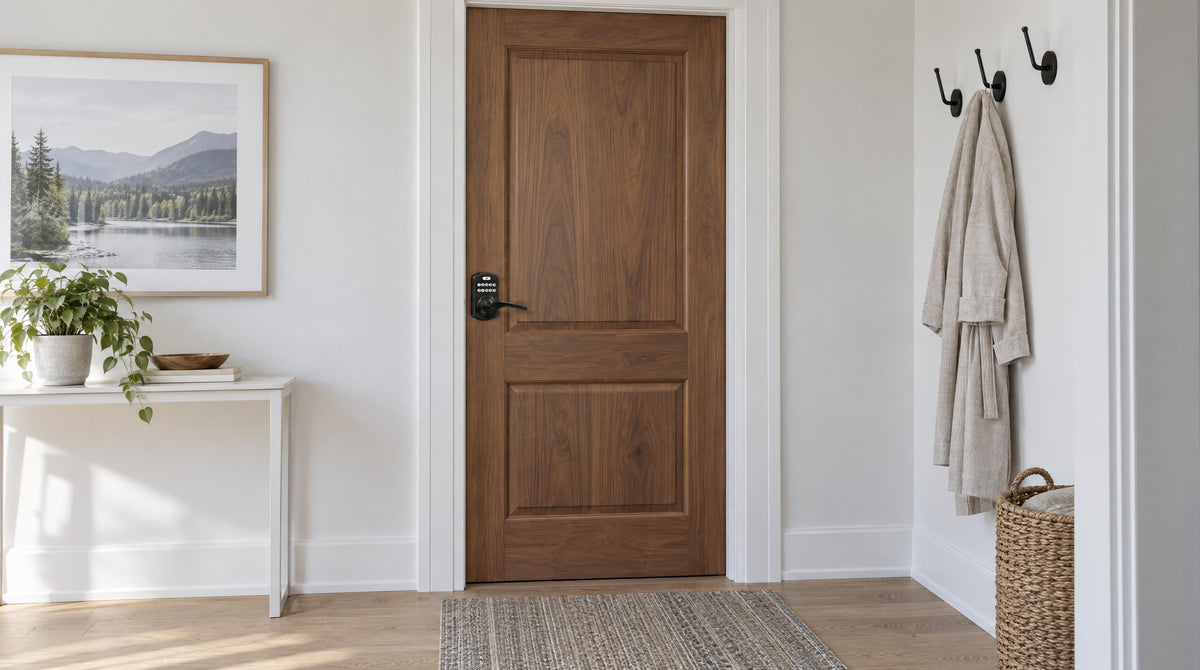
A bedroom door lock with a key sounds like a simple purchase — and in many ways it is. But walk into any hardware store or scroll through any product listing and you'll quickly find yourself choosing between knobs, levers, deadbolts, privacy locks, and smart locks, all described in near-identical language. The wrong choice isn't just a wasted $30; it's a lock that doesn't fit your door, doesn't suit your household, or solves the wrong problem entirely.
This guide cuts through the noise. Whether you're securing a master bedroom that stores valuables, managing a short-term rental property, or simply want more privacy in a shared home, the considerations below will help you choose the right bedroom door lock with key — and feel confident doing it.
Privacy Lock vs. Keyed Lock: Understanding the Real Difference
Before you shop for a bedroom door lock with key, it helps to understand why the keyed option exists as a distinct category. Most bedroom doors come standard with a privacy lock — a knob or lever that locks securely from the inside with a turn knob, no key involved, plus an emergency release on the outside that opens with a coin or screwdriver. That release is a deliberate safety feature: it prevents a child or an unwell family member from being locked in. Privacy locks are built for interior rooms where privacy matters; they are not built to control access from the hallway. A keyed bedroom lock, by contrast, requires a physical key to enter from outside, offering a meaningfully higher level of access control.
The key question — pun intended — is whether your bedroom situation calls for true access control or just privacy. For most family bedrooms, a quality privacy lock does the job well. But there are real scenarios where a keyed lock makes sense: a master bedroom that doubles as a home office with sensitive documents, a room in a short-term rental where you want to control which guests can access which areas, or a household where a teenager needs a proper lockable space. Once you've answered that question honestly, the rest of the decision gets much easier.
It's also worth noting that keyed interior locks introduce a key-management responsibility that privacy locks don't. You'll need to store a spare key somewhere accessible in case of accidental lockouts, and if the lock is ever rekeyed or changed, you'll need to distribute new copies. For Veise's Keyed Entry Door Knobs and Keyed Entry Door Levers, this isn't a dealbreaker — it's simply something to plan for. If key management feels like a burden, a keypad-based option (covered below) can give you the same access control without a physical key in the equation at all.
Types of Bedroom Door Locks With Keys
Understanding the available lock types helps you match hardware to your actual needs rather than defaulting to whatever ships fastest. Here are the main categories relevant to bedroom doors:
- Keyed Entry Door Knobs — The most familiar option. A round knob with a key cylinder on the outside and a turn button on the inside. Easy to use, widely available in multiple finishes, and a direct replacement for most standard bedroom hardware. Best for rooms where you want straightforward keyed access without changing the overall look of the door.
- Keyed Entry Door Levers — The same access control as a keyed knob, but with a lever handle instead of a round knob. Levers are easier to operate for children, older adults, or anyone carrying items — a push-down motion rather than a grip-and-turn. Increasingly preferred for modern home aesthetics.
-
Privacy Door Knobs and Levers — Not a keyed lock in the traditional sense, but included here because many buyers search for "bedroom door lock with key" when a privacy lock is actually what they need. Privacy Door Knobs and Privacy Door Levers lock from the inside with a turn knob and carry an emergency release on the outside that opens with a coin or screwdriver. They don't require key distribution, and the emergency release supports child safety — which is why they work well in the vast majority of family home scenarios.
- Keypad Latch Locks — An integrated handle-and-lock unit operated by keypad code or physical key backup. A practical, space-efficient option for doors where a full deadbolt setup isn't necessary but code-based access is preferred. They offer the convenience of keyless access while keeping a physical key available as a backup.
- Keyed Entry Handlesets — A combined keyed handle and deadbolt in one coordinated set, available as deadbolt + keyed lever or deadbolt + keyed knob. This gives interior or secondary doors both the everyday convenience of a handle and the added bolt security of a deadbolt. Useful when a bedroom door doubles as an entry point to a sensitive area of the home.
If you're weighing traditional keyed hardware against a keypad option, consider how often you'll need to grant or revoke access. Physical keys require cutting copies and collecting them back; a keypad code can be changed in seconds. For most households upgrading a single bedroom, both approaches work — the decision comes down to personal preference and how much you value keyless convenience.
Door Compatibility: Measure Before You Buy
One of the most preventable frustrations in a lock upgrade is buying hardware that doesn't fit the door. Interior doors have a few key measurements that determine compatibility, and taking two minutes to check them before you order will save you a return trip to the hardware store.
- Door thickness — Most interior doors fall between 1-3/8" and 1-3/4" thick. Veise locks are compatible with wood doors from 1-3/8" to 2". If your door is on the thinner or thicker end, confirm the lock's stated thickness range before purchasing.
- Bore hole diameter — The large hole drilled through the face of the door where the knob or lever mechanism sits. The standard size on most residential doors is 2-1/8" in diameter. Almost all modern locksets are designed around this dimension.
- Backset — The distance from the edge of the door to the center of the bore hole. Two standard backsets exist in North American homes: 2-3/8" (more common on interior doors) and 2-3/4" (more common on exterior doors). Many latch assemblies are adjustable to fit both, but it's worth confirming before you buy.
- Door material — This matters more than most buyers realize. Veise locks are engineered and tested for wood doors. They are not compatible with fiberglass, metal, storm, or sliding doors. If your bedroom door is wood — which the vast majority of interior residential doors are — you're in good shape.
If you're replacing existing hardware, measuring is straightforward: note the bore hole size and measure the backset with the old lock still in place. If you're installing on a door that has never had a lock, you'll need to drill both holes — a process that requires a hole saw kit and is covered in detail in most lock installation guides. For most homeowners replacing like-for-like hardware, the existing door prep will accommodate almost any standard lockset without modification.
Matching the Lock to Your Household
The right lock for a master bedroom in a single-family home is not necessarily the right lock for a room in a short-term rental. Here's how to think through common household situations:
Families With Children
When young children are in the home, the priority shifts from security to safety. Children can accidentally lock themselves in a room and panic, so an interior door that can be opened from outside — whether by the privacy lock's emergency release or by a key — matters. For a child's bedroom, a privacy knob or privacy lever with its emergency release is often the most sensible choice. For a master bedroom where parents want to keep valuables or medications secured, a keypad latch lock gives them control without introducing key-distribution complexity for the kids. If you want to be able to check who's been entering the master bedroom remotely — especially in a larger household — a smart lock with app-based access history is worth considering.
Shared Living and Rental Properties
For property owners managing a rental — whether a long-term rental room, a short-term vacation rental, or a property with multiple units — keyed bedroom locks serve a legitimate access-control purpose. The challenge with traditional keys is distribution: guests or tenants need copies, and collecting them at the end of a stay is not always reliable. A keypad-based lock solves this cleanly. You set a unique access code for each occupancy period, and when the stay ends, you change the code. No key retrieval, no rekeying fees. Veise's Keypad Latch Locks and Keypad Deadbolt Locks are well-suited to this use case — straightforward code-based access with a physical key backup for property managers.
Home Offices and Sensitive Storage
A bedroom that doubles as a home office — with a computer, confidential documents, or valuable equipment — is a real case for a keyed or keypad-secured lock rather than a basic privacy lock. The goal here is not just "do not disturb" signaling but genuine access control during working hours or when the room is unoccupied. A keypad lock is particularly convenient in this context because household members who are trusted can be given the code, while guests or service workers cannot enter unsupervised.
When a Keyed Lock Isn't Enough: The Smart Lock Upgrade
A physical key provides access control, but it doesn't give you visibility. You can lock a bedroom door with a key and never know whether someone entered while you were out. Smart locks change that equation. With a Wi-Fi or gateway-paired smart lock on a bedroom door, you can check the access log from your phone, receive notifications when the door is unlocked, and grant or revoke access remotely — all without being physically present.
For families with older children or households where a bedroom stores valuables, this visibility is genuinely useful. Veise's Wi-Fi Smart Locks connect directly to your home's Wi-Fi network, giving you remote access history and app-based control without requiring any additional hardware. Parents can monitor entry activity from anywhere and review who accessed the room and when — a practical feature that a traditional keyed lock simply can't offer. The locks also support Alexa and Google Assistant voice commands, and every model includes a physical key backup so you're never locked out if the power goes down.
If you prefer a setup that doesn't put the lock on your Wi-Fi network directly, Veise's Smart Locks w/ G1 and Smart Locks w/ G2 use a paired gateway that bridges the lock to your smartphone. The G1 line is built on a single product series (the VE017) and is an especially capable all-in-one option: every G1 model includes fingerprint recognition, USB-C emergency power backup, and multilingual voice prompts in English, Spanish, and French — making it a strong fit for multilingual households. Smart Lock w/ G2 supports Apple Watch unlock and a web portal for homeowners who want those specific features. Both lines include a physical key and key fob as standard backups, and even if your Internet connection goes down, app control continues to work locally as long as you're within short-range wireless distance.
Remote access always requires a smart lock — gateway-paired or Wi-Fi. An electronic keypad lock, even a quality one, does not support remote app control on its own. Keep that in mind if remote monitoring is a priority for your bedroom security setup.
Built on Kaadas Group's 38 years of lock industry expertise and 711 patents — the world's largest smart lock patent portfolio — Veise has sold 10M+ smart locks across 41+ countries and has been recognized by Frost & Sullivan as the global No.1 high-end smart lock brand by sales. Easy from Day One. Every lock in the lineup is designed with the Effortless Home Improvement™ Experience in mind: practical, family-ready hardware that installs in about 15 minutes with a screwdriver — no wiring, no locksmith, no special tools, and no subscription fees.
Installation: What to Expect
One of the most common hesitations around upgrading a bedroom lock is the assumption that it's complicated. For standard wood interior doors, replacing an existing knob or lever lock is genuinely a beginner-level DIY task. Every Veise lock ships with a step-by-step user manual and an installation video — follow those for the exact sequence on your model. Here's a general overview of what the process looks like:
- Remove the existing hardware — Unscrew and pull out the current knob, lever, or lock body from both sides of the door. The latch assembly on the door edge typically comes out with two screws.
- Insert the new latch — Slide the latch assembly into the edge hole, making sure the faceplate sits flush against the door edge. Align the screw holes, then secure the faceplate with the provided screws.
- Fit the exterior assembly, then the interior assembly — Feed the exterior side through the bore hole, keeping it parallel to the door edge, then align the interior assembly and mounting plate over the spindle and fasten with the through-bolts or mounting screws.
- Install or adjust the strike plate — Use the strike plate included with the lock; it should align cleanly with the latch bolt on the door frame. If you're replacing hardware in the same bore hole, the existing strike plate location often works without adjustment.
- Test the mechanism — Turn the knob or lever, engage the latch, and test the key (or keypad code) from both sides before closing the door for the first time.
Most Veise knob and lever locks install in about 15 minutes with a screwdriver — no wiring, no locksmith, and no special tools. Keypad and smart locks follow the same physical installation steps, with an additional five-minute setup for pairing the lock to an app or programming the first access code. If you're installing on a door that has never had hardware, you'll need to drill the bore hole and latch hole first, which adds time and requires a hole saw — in that case, having a helper to steady the door makes the job easier.
Finish, Style, and Matching Your Home's Hardware
Once you've settled on the right lock type and confirmed door compatibility, finish and style are the final consideration. A bedroom lock that clashes with the rest of the home's hardware creates a low-grade visual inconsistency that most homeowners notice every day. The good news is that most lock collections — including Veise's Mechanical Locks range — are available in coordinating finishes, so you can match a new bedroom lock to existing door hardware throughout the home.
Common finish options include matte black, satin nickel, and oil rubbed bronze. Matte black has become increasingly popular in modern and transitional interiors; satin nickel remains a versatile neutral for traditional and contemporary spaces alike, while oil rubbed bronze adds a warm, classic touch. If your home currently has a mix of finishes — which is common in older homes — picking a finish that coordinates with the dominant hardware in adjacent rooms (hallway, bathroom) will give the bedroom a more intentional look.
Beyond finish, consider the handle style in the context of the room's users. Levers are generally easier to operate than round knobs — particularly for young children, older adults, or anyone whose hands are frequently full. If accessibility is a consideration for any member of your household, a lever-style lock is almost always the better ergonomic choice. Veise offers coordinated Keyed Entry Door Levers, Privacy Door Levers, and Keyed Entry Handlesets across multiple finishes, so you can build a consistent look throughout the home without sacrificing function. You can browse the full lineup at iveise.com.
The Bottom Line
Choosing a bedroom door lock with key comes down to four honest questions: How much access control do you actually need? Does your door physically fit the lock you're considering? Who in your household will use this lock every day? And do you want visibility into who's coming and going, or is basic mechanical security enough? Work through those questions before you shop, and the right product becomes obvious rather than overwhelming.
For most homeowners, the upgrade from a basic privacy lock to a keyed entry knob, keyed lever, or keypad-based lock is a straightforward 15-minute project that delivers a meaningful improvement in household privacy and security. And if you want the added confidence of remote access history and app-based control, Veise's smart lock range offers that capability without the complexity or subscription fees you might expect. Easy from Day One.
Frequently Asked Questions
Can I put a keyed lock on an interior bedroom door?
Yes. Most standard interior bedroom doors use the same bore hole size (2-1/8") and backset dimensions as exterior doors, so a keyed knob or lever designed for interior use will typically fit without any modification. Always confirm your door's backset (2-3/8" or 2-3/4") and thickness (Veise supports 1-3/8" to 2") before purchasing.
What's the difference between a privacy lock and a keyed bedroom lock?
A privacy lock locks from the inside with a turn knob — no key needed — and carries an emergency release on the outside that opens with a coin or screwdriver, so nobody can be locked in accidentally. A keyed bedroom lock requires an actual key to enter from outside, which is what gives it access control. Privacy locks are suitable for most everyday bedroom use; keyed locks make sense when you need to restrict entry to specific people.
Do I need a deadbolt on a bedroom door?
For most interior bedrooms, a deadbolt is not necessary and can create inconvenience. A quality keyed knob, keyed lever, or keypad latch lock provides appropriate access control for a bedroom without the added complexity of a deadbolt. Deadbolts are typically the right primary lock for exterior entry doors where forced-entry resistance is the priority.
What is the easiest bedroom door lock to install?
A keyed entry door knob or lever that matches your existing bore hole size is the easiest install — it's a direct replacement that typically takes about 15 minutes with a screwdriver. Keypad locks follow the same installation steps with a brief code-setup step afterward. Smart locks add a short app-pairing process but do not require any wiring or professional installation on wood doors.
Can I use a smart lock on a bedroom door?
Yes. Smart locks are not limited to front doors. Installing a Wi-Fi or gateway-paired smart lock on a bedroom door gives you remote access history, app-based monitoring, and the ability to grant or revoke access codes without a physical key — useful for master bedrooms, home offices, or rooms in rental properties. Veise smart locks are compatible with standard wood interior doors in the 1-3/8" to 2" thickness range.
What door materials are compatible with Veise locks?
Veise locks are designed and tested for wood doors. They are not compatible with fiberglass, metal, storm, or sliding doors. Standard door thickness supported is 1-3/8" to 2", which covers the vast majority of residential interior bedroom doors.
What if my Wi-Fi goes down — will a smart lock still work?
Yes. Veise Wi-Fi smart locks and gateway-paired smart locks can still be operated via the app even when Wi-Fi is down, as long as you're within short-range wireless distance of the lock. Keypad codes, physical key, fingerprint (every Smart Lock w/ G1 and Wi-Fi model; many Smart Lock w/ G2), and key fob (every gateway-paired model and the VE027 series; not on VE012W series) all continue to function regardless of Internet connectivity.
Not Sure Which Lock Is Right for Your Bedroom?
Our team is happy to help you find the right fit — whether you need a simple keyed knob, a keypad option, or a fully connected smart lock. Built on 38 years of lock industry expertise and 711 patents — the world's largest smart lock patent portfolio — Veise makes it easy to upgrade your home hardware with confidence.
Contact Us


Leave a comment
This site is protected by hCaptcha and the hCaptcha Privacy Policy and Terms of Service apply.