
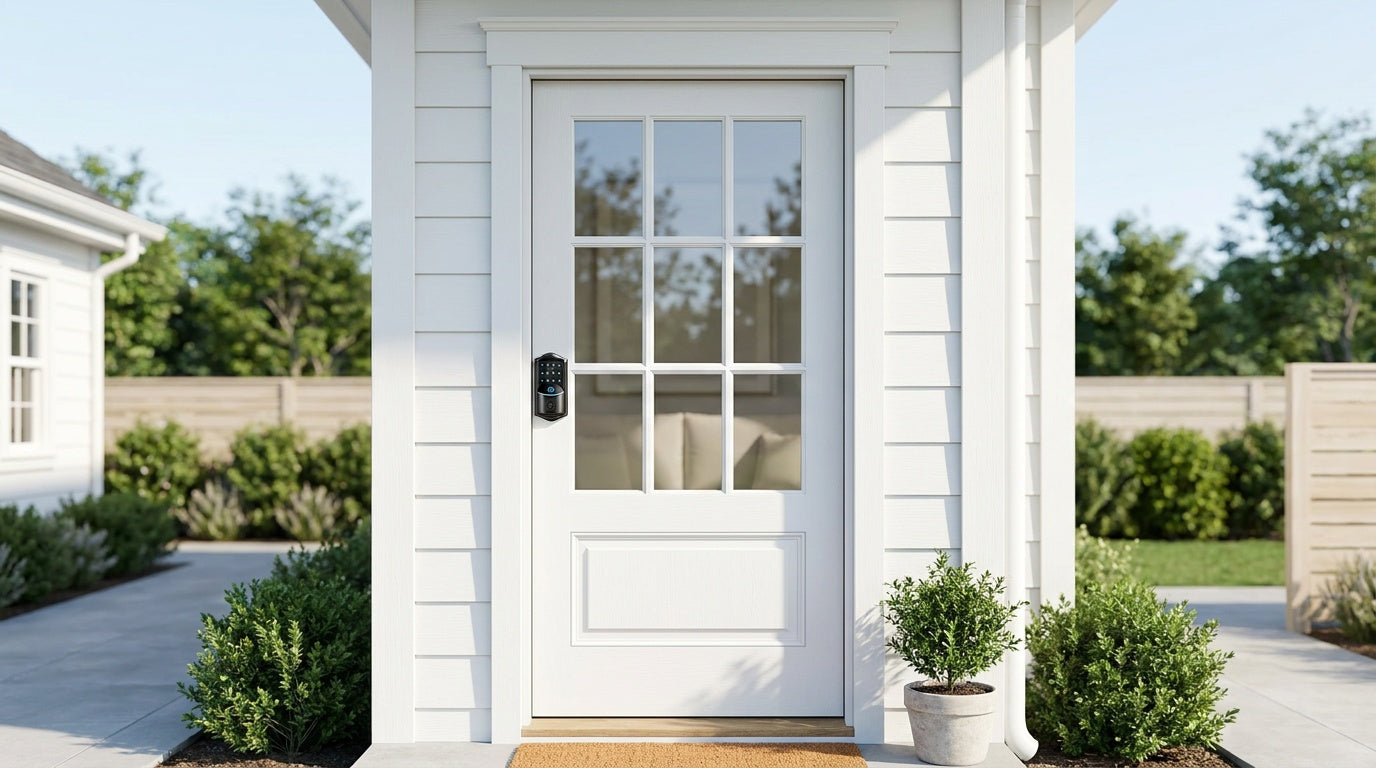
You press your finger to a small sensor on your front door and it unlocks in less than a second. No fumbling for keys, no trying to remember a code in the dark — just you, recognized instantly. That's the promise of a biometric door lock, and it's no longer a feature reserved for high-security office buildings or spy thrillers.
Biometric locks have become a practical, affordable option for everyday homeowners. But with new technology comes new questions: How do they actually work? What types are available? And are the downsides worth thinking about before you buy? This guide breaks it all down — from the core technology to the real-world pros and cons — so you can decide whether a biometric lock belongs on your door.
What Is a Biometric Door Lock?
A biometric door lock is an electronic lock that uses a unique physical characteristic — most commonly a fingerprint — to verify a person's identity and grant or deny access. The word "biometric" refers to biological measurements: traits that are specific to you and nearly impossible to replicate. Unlike a traditional lock that responds to a physical key, or a keypad lock that accepts a code anyone could share, a biometric lock ties entry directly to who you are.
For residential use, fingerprint recognition is by far the most common biometric method. When you enroll your fingerprint, the lock's onboard processor scans your finger multiple times, maps its unique ridge patterns, and stores that template locally on the device. The next time you press your finger to the sensor, the lock compares the live scan to its stored templates in a fraction of a second. If there's a match, the deadbolt retracts. If there isn't, it stays locked.
How Does a Biometric Door Lock Work?
The core of any fingerprint lock is a small capacitive or optical sensor paired with a dedicated processing chip. When you place your finger on the sensor, the chip captures a digital image of your fingerprint's ridge-and-valley pattern. This image is converted into a mathematical template — not a photograph — which is stored in encrypted memory inside the lock itself. No image of your fingerprint ever leaves the device, and no cloud account is required to make it work.
During enrollment, the lock typically captures the fingerprint from several angles and under varying pressure to build a robust template. On Veise fingerprint locks, enrollment captures the finger eight times, which means the lock recognizes your print reliably whether you press firmly or barely graze the sensor. Verification happens fast — under 0.3 seconds — which is quick enough that the door feels like it's simply responding to your presence rather than running a security check.
Most residential biometric locks also include backup entry methods. A keypad code, a physical key, a key fob, or app-based access can all serve as fallbacks if the fingerprint sensor encounters an issue, keeping you from ever being locked out of your own home.
Types of Biometric Door Locks
While fingerprint recognition dominates the residential market, biometric locks span several different identification technologies. Understanding the differences helps you choose the right fit for your home.
Fingerprint Locks
The most widely used type for homes. A fingerprint sensor reads the unique pattern of ridges on a fingertip and matches it against stored templates. Modern fingerprint locks are fast, reliable, and increasingly affordable. They work well for households where multiple people need access — parents, children, housekeepers, frequent guests — because each person can enroll their own fingerprint independently, and access can be revoked just as easily. Veise fingerprint locks store multiple unique fingerprints per device, with all data processed and held locally on the lock itself, so there's no cloud dependency and no privacy exposure.
Facial Recognition Locks
These locks use a camera and AI software to map the geometry of a face — the distance between eyes, the shape of the jaw, the contour of the nose — and compare it against enrolled profiles. Facial recognition locks are still relatively rare in the residential market and tend to sit at the higher end of the price spectrum. Performance can vary depending on lighting conditions, and some users have raised concerns about privacy given the amount of facial data being processed. They're more commonly found in commercial or high-security settings.
Iris Recognition Locks
Iris scanners analyze the intricate pattern of the colored ring around your pupil, which is unique to every individual. This technology is extremely accurate and difficult to spoof, but it requires the user to position their eye close to a scanner — which is practical in controlled environments but awkward for a front door. Residential iris locks exist but remain a niche product. Most homeowners will have no reason to consider them over a fingerprint lock.
Vein Pattern Locks
Vein recognition scans the pattern of blood vessels beneath the skin, typically in the palm or finger, using near-infrared light. Because veins are internal and invisible to the naked eye, this method is considered highly resistant to spoofing. It's used in medical facilities, data centers, and other high-security applications. For a residential front door, it's significant overkill — and the cost reflects that.
Voice Recognition Locks
Voice biometric systems analyze the acoustic characteristics of a person's voice — pitch, cadence, accent, and resonance — to confirm identity. Standalone voice recognition door locks are uncommon in home security, though voice control (telling a smart assistant to lock or unlock a door) is a related but distinct concept. True voice biometric verification for physical access remains largely a commercial or enterprise product.
Pros of Biometric Door Locks
For most homeowners, the appeal of a fingerprint lock comes down to a few practical benefits that stack up quickly in daily life.
- No keys to lose or copy. Your fingerprint can't be misplaced, left in a jacket pocket, or silently duplicated by a neighbor. Physical keys remain a common way homes get broken into — biometric locks remove that vulnerability entirely.
- Fast, hands-free-style entry. Carrying groceries, holding a baby, or coming home in the dark are all situations where a fingerprint unlock (under 0.3 seconds) is simply faster and less frustrating than any other method.
- Granular access control. You can enroll individual fingerprints for each family member, a pet sitter, or a contractor — and revoke a specific person's access without changing codes or collecting keys. Each person's print is independent.
- No code-sharing risk. Keypad codes get shared, borrowed, and forgotten. A fingerprint is inherently personal — it can't be forwarded in a text message or written on a sticky note.
- Local data storage means better privacy. On quality residential fingerprint locks, biometric data never leaves the device. There's no cloud account to breach, no subscription required to keep the feature active.
- Works alongside other unlock methods. The best biometric locks aren't fingerprint-only. A good lock gives you multiple ways to enter — fingerprint, keypad code, physical key, and app access — so you always have a path inside regardless of circumstances.
Cons of Biometric Door Locks
No technology is perfect, and biometric locks have real limitations worth considering before you buy.
- Sensor performance can vary with skin condition. Wet fingers, dry or cracked skin, cuts, or heavy calluses can affect read accuracy. This is a known issue with capacitive sensors and less pronounced with optical ones. It's rarely a dealbreaker but worth knowing, especially for those who work with their hands.
- Battery dependency. Unlike a purely mechanical lock, a biometric lock needs power to operate. If the battery dies, the fingerprint sensor won't function. Most quality locks include a physical key backup for exactly this reason, and some models add a USB emergency power port.
- Higher upfront cost than basic locks. A fingerprint lock costs more than a standard deadbolt. However, the gap has narrowed significantly — quality fingerprint locks are now available at accessible price points without sacrificing reliability.
- Requires proper installation. A biometric lock is still a full door lock that needs to be installed correctly to function securely. Improper installation can create gaps that undermine the lock's physical resistance, regardless of how good the sensor is. The good news is that most modern residential fingerprint locks are designed for DIY installation.
- Temperature and environmental exposure. Extreme cold or heat can affect battery life and, in some cases, sensor responsiveness. Locks installed on doors with heavy direct sun exposure or in very cold climates deserve extra consideration.
Fingerprint Locks from Veise: Practical Security Without the Complexity
Veise designs, engineers, and manufactures its own locks — not an OEM reseller passing off someone else's product with a new label. That vertical integration matters because it means Veise controls every part of the product, from the AI fingerprint chip to the lock cylinder to the firmware, and backs it with US-based support. The result is a lock that's built for real households, not for a spec sheet.
Fingerprint recognition is built into select models across two of Veise's main lock categories: the Keypad Deadbolt line and the Smart Lock lines. Here's how they break down in practice.
Keypad Deadbolt with Fingerprint
The Keypad Deadbolt line includes fingerprint-equipped models in the KS02 series. These locks support entry via fingerprint, keypad code, and physical key backup, and they're a strong fit for the front door of a home where remote access isn't a priority. All Veise locks are designed for wood doors (standard thickness 1-3/8" to 2"), install in about 15 minutes with a screwdriver, and require no wiring. They're ANSI/BHMA Grade 3 certified, which is the recognized standard for residential door security. Auto lock is configurable between 10 and 99 seconds, and fingerprints are captured eight times during enrollment for reliable recognition across angles and pressure.
Smart Lock w/ Gateway 1 — Full-Featured Fingerprint + Remote Access
For families who want to do more than just unlock with a fingerprint, the Smart Lock w/ G1 adds remote app control (via a paired gateway), key fob backup, multilingual voice prompts (English, Spanish, and French), and a USB-C emergency power port — all standard across the entire G1 line, which is built on a single product series. Voice control through Alexa or Google Assistant is supported when the gateway is in place, bridging the lock to your voice assistant. This line is a particularly good fit for multilingual households or anyone who wants the full connected experience with a first-party Veise-developed app.
Smart Lock w/ Gateway 2 — Apple Watch and Web Portal Access
The Smart Lock w/ G2 line shares the core connected features of G1 — keypad code, key fob, physical key, and remote app control — and adds Apple Watch unlock and web portal access, which are unique to this line. Smart Lock w/ G2 offers both fingerprint and non-fingerprint SKUs, as well as standalone and handle-set bundle form factors, making it the more versatile option for buyers with specific preferences on form or budget. Voice control via Alexa or Google Assistant is available with the gateway in place.
Wi-Fi Smart Lock — No Gateway Needed, Built-In Remote Access
The Wi-Fi Smart Lock line connects directly to your home's Wi-Fi, so there's no gateway to purchase or configure separately. Remote access, app control, and Alexa/Google voice commands work through the lock's built-in Wi-Fi connection. Even when Wi-Fi is down, app control continues to work locally as long as you're within short-range wireless distance of the lock. Fingerprint is included, and the line comes in two variants: the Touchscreen Wi-Fi Smart Lock (VE027 Series), which features a touchscreen interface and a USB-C emergency power port, and the Push-Button Wi-Fi Smart Lock (VE012W Series), which uses a traditional press-button keypad. Both series use an 8 AA battery design for stronger signal and a more stable connection compared to the standard 4 AA setup common in the category. For parents managing when kids arrive home or landlords handling a short-term rental property remotely, the Wi-Fi Smart Lock is the most seamless option in the Veise lineup.
Every Veise lock — from a basic keypad lock to the most connected Wi-Fi model — stores biometric data locally on the device, requires no subscription, and is priced between $30 and $180. Explore the full Veise product lineup to find the right fit for your door.
Frequently Asked Questions
Are biometric door locks safe?
Yes, when properly installed and maintained. Modern residential fingerprint locks use encrypted local storage, meaning your biometric data never leaves the lock. They're at least as secure as keypad locks and significantly harder to bypass than traditional keyed locks, which can be picked or have keys copied. The best locks also include physical key backups and anti-tamper alarms as additional safeguards.
What happens if the fingerprint sensor fails or the battery dies?
Quality biometric locks include backup entry methods precisely for this reason. Most support a physical key override, and some models also include a keypad code option or an emergency power port (USB-C on select Veise models like the VE017 and VE027 series) that lets you power the lock temporarily with an external battery. Always confirm your chosen lock has at least one reliable backup method before purchasing.
Can a biometric lock be fooled by a photograph or a copy of a fingerprint?
Not easily with a modern capacitive or optical sensor. High-quality sensors detect liveness cues (such as the slight electrical conductivity of a real finger) that a flat photograph or a simple mold can't replicate. Consumer-grade locks are not impervious to sophisticated spoofing attempts, but the effort required far exceeds what a typical burglar would attempt when much simpler entry methods are available.
How many people can be enrolled on a fingerprint lock?
It varies by model. Veise fingerprint locks store multiple unique fingerprints per device — enough for a typical household of any size. Each fingerprint is stored as a local encrypted template, not a photo, so there's no privacy risk and no Internet account required to manage them.
Do biometric locks work in cold weather?
Generally yes, though very cold temperatures can slow sensor response slightly and reduce battery life. If you live in a region with harsh winters, look for locks rated for outdoor temperature ranges and consider a model with the 8 AA battery design (like Veise Wi-Fi Smart Locks) for a more stable power reserve during cold months.
Do I need a subscription to use a biometric lock?
Not with Veise. All fingerprint features, local access logs, and standard lock functions work without any monthly fee. Remote access on gateway-paired or Wi-Fi smart locks also requires no subscription — just the lock (and a gateway, for gateway-paired models). No recurring costs, ever.
What door types are compatible with Veise biometric locks?
Veise locks are designed for wood doors with a standard thickness of 1-3/8" to 2". They are not compatible with fiberglass, metal, storm, or sliding doors. Veise locks are full replacements of your existing door hardware — not overlay systems — so installation requires ownership or authority to modify the door.
Biometric door locks have moved well past the novelty phase. Fingerprint recognition, in particular, has become a genuinely practical upgrade for the front door — faster than a key, more personal than a code, and accessible at price points that make sense for everyday homeowners. The cons are real (battery dependency, sensor sensitivity to skin condition, higher cost than basic locks) but manageable with the right lock design and proper backup methods in place.
Whether you want a straightforward fingerprint deadbolt or a fully connected smart lock that lets you monitor your home from anywhere, the key is matching the technology to how your household actually lives. That's exactly the lens Veise was built around: premium security that's simple enough for real people, affordable enough to make sense, and reliable enough to trust every single day.
Not sure which Veise lock is right for your door?
Our US-based support team is ready to help you find the perfect fit — no bots, no runarounds.
Contact Us

Leave a comment
This site is protected by hCaptcha and the hCaptcha Privacy Policy and Terms of Service apply.