
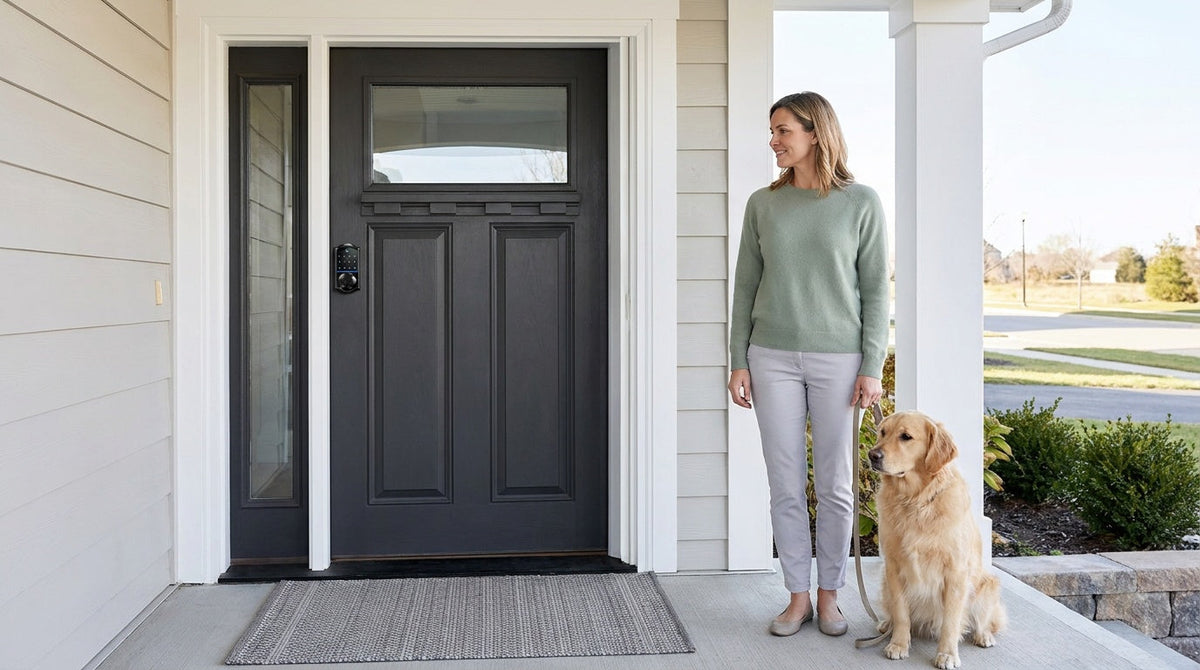
You probably walk past your front door deadbolt dozens of times a week without thinking twice about it. But that simple bolt sliding into the doorframe is quietly doing one of the most important jobs in your home: keeping your family safe while you sleep, run errands, or head out on vacation.
So what exactly is a deadbolt, how does it work, and why do security professionals consistently recommend it over other door locks? More importantly, how do you know which type is right for your exterior door — especially now that traditional keyed deadbolts share shelf space with fingerprint scanners and app-connected smart locks?
This guide answers all of that. We'll cover the mechanics of how a deadbolt works, break down every major type from single-cylinder to Wi-Fi smart locks, explain what ANSI certification actually means for a residential door, and walk you through what to look for when choosing or upgrading your deadbolt.
What Is a Deadbolt?
A deadbolt is a locking mechanism that uses a solid metal bolt to secure a door by extending it deep into the door frame or strike plate. Unlike the spring-latch found in most door knobs and lever handles, a deadbolt bolt is completely rigid — it does not move on its own and cannot be pushed back without manually operating the lock using a key, thumb-turn, or electronic input.
The word "dead" in deadbolt refers specifically to this non-spring nature. Because the bolt is mechanically inert until it is actively operated, it resists the fast, low-effort attacks that spring latches are vulnerable to. That single characteristic is why security professionals have recommended deadbolts for exterior doors for decades.
Deadbolts are most commonly installed on exterior entry doors — the front door, the back door, and side entries. They can also appear on interior doors where a higher level of security is needed, such as home offices or storage rooms. That said, exterior doors are where a deadbolt earns its keep, and they are the primary reason this type of lock exists.
How Does a Deadbolt Work?
At its core, a deadbolt works by driving a hardened metal bolt from the door's edge into a reinforced pocket in the door frame, called the strike plate. When the bolt is extended, the door cannot be pulled or pushed open regardless of how much force is applied to the door handle, because the bolt is physically blocking the door from swinging. The only way to retract the bolt — and open the door — is to operate the locking mechanism itself.
On a traditional keyed deadbolt, turning a key on the exterior rotates a cylinder, which in turn rotates a cam or drive bar that pushes the bolt in or out. On the interior side, a thumb-turn performs the same mechanical action without needing a key. On modern keypad and smart deadbolts, a small motor replaces the manual turning action — enter the correct code, press your finger on the sensor, or send a command from your phone, and the motor drives the bolt in the same direction.
The bolt itself typically extends at least one inch into the door frame. This depth matters enormously. A shallow bolt can tear through a wooden frame under a hard kick, while a deeper bolt distributes that force across more material, making a forced entry attempt significantly harder and louder — both deterrents in their own right.
The Main Parts of a Deadbolt
Understanding the key components of a deadbolt helps you evaluate quality and know what to look for when shopping. Most deadbolts share four core parts:
- The Bolt: The rectangular or cylindrical piece of hardened metal that extends from the lock body into the door frame. Quality bolts are made of steel and resist cutting or sawing.
- The Exterior Cylinder (Outer Trim): The keyed side of the lock, mounted on the outside of the door. On keypad and smart deadbolts, an electronic interface — a keypad, fingerprint reader, or touchscreen — is added alongside it, with the key cylinder retained as a backup.
- The Interior Thumb-Turn (Inner Trim): The interior-facing component, usually a simple rotating thumb-turn that lets you lock and unlock from inside without a key. Some double-cylinder models use a keyed cylinder here instead.
- The Strike Plate: A metal plate installed in the door frame that reinforces the pocket where the bolt sits. This is one of the most overlooked — and most important — parts of the system. A strike plate that isn't properly anchored can fail under a kick even if the lock itself is high quality. Always use the strike plate and screws that come with the lock — a mismatched aftermarket plate can cause the bolt to extend unevenly — and make sure they are secured into the door frame stud.
On electronic and smart deadbolts, you'll also find an internal motor, a circuit board, and a battery compartment. These components handle the electronic operation but sit behind the same bolt-and-cylinder framework described above. The physical security foundation does not change just because the lock is also connected to an app.
Deadbolt vs. Spring Latch: Why the Difference Matters
Most exterior doors come with two pieces of hardware already installed: a door knob or lever handle (which uses a spring latch) and a separate deadbolt above it. Many homeowners use the knob lock for quick trips and the deadbolt when they leave for extended periods — but it's worth understanding why that habit makes sense from a security standpoint.
A spring latch — the angled bolt in most door knobs and lever handles — is spring-loaded by design. That spring is exactly what lets the door click shut automatically when you close it. But the same spring can be worked against: a credit card, a stiff piece of plastic, or a professional shimming tool can press the angled face of the latch inward and retract it without a key. This technique, called loiding or shimming, is fast and requires no specialized skill. A deadbolt, with its straight-faced, rigid bolt, cannot be shimmed at all.
There is also the matter of depth. A spring latch typically extends only about half an inch into the door frame. A standard deadbolt extends at least one inch, sometimes more on higher-quality locks. Under a kick-in attempt, that extra depth translates into significantly more resistance. The combination of a keyed knob or lever and a separate deadbolt is the standard in residential construction for exactly this reason — a keyed knob or lever locks the door on its own, and the deadbolt adds the heavier-duty resistance to forced entry.
Types of Deadbolts: From Traditional to Smart
Deadbolts have evolved considerably over the past decade. The mechanical principles remain the same, but the way you operate them has expanded from a simple key to a full range of electronic and connected options. Here are the main types you'll encounter:
Single-Cylinder Deadbolt
The most common type found in American homes. A single-cylinder deadbolt is keyed on the exterior and uses a thumb-turn on the interior. It is straightforward to use, widely available, and appropriate for most standard residential exterior doors. The thumb-turn allows quick exit in an emergency — a meaningful safety consideration — while the keyed exterior prevents unauthorized entry.
Double-Cylinder Deadbolt
A double-cylinder deadbolt uses a keyed cylinder on both the interior and exterior sides of the door, removing the thumb-turn entirely. Because there is no thumb-turn that can be reached through a broken window or glass panel, this type offers an additional barrier in specific situations. However, the trade-off is real: in a fire or emergency, you need a key in hand to exit, which introduces a meaningful safety risk. Check your local building codes before installing a double-cylinder lock, as some jurisdictions restrict their use.
Keypad Deadbolt
A keypad deadbolt adds an electronic keypad alongside the exterior key cylinder. You enter a personal access code to retract the bolt, and the physical key slot is still there as a backup. Keypad deadbolts are a popular upgrade for families — no more fumbling for keys with grocery bags in hand, no more hiding a spare under the mat, and no risk of copying a lost key. Many models also support fingerprint access on select versions. Codes can be changed anytime, which is especially useful when sharing access with housekeepers, contractors, or guests. Explore Keypad Deadbolt Locks to see the range of options available.
Smart Deadbolt (Wi-Fi or Gateway-Paired)
Smart deadbolts take the keypad concept further by connecting the lock to your home network — either directly via built-in Wi-Fi or through a paired gateway device. This connection enables remote locking and unlocking from anywhere, access history logs, and integration with voice assistants like Alexa and Google Assistant. For families with kids, a smart lock means you can check from work whether the door was locked after school, and lock it remotely if it wasn't. Smart deadbolts still include a physical key backup and typically a keypad as well, so your family is never left outside even if a battery runs low.
Within the smart category, there are two primary connection approaches: Wi-Fi smart locks (which connect directly and require no extra hardware) and gateway-paired smart locks (which use a separate gateway device to bridge the lock to your network). Each has practical advantages depending on your setup. Browse Wi-Fi Smart Locks and Smart Locks w/ G1 or Smart Locks w/ G2 to compare both approaches.
Vertical Deadbolt
Instead of extending horizontally, a vertical deadbolt drops two bolts downward into interlocking rings on the door frame. This orientation makes the lock substantially harder to pry open with a crowbar, because the force of prying works against the bolt's own geometry. Vertical deadbolts are more common in high-security commercial applications, though they are available for residential use as well.
What ANSI/BHMA Grades Mean for Residential Deadbolts
When you shop for a deadbolt, you'll frequently see references to ANSI/BHMA grades — typically Grade 1, Grade 2, or Grade 3. These grades come from the American National Standards Institute (ANSI) and the Builders Hardware Manufacturers Association (BHMA), who jointly develop testing standards for door hardware. Each grade reflects performance benchmarks for strength, durability, and cycle life — meaning how many times a lock can be operated before it degrades.
Grade 1 is the highest rating and is engineered for commercial and high-traffic environments: building lobbies, institutional corridors, and commercial spaces with constant daily use. Grade 2 sits in the middle and is often specified for light commercial settings and higher-traffic residential entries. Grade 3 is the recognized residential standard — it is the grade most commonly certified for consumer deadbolts, keypad locks, and smart locks sold through retail channels. A Grade 3 lock has passed independent laboratory testing and earned a certification. It is the appropriate benchmark for standard single-family home exterior doors.
The important point here is that higher grades are not automatically better for a residential context — they are calibrated for the heavier cycle demands of commercial settings. For your front door or back door, ANSI/BHMA Grade 3 certification means the lock has met the residential performance standard it was designed for. Look for the BHMA Certified Secure Home label on packaging to confirm a lock has been independently tested, not just marketed with grade language.
Installation: What to Know Before You Buy
One of the practical advantages of a standard deadbolt — mechanical or electronic — is how straightforward the installation is. Most residential deadbolts are designed to fit the same pre-drilled hole pattern on standard wood doors: a 2-1/8-inch bore hole in the face of the door and a 1-inch edge bore for the bolt. If your door already has a deadbolt, you're almost certainly looking at a direct swap with no drilling required.
The process typically takes about 15 minutes with a screwdriver, with no wiring involved. Battery-powered keypad and smart deadbolts are particularly accessible for homeowners who want to upgrade without hiring a professional — there are no electrical connections to make. Because this is a full lock replacement (not an adapter that attaches to an existing lock), it requires ownership or authority to modify the door hardware.
A few things to keep in mind before purchasing:
- Door material: Standard residential deadbolts are designed for wood doors. They are not compatible with fiberglass, metal, storm, or sliding doors, so confirm your door type before ordering.
- Door thickness: Most deadbolts accommodate doors between 1-3/8 inches and 2 inches thick — the standard range for exterior wood doors. Check the spec sheet if your door is unusual.
- Strike plate: This is the most commonly skipped step. Install the strike plate and screws supplied with the lock rather than an aftermarket substitute, and make sure they are secured into the door frame stud. An unanchored strike plate is a common reason a properly locked door fails under a kick.
- Backset: This is the distance from the edge of the door to the center of the bore hole, typically 2-3/8 inches or 2-3/4 inches. Most modern deadbolts are adjustable to fit both, but confirm before buying.
How to Choose the Right Deadbolt for Your Home
The "right" deadbolt depends on how you use the door, who needs access, and how much convenience matters to your household. Here is a practical framework for thinking through the choice:
If you want simple, reliable security with no batteries: A traditional single-cylinder mechanical deadbolt does the job well and requires zero maintenance beyond re-keying if you lose a key. Veise's Mechanical Locks lineup covers this, including the standalone Deadbolt Lock and the Keyed Entry Handleset bundle (deadbolt plus a keyed lever or keyed knob).
If you want keyless convenience without app connectivity: A keypad deadbolt gives you personal access codes for every household member, eliminates the need to carry or hide keys, and still includes a physical key backup. It's a meaningful upgrade in usability without any network requirements. Fingerprint-enabled models add sub-second biometric access on top of the keypad.
If you want remote access and activity monitoring: Remote access requires a smart lock — either gateway-paired or Wi-Fi. A gateway-paired smart lock connects to your network through a separate bridge device and supports remote app control, voice assistant integration, and access logs. A Wi-Fi smart lock has the connection built in and needs no additional hardware. For households with children, both options let you verify from anywhere that the door is locked and review who came and went. Remote locking and off-site alerts require an active Internet connection, but if Wi-Fi is down, app control continues to work locally as long as you're within short-range wireless distance of the lock.
If you're managing a short-term rental or vacation property: A Wi-Fi smart lock or gateway-paired smart lock is the practical choice. You can issue and revoke access codes remotely, monitor entry history, and never worry about guests forgetting to lock up when they check out.
Upgrading Your Deadbolt: The Veise Lineup
Veise was built on one belief: technology should simplify life, not complicate it. That philosophy runs through every lock in the lineup, starting with a foundation of 38 years of lock industry expertise from parent company Kaadas Group and 711 patents — the world's largest smart lock patent portfolio. The result is a range of deadbolts designed for real families, priced in the $30–$180 range, and built to install in about 15 minutes with a screwdriver. Every Veise deadbolt is single cylinder — keyed outside, thumb-turn inside — so quick exit is never blocked by a missing key. Easy from Day One.
Because Veise operates its own factory — not an OEM reseller model — every lock is engineered and quality-controlled in-house from the ground up. That vertical integration means tighter tolerances, consistent build quality, and direct accountability. Kaadas Group has sold 10M+ smart locks across 41+ countries and has been recognized by Frost & Sullivan as the global No.1 high-end smart lock brand by sales. Every Veise lock is ANSI/BHMA Grade 3 certified — the recognized residential standard — and designed for standard wood exterior doors.
Here is a quick overview of the Veise deadbolt categories to help you match the right option to your door:
Keypad Deadbolt Locks
Veise Keypad Deadbolt Locks are the workhorse upgrade for homeowners who want to eliminate physical keys without adding network complexity. All models support keypad code entry and include a physical key backup. The KS02 series adds a fingerprint reader — every KS02 SKU has one — and the AI chip scans in under 0.3 seconds, storing fingerprints on the device itself (no cloud, no Internet account). The non-fingerprint RZ and KS01 series are available as standalone deadbolts or as handleset bundles that include a matching lever or knob. Every model includes auto lock, configurable between 10 and 99 seconds on this category. For households that want bundle convenience — a matched handle and deadbolt in one package — explore the Keyed Entry Handleset options.
Smart Lock w/ Gateway 1/2
For remote access and app control, Veise offers two gateway-paired smart lock lines. Smart Locks w/ G1 is built on a single product series — the VE017 — which means every unit in the line ships with multilingual voice prompts (English, Spanish, and French), a USB-C emergency power port, and fingerprint access as standard features. It pairs with a Veise-developed first-party app, making it the most integrated all-in-one option in the lineup. Smart Locks w/ G2 adds Apple Watch unlock and web portal control, and offers both fingerprint and non-fingerprint SKUs in standalone or handle-set form factors — a good fit when those specific features drive the decision. Both lines support keypad code, key fob, physical key backup, and remote app control via the paired gateway — which is a separate device, sold separately, and should be plugged in within range of the lock rather than next to your router. Fingerprint coverage differs: every Smart Lock w/ G1 includes it, while Smart Lock w/ G2 offers both fingerprint and non-fingerprint SKUs. Browse Smart Locks w/ G1 and Smart Locks w/ G2 to compare the two lines.
Wi-Fi Smart Locks
Veise Wi-Fi Smart Locks connect directly to your home's Wi-Fi network with no gateway required. There are two series: the Touchscreen Wi-Fi Smart Lock (VE027 Series), which features a touchscreen interface and a USB-C emergency power port on every unit, and the Push-Button Wi-Fi Smart Lock (VE012W Series), which uses a traditional press-button keypad. The two series share Wi-Fi connectivity, fingerprint access, keypad code entry, remote app control, and Alexa and Google Assistant voice control via built-in Wi-Fi. They differ in four concrete ways: interface (touchscreen vs. press-button), USB-C emergency power (VE027 series only), key fob support (VE027 series only), and on-device multilingual voice prompts in English, Spanish, and French (VE027 series only — the VE012W series has no on-device voice prompts, though it still supports Alexa and Google voice control). Both also use an 8 AA/LR6 alkaline battery design instead of the more common 4 AA setup, which delivers a stronger signal and a more reliable power reserve. Physical key backup is included on all models. That's the Effortless Home Entry™ in practice: a code, a fingerprint, or a voice command, with the key still in your pocket if you want it.
For a complete view of the lineup, visit the All Products page.
Final Thoughts
A deadbolt is one of the most practical investments you can make in your home's security. The mechanical principle is simple — a rigid bolt that can only be moved by actively operating the lock — but that simplicity is exactly what makes it effective. It resists the fast, low-effort attacks that spring latches are vulnerable to, and it puts a meaningful physical barrier between your family and a forced entry attempt.
Whether you choose a traditional single-cylinder lock, a keypad deadbolt that takes the key out of your daily routine, or a Wi-Fi smart lock that lets you monitor access from the other side of the country, the foundation is the same: a solid bolt, a reinforced strike plate, and proper installation. Get those three things right and your exterior door becomes substantially harder to defeat quickly — and that's the point.
If you're ready to upgrade, start with your door's biggest vulnerability and work from there. Even a straightforward swap to a quality keypad deadbolt takes about 15 minutes and makes an immediate difference in daily convenience and security confidence.
Frequently Asked Questions
What is the difference between a deadbolt and a regular door lock?
A regular door lock (door knob or lever) uses a spring-loaded latch that automatically extends when the door closes and can be retracted by turning the handle — or in some cases by shimming it with a flat tool. A deadbolt uses a rigid bolt that does not spring and can only be moved by deliberately operating the lock with a key, thumb-turn, keypad code, or electronic command. This makes deadbolts substantially more resistant to forced or manipulated entry on exterior doors.
Do I need a deadbolt if I already have a door knob lock?
Yes, for exterior doors. A keyed door knob or lever is itself a lock — it secures the door on its own — but its spring latch can be shimmed, so it offers less resistance to forced entry than a deadbolt does. Adding a deadbolt strengthens that resistance considerably, because the rigid bolt can't be shimmed and seats deeper into the frame. The two typically work together: the knob or lever covers daily access, and the deadbolt is the heavier-duty security layer when you leave or go to bed.
What does ANSI/BHMA Grade 3 mean for a deadbolt?
Grade 3 is the recognized residential performance standard under the ANSI/BHMA grading system. A Grade 3 lock has passed independent laboratory testing for strength, durability, and cycle life at the thresholds appropriate for residential use. It is the grade most commonly certified for consumer deadbolts and smart locks sold through retail channels. Grades 1 and 2 are calibrated for the higher cycle demands of commercial and institutional settings, not a higher quality tier for home use.
Can I install a deadbolt myself?
In most cases, yes. Standard residential deadbolts — including keypad and smart models — are designed to fit the pre-drilled hole pattern on wood doors and install in about 15 minutes with a screwdriver and no wiring. You'll need to confirm the door bore size and backset before purchasing, and you should always install the strike plate with screws long enough to reach the structural framing of the door jamb. Because installation requires modifying the door hardware, you need to be the property owner or have the authority to make that change.
What types of doors are compatible with a standard deadbolt?
Standard residential deadbolts are designed for wood doors with a thickness between 1-3/8 inches and 2 inches. They are not compatible with fiberglass, metal, storm, or sliding doors, which require specific hardware designed for those materials. Always check the product specifications for door type and thickness compatibility before purchasing.
What is a keypad deadbolt and how is it different from a smart lock?
A keypad deadbolt adds a number pad alongside the exterior key cylinder — you enter a code to unlock instead of inserting a key, and the physical key backup stays on the lock, included on all models. It operates entirely stand-alone, with no app, no Wi-Fi, and no network required. A smart lock adds a wireless connection (via a paired gateway or built-in Wi-Fi) that enables remote access from anywhere, mobile app control, voice assistant integration, and entry history logs. Both types use the same deadbolt mechanism underneath; the difference is in how the bolt is controlled and what information you can access remotely.
Is a keypad deadbolt as secure as a keyed deadbolt?
Yes, the physical security of the bolt mechanism is the same. The bolt, the strike plate, and the door frame resistance are identical. Where keypad deadbolts differ is in how access is granted — via a code rather than a physical key. A code that is too short, too obvious, or never changed can be a vulnerability, just as a copied or lost key can be a vulnerability on a traditional lock. Veise keypads accept codes of 4 to 10 digits, and the lock automatically pauses for 3 minutes after 10 wrong attempts. Use a longer code, change it periodically, and issue separate codes to different family members or guests so you can manage access appropriately.
Ready to Upgrade Your Deadbolt?
Whether you're replacing an aging keyed lock or stepping up to a smart deadbolt, Veise makes the upgrade simple. Browse the full lineup — from straightforward keypad deadbolts to app-connected smart locks — and find the right fit for your door, your family, and your budget.
- Keypad Deadbolt Locks — keyless entry, no network needed
- Wi-Fi Smart Locks — remote access, no gateway required
- Smart Locks w/ G1 — multilingual, fingerprint, USB-C standard
- Smart Locks w/ G2 — Apple Watch unlock, web portal control
- Mechanical Deadbolt Locks — browse the complete deadbolt selection
Have questions about which lock fits your door? Contact Us — the Veise team is here to help.

Leave a comment
This site is protected by hCaptcha and the hCaptcha Privacy Policy and Terms of Service apply.