
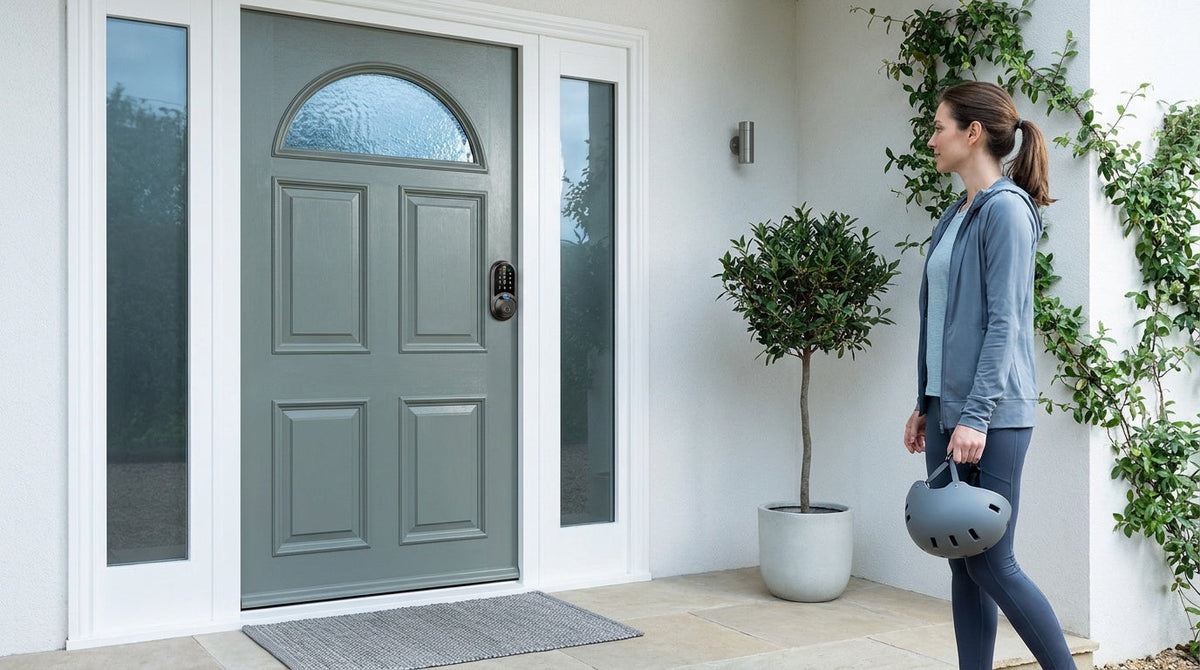
Walk into any home improvement store — or open any lock product page — and you'll face a wall of options: single cylinder, double cylinder, keypad, smart, Wi-Fi, fingerprint, gateway. Each type promises security, but they solve very different problems. Pick the wrong one and you're either overpaying for features you'll never use, or you've got a lock that falls short when it actually matters.
This guide cuts through the confusion. Whether you're a first-time homeowner replacing a builder-grade deadbolt, a parent who wants to know when the kids get home, or someone managing a short-term rental property, there is a deadbolt type built for your situation. We'll cover how each type of deadbolt works, who it's right for, what the trade-offs are, and how they compare side by side — so you can make one confident decision and move on.
What Is a Deadbolt Lock?
A deadbolt is a lock that uses a solid steel bolt — one that moves only when deliberately operated, not from spring pressure alone. Unlike a spring latch (the kind built into most door knobs and levers), a deadbolt cannot be slipped open with a credit card or pushed back with force. To move the bolt, you need a key, a thumb turn, a code, a fingerprint, or a remote command — depending on the type you choose. That mechanical resistance is what makes deadbolts the go-to choice for exterior door security on homes everywhere.
The term "deadbolt" covers a wider family than most people realize. At one end, you have purely mechanical single and double cylinder locks that have been around for over a century. At the other end, you have app-connected smart locks that let you lock your door from across the country. Understanding the differences between these types is the first step to choosing the one that actually fits your home and your life.
Single Cylinder Deadbolt: The Everyday Standard
The single cylinder deadbolt is the most widely installed deadbolt type in residential homes, and for good reason. The mechanism is straightforward: a keyhole on the exterior side of the door lets you lock and unlock with a physical key, while a thumb turn on the interior side lets anyone inside open the door immediately — no key needed. That thumb turn is what makes this type so practical for everyday use. In an emergency, you can exit your home in a single motion without hunting for a key.
Single cylinder deadbolts are typically the most affordable option in the deadbolt category, and they install cleanly into the standard 2-1/8" cylindrical prep found on most residential wood doors. They work well as the primary security layer on any exterior door that doesn't have glass panels immediately adjacent to the lock. One meaningful limitation: because the interior side only requires a thumb turn, an intruder who breaks a nearby window and reaches inside can unlock the door without a key. For doors without glass within arm's reach, this is rarely a concern — but it's worth noting for specific door configurations.
For most homes and most exterior doors, a quality single cylinder deadbolt paired with a solid strike plate and reinforced door frame is a reliable, cost-effective security solution. If you're looking to build on top of that mechanical foundation with keyless entry, the keypad deadbolt and smart lock options below pick up right where the single cylinder leaves off.
Single Cylinder Deadbolt: Quick Summary
- How it works: Key from outside, thumb turn from inside
- Best for: Standard exterior doors without adjacent glass panels
- Main advantage: Simple, reliable, fast emergency exit
- Main limitation: Thumb turn accessible if glass is within arm's reach of the lock
Double Cylinder Deadbolt: Extra Security, Extra Caution
A double cylinder deadbolt requires a physical key to operate from both the exterior and the interior side of the door. There is no thumb turn. This design specifically addresses one weakness of the single cylinder: a glass panel or sidelight near the lock. If a would-be intruder breaks the glass and reaches inside, the lack of a thumb turn means they still can't unlock the door without a key. For doors with large glass panels or decorative sidelites positioned within arm's reach of the lock hardware, a double cylinder is a logical response to that specific threat.
The trade-off is significant, however, and worth understanding clearly before installing one. In a fire, a home invasion, or any emergency requiring fast exit, every occupant inside must locate and use a key to get out. That delay can be dangerous — especially for children, elderly occupants, or anyone disoriented by smoke. This is precisely why building and fire codes in many jurisdictions restrict or prohibit double cylinder deadbolts on primary egress doors. The International Residential Code (IRC) states that egress doors in 1- and 2-family dwellings must be openable from inside without the use of a key, which effectively prohibits double cylinder deadbolts in those applications in jurisdictions that follow the IRC without amendments. Always check your local building and fire codes before installing one.
Double Cylinder Deadbolt: Quick Summary
- How it works: Key required on both exterior and interior sides
- Best for: Doors with glass panels where reaching the interior is a specific concern
- Main advantage: Eliminates the thumb-turn vulnerability near glass
- Main limitation: Slower emergency exit; restricted or prohibited by code in many jurisdictions — always verify local rules before installing
Keypad Deadbolt: Keyless Convenience Without Connectivity
A keypad deadbolt offers the same solid bolt-strength security as a mechanical single cylinder deadbolt, with one meaningful upgrade: you enter a PIN code instead of using a physical key. There's no app to set up, no Wi-Fi required, and no subscription to manage. You program your codes directly at the lock, and that's it. For households that want to stop carrying keys — or stop hiding spare keys under a mat — a keypad deadbolt is often the most practical and affordable step forward.
Keypad deadbolts are particularly useful for families with kids who regularly lose keys, homeowners who frequently share access with house sitters or contractors, and anyone who wants the simplicity of a code without the complexity of a connected system. All Veise keypad deadbolts include a physical key backup on every model, so you're never locked out if a battery runs low. The primary split in the Veise keypad deadbolt lineup is between models with fingerprint (the KS02 series) and those without (the RZ and KS01 series). On fingerprint-enabled models, a biometric scan recognizes your finger in under 0.3 seconds — faster than digging for a key and more convenient than punching in a code when your hands are full of groceries. Fingerprints are processed and stored on the lock itself, with no cloud account and no data leaving the device.
One important distinction: a keypad deadbolt operates entirely offline. It does not support remote app control, and it cannot be upgraded to remote access by pairing it with a separate gateway. If being able to check your lock status from across town or receive entry notifications on your phone is important to you, that points toward one of the smart lock categories covered next. For households that simply want reliable, subscription-free keyless entry, a keypad deadbolt handles the job cleanly, sitting at the accessible end of Veise's $30–$180 lineup.
Keypad Deadbolt: Quick Summary
- How it works: PIN code entry; physical key backup on all models; fingerprint on select models
- Best for: Households wanting keyless entry without connectivity or ongoing subscriptions
- Main advantage: Simple, fully offline, no subscription, easy to share codes
- Main limitation: No remote access; cannot be paired with a gateway to add connectivity
Smart Locks: Remote Access and Full Home Integration
Smart locks start where keypad deadbolts leave off. These locks connect to your home network and let you manage access from anywhere with an active Internet connection. Check the lock status while you're at work, receive a notification the moment your kids get home from school, issue a time-limited code to a contractor without being present, or lock up after a short-term rental checkout — all from your phone. That shift from local to remote control is what separates smart locks from every other type in this guide.
Smart locks come in two connectivity architectures worth understanding. A Smart Lock w/ Gateway 1/2 is a physical lock that pairs with a small gateway device — a separate product, sold separately — plugged in within wireless range of the lock and connected to your home network. (Placing it next to the router instead of near the door is the most common cause of "lock offline" problems.) The gateway bridges the lock to the Internet while keeping the lock hardware itself lean and battery-efficient. Veise's Smart Locks w/ G1 and Smart Locks w/ G2 both follow this model, with all models supporting keypad code, key fob, physical key, and remote app control via the paired gateway. Fingerprint coverage differs by line: every Smart Lock w/ G1 includes it, while Smart Lock w/ G2 offers both fingerprint and non-fingerprint SKUs. A Wi-Fi Smart Lock, by contrast, connects directly to your home network with no separate gateway needed. Veise's Wi-Fi Smart Lock lineup includes both a Touchscreen model (VE027 series) and a Push-Button model (VE012W series), both supporting fingerprint, keypad code, app control, and voice commands via Alexa and Google Assistant through the lock's built-in Wi-Fi.
One point worth stating plainly, because it causes genuine confusion: remote access requires a smart lock — either gateway-paired or a Wi-Fi model. A standard keypad deadbolt, no matter how well-featured, cannot be upgraded to remote access by adding a separate gateway. The lock itself must be built for it. If remote monitoring and app control matter to your situation, that requirement shapes which lock category you're shopping in before you evaluate any other feature. For families with children, a Wi-Fi smart lock or a gateway-paired smart lock is a particularly good fit — parents can review entry history and monitor lock activity from anywhere, without needing to call the kids to confirm they made it home.
Smart Locks: Quick Summary
- How it works: Keypad code + app control; physical key backup on all models; key fob on all Smart Lock w/ Gateway 1/2 and on the VE027 Wi-Fi series (not VE012W series); fingerprint on all Smart Lock w/ G1 and all Wi-Fi models, and on many Smart Lock w/ G2; voice assistant support
- Best for: Parents, property managers, frequent travelers, and anyone who needs remote visibility into their home's entry
- Main advantage: Remote lock/unlock, real-time entry notifications, temporary access codes, smart home integration
- Main limitation: Requires Wi-Fi or a gateway; higher price point than keypad-only models
Side-by-Side Comparison: Which Deadbolt Type Is Right for You?
The four deadbolt types are built for genuinely different situations. Here's how they stack up across the features that matter most for a residential door:
| Feature | Single Cylinder | Double Cylinder | Keypad Deadbolt | Smart Locks |
|---|---|---|---|---|
| Physical key required | Yes (outside only) | Yes (both sides) | Backup only | Backup only |
| PIN code entry | ✗ | ✗ | ✓ | ✓ |
| Fingerprint unlock | ✗ | ✗ | Select models | Most models |
| Remote app control | ✗ | ✗ | ✗ | ✓ |
| Entry history / alerts | ✗ | ✗ | ✗ | ✓ |
| Works without Wi-Fi | ✓ | ✓ | ✓ (fully offline) | ✓ locally; remote features need Internet |
| Voice assistant support | ✗ | ✗ | ✗ | ✓ (Wi-Fi direct; gateway-paired via gateway) |
| Subscription required | No | No | No | No (with Veise) |
| Typical price range (industry-wide, not Veise pricing) | $15–$60 | $20–$80 | $30–$180 | $80–$300+ |
How to Choose the Right Deadbolt for Your Home
The right deadbolt type depends less on any single feature and more on how your household actually lives. These decision points help narrow it down quickly:
- If your door has no glass near the lock and you want zero maintenance: A single cylinder deadbolt is a dependable, no-fuss choice. No batteries, no setup, no app — just a key and a bolt.
- If your door has a glass panel or sidelight within arm's reach of the lock: A keypad deadbolt solves the reach-through vulnerability without creating an emergency egress risk. A double cylinder is an option for specific applications, but always verify your local building codes first.
- If you want to stop carrying keys and share codes easily: A keypad deadbolt handles this well and stays fully offline. A physical key backup is still included on every Veise model, so you're covered if the battery runs low.
- If you're a parent and want to know when your kids get home: A Wi-Fi smart lock or gateway-paired smart lock lets you receive entry notifications and review activity from anywhere — remote monitoring requires a smart lock, not a keypad-only model.
- If you manage a short-term rental or vacation property: A Wi-Fi smart lock or Smart Lock w/ G1 lets you issue and revoke access codes remotely, confirm check-ins, and verify the property is locked after checkout — without needing to be on site.
- If you travel frequently and want peace of mind: A smart lock's remote access means you can check the lock status and lock up from anywhere, even if you left in a hurry. That reassurance alone is worth the upgrade for many homeowners.
The Veise Deadbolt Lineup
Veise was built on one belief: technology should simplify life, not become another burden. Backed by Kaadas Group's 38 years of lock industry expertise, 711 patents (the world's largest smart lock patent portfolio), and recognition by Frost & Sullivan as the global No.1 high-end smart lock brand by sales, Veise designs locks that install in 15 minutes with a screwdriver, no wiring, no professional help required — and no subscription fees. All features come included at purchase. The lineup covers every deadbolt type covered in this guide:
- Keypad Deadbolt Locks: Fully offline, keypad code entry with physical key backup on all models. The KS02 series adds fingerprint recognition — every KS02 SKU includes it — scanning in under 0.3 seconds, with biometric data stored entirely on the lock, no cloud dependency. Models without fingerprint (RZ and KS01 series) are available as standalone deadbolts or handleset bundles with a lever or knob.
- Keypad Latch Locks: An integrated handle-and-lock unit that works on interior doors, side doors, garage entries, and office doors. Keypad code and physical key only — simple, affordable, and fast to install. Available in knob-top (KS03) or lever-top (KS04).
- Smart Locks w/ G1: Smart Lock with Gateway 1. The entire G1 line is one series — the VE017 — and every model ships with fingerprint, multilingual voice prompts (English, Spanish, and French), and a USB-C emergency power port as standard across the whole series. Pairs with a Veise-developed first-party app. All models include keypad code, key fob, physical key, and remote app control via the paired gateway.
- Smart Locks w/ G2: Smart Lock with Gateway 2. Offers more SKU variety, including both fingerprint and non-fingerprint options in standalone or handle-set bundle form factors. Unique to G2 line: Apple Watch unlock and web portal control. English voice prompts only.
- Wi-Fi Smart Locks: Connects directly to your home network — no separate gateway required. Two series: the Touchscreen Wi-Fi Smart Lock (VE027 series) and the Push-Button Wi-Fi Smart Lock (VE012W series). Both include fingerprint, keypad code, app control, physical key backup, and Alexa and Google Assistant voice control via built-in Wi-Fi. They differ in four ways: interface (touchscreen vs. press-button), USB-C emergency power (VE027 series only), key fob support (VE027 series only), and on-device multilingual voice prompts in English, Spanish, and French (VE027 series only). The VE027 and VE012W series share an 8 AA/LR6 alkaline battery design for a stronger signal and more stable connection compared to the standard 4 AA setup.
All Veise locks are designed for standard wood doors (1-3/8" to 2" thickness), are ANSI/BHMA Grade 3 certified — the right residential benchmark — and include auto lock — configurable between 10 and 99 seconds on Keypad Deadbolt and Keypad Latch locks, and between 10 and 180 seconds on connected models. Every Veise deadbolt is single cylinder by design (keyed outside, thumb turn inside); Veise does not make a double cylinder model, so quick exit is never blocked by a missing key. Because Veise is vertically integrated with its own manufacturing facility, every lock that ships is built to the same quality standard rather than sourced from third-party OEM suppliers. The Effortless Home Improvement™ Experience starts at the door: one screwdriver, 15 minutes, and your home entry is upgraded.
Not sure where to start? Browse the full Veise product lineup or contact the team for a recommendation tailored to your door and situation.
The Right Deadbolt Is the One That Fits How You Actually Live
Single cylinder deadbolts are dependable workhorses for standard exterior doors. Double cylinder models address a specific glass-near-lock vulnerability, but carry real fire-safety trade-offs and code restrictions that demand careful consideration. Keypad deadbolts take the key out of your daily routine while keeping it as a backup, and remain fully offline — a clean, subscription-free upgrade for most households. Smart locks extend that keyless convenience into remote access, real-time notifications, and full home integration — the right choice when visibility and control from anywhere matter.
None of these types is universally "best." The best deadbolt is the one that matches your door, your household's routine, and your security priorities. Start with that, and the right choice becomes straightforward. Easy from Day One.
Frequently Asked Questions
What is the difference between a single cylinder and a double cylinder deadbolt?
A single cylinder deadbolt is keyed on the outside and uses a thumb turn on the inside, so anyone indoors can unlock and exit without a key. A double cylinder deadbolt replaces that thumb turn with a second keyed cylinder, which closes the reach-through-broken-glass vulnerability but means a key is required to get out. Single cylinder is the residential standard and is accepted under building codes everywhere. Every Veise deadbolt is single cylinder by design — keyed outside, thumb turn inside — so quick exit is never blocked by a missing key.
Are double cylinder deadbolts legal?
There is no single nationwide ban in the United States, but many cities and states restrict or prohibit them on primary exit doors under local fire and building codes, because an occupant without a key in hand can be trapped inside. Some jurisdictions permit them on secondary doors. Always check with your local building department before installing one.
Can I add remote access to a keypad deadbolt later?
No. Remote access requires a smart lock — either a Smart Lock w/ Gateway 1/2 or a Wi-Fi Smart Lock. A Keypad Deadbolt or Keypad Latch has no wireless radio, so it cannot be paired with a gateway after the fact. If app control, entry history, or off-site alerts matter to you, start in the smart lock category rather than planning to upgrade into it.
Do keypad deadbolt and smart locks still have a physical key?
Yes. Every Veise lock — keypad deadbolt, keypad latch, Smart Lock w/ Gateway 1/2, and Wi-Fi Smart Lock — ships with a physical key cylinder as a backup entry method. The keypad or fingerprint reader is added alongside that cylinder rather than replacing it, so a dead battery never leaves your family outside.
What ANSI/BHMA grade should a residential deadbolt be?
Grade 3 is the recognized residential standard, and every Veise lock is ANSI/BHMA Grade 3 certified. Grades 1 and 2 are calibrated for the heavy cycle demands of commercial and institutional settings — they are built for different traffic, not a higher quality tier for a home.
How long does it take to install a deadbolt?
About 15 minutes with a screwdriver on a door that already has standard deadbolt preparation. There is no wiring and no locksmith required. Every Veise product ships with a step-by-step user manual and an installation video — worth following closely, since small details like alignment and torque blade direction are the most common source of post-install problems. Veise locks do not ship with batteries, so pick up a fresh set of AA/LR6 alkaline cells before you start.
What doors are Veise deadbolts compatible with?
Wood doors with a standard thickness of 1-3/8" to 2". Veise locks are not compatible with fiberglass, metal, storm, or sliding doors. Because they are full lock replacements rather than overlays, the buyer needs to be the property owner or have authority to modify the door hardware.
Need Help Choosing the Right Lock?
The Veise team is ready to help you find the right fit for your door, your household, and your budget — with no pressure and no upsell. Reach out and get a straightforward recommendation backed by 38 years of lock industry expertise.
Contact Us

Leave a comment
This site is protected by hCaptcha and the hCaptcha Privacy Policy and Terms of Service apply.