
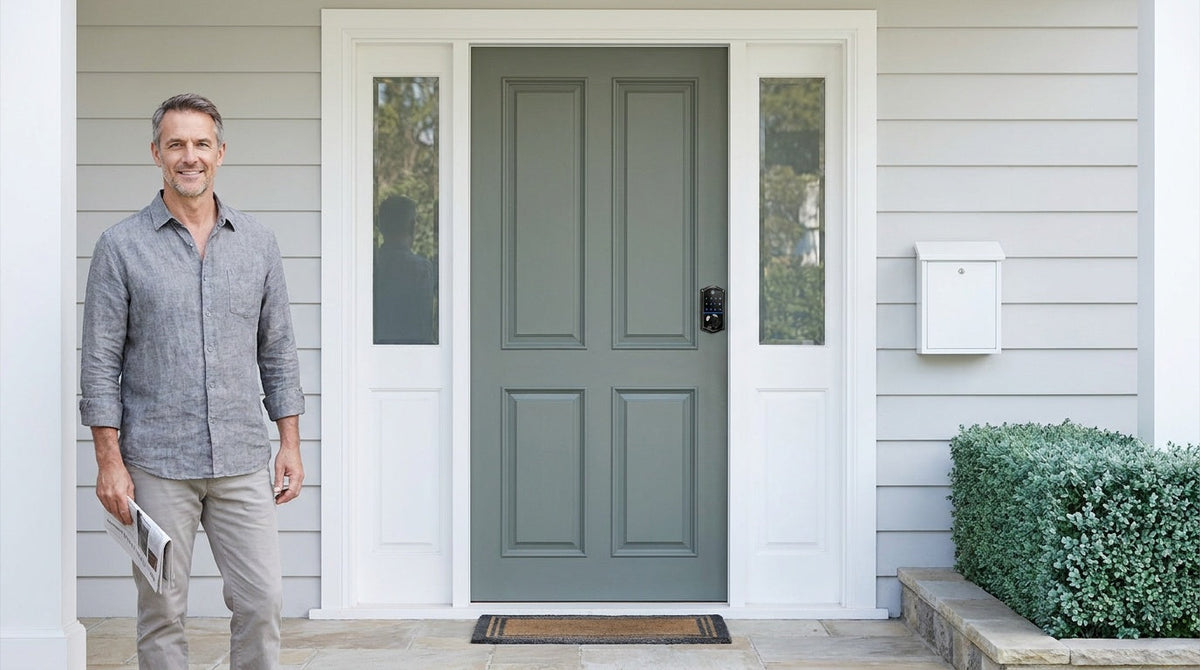
You've decided to go keyless. No more fumbling for keys at the door, no more hiding spares under the mat, no more worrying about who still has a copy. A keypad door lock solves all of that — but once you start shopping, a new question surfaces: which type of keypad lock do you actually need?
Deadbolts, latch locks, and lever locks all accept a keypad code, but they work differently, fit different doors, and offer different levels of security. Choosing the wrong one doesn't just waste money — it can leave a door under-protected or create daily frustration for everyone in the household. This guide breaks down each type clearly, maps them to the doors they belong on, and helps you make a confident decision without needing to be a locksmith to do it.
What Is a Keypad Door Lock?
A keypad door lock adds a numeric or alphanumeric pad alongside the traditional key cylinder. Instead of inserting a key, you enter a PIN code — and the lock does the rest. Every Veise lock keeps a physical key cylinder as a backup, so you're never completely locked out if a battery runs low. Beyond that shared trait, keypad locks diverge significantly based on the bolt mechanism inside: a deadbolt or a spring latch. That internal mechanism determines where the lock belongs on your home and how much security it provides.
Veise's keypad lock lineup is built on 38 years of lock industry expertise from parent company Kaadas Group, with 711 patents — the world's largest smart lock patent portfolio. The result is a range that covers every common residential use case, from a straightforward front-door deadbolt to a compact latch lock for an interior office door, sitting within Veise's $30–$180 lineup and designed for a 15-minute DIY install with just a screwdriver.
Keypad Deadbolt Locks: Maximum Security for Exterior Doors
A deadbolt is defined by its bolt mechanism. When you lock a deadbolt, a solid metal bolt extends directly into the door frame — no spring tension involved. It sits there, inert, until you deliberately retract it with a key, thumb-turn, or in the keypad version, a correct PIN. That design makes it dramatically more resistant to forced entry than any spring-loaded latch. A spring latch can be pushed back with a thin tool; a deadbolt cannot be shimmed, twisted off, or kicked open the same way.
Keypad deadbolts carry all the security benefits of a traditional deadbolt and take the key out of daily entry. You no longer need to make copies, worry about who lost theirs, or rekey the lock when a roommate moves out. Every authorized person gets their own code, which can be changed or deleted in seconds. Veise keypad deadbolt locks support a PIN code and include a physical key backup on every model. Every SKU in the KS02 series adds fingerprint recognition that scans in under 0.3 seconds — fast enough that most users don't even break stride walking through the door.
The Veise keypad deadbolt line splits primarily into two groups:
- With fingerprint (KS02 series): Includes fingerprint recognition stored locally on the device — no cloud account, no Internet connection needed for biometrics to function. Available as a keypad-only deadbolt (KS02A) or as a handle-set bundle with a lever, knob or vertical handle (KS02B/KS02C/KS02D) for a complete, matched look on the door.
- Without fingerprint (RZ and KS01 series): Keypad code plus physical key backup.
All models include auto lock, which engages the bolt automatically after a configurable interval of 10 to 99 seconds. That means the days of standing at the curb wondering "did I lock the door?" are behind you, even on the most rushed school-run mornings. Keypad deadbolts are standalone devices — they don't connect to an app or Wi-Fi, which keeps setup simple and means no subscription fees. They are ANSI/BHMA Grade 3 certified, which is the correct residential security standard for most homes.
Keypad Latch Locks: Simple Access Control for Interior and Side Doors
A latch lock uses a spring-loaded bolt with a beveled edge. When you push the door closed, the bevel automatically slides past the strike plate and snaps into place — no need to manually throw a bolt. That convenience is the point. Latch locks are designed for doors that need to close and stay closed without requiring a deliberate locking action every time. The trade-off is that a spring latch offers less resistance to forced entry than a deadbolt, which is why latch locks are typically the right fit for interior doors, side entries, home office doors, and similar locations where light access control matters more than heavy-duty security.
Veise keypad latch locks are designed as an integrated unit: the handle and keypad are built into a single body, so there's no separate hardware to coordinate. They support keypad code entry and include a physical key backup — straightforward, reliable, and exactly as complex as they need to be. Currently, two models are available, differing only in the top handle style:
- KS03: Integrated top knob handle
- KS04: Integrated top lever handle
One useful application worth knowing: a keypad latch lock can also work on an entry door when paired with a separate deadbolt. In that setup, the latch handles everyday code-based access — family members punch in a code and walk right in — while the deadbolt provides the primary security layer overnight or when the home is unoccupied. Some homeowners prefer this combination over a single combined lock because it keeps daily traffic convenient without compromising nighttime security. If you're managing a short-term rental property, a keypad latch at the door handle combined with a separate deadbolt above or below it gives guests keyless check-in while the property owner retains full security control.
Keypad Lever Handles: Combining Everyday Ease with Code-Based Entry
Lever handle locks operate with a push-down mechanism rather than a rotating knob. That single design difference makes them meaningfully easier to use for children, older adults, and anyone carrying grocery bags, a baby, or anything else that leaves only one hand free. In a busy household, a lever handle on a frequently used interior door is less a luxury than a practical upgrade. When that lever is paired with a keypad, you get the access control of a code lock combined with the ergonomic ease of lever operation.
Within the Veise lineup, lever-style handles appear in several keypad lock configurations. The keypad deadbolt handle-set bundles in the KS02 and KS01/RZ series pair a lever handle with a keypad deadbolt for a fully matched, code-secured entry. For doors that don't need deadbolt-level security, the KS04 keypad latch lock integrates a lever top handle directly into the lock body. And if you don't need keyless entry and are simply looking to refresh your existing door hardware, there are plenty of traditional options to consider. Browse Veise's keyed entry door levers, privacy door levers, and Keyed Entry Handlesets to compare different handle styles and configurations.
Choosing between a knob-style and lever-style handle for your keypad lock comes down to personal preference and household needs. Levers are easier to operate for anyone with limited grip strength and are increasingly the default choice in modern home design. Knobs remain common in traditional-style homes. Either way, the security of the underlying lock mechanism — deadbolt or latch — doesn't change based on the handle shape.
When a Keypad Lock Isn't Enough: Upgrading to a Smart Lock
Keypad deadbolts and latch locks are excellent at what they do, but they are offline devices — no app, no remote access, no activity history. For many households, that's perfectly fine. For others, the ability to check whether the door is locked from across town, receive a notification when kids arrive home from school, or issue a temporary code to a house cleaner without being there in person is exactly the kind of peace of mind that makes home life simpler. That's where smart locks come in, and it's important to understand that remote access requires a smart lock specifically — you cannot add app connectivity to a keypad deadbolt or keypad latch lock later by pairing it with a gateway.
Veise offers two connected lock categories, each with a different connectivity method:
- Smart Locks w/ G1 and Smart Locks w/ G2: These locks pair with a plug-in gateway hub for remote app control, activity logs, and voice assistant support. Smart Lock w/ G1 is built on a single product series — the VE017 — and ships with multilingual voice prompts in English, Spanish, and French, a USB-C emergency power port, and fingerprint as standard on every unit, a strong all-in-one package for multilingual households. Smart Lock w/ G2 supports Apple Watch unlock and web portal control for users who want those specific features, and offers both fingerprint and non-fingerprint options.
- Wi-Fi Smart Locks: Built-in Wi-Fi means no gateway hub is required. These locks connect directly to your home network and support remote app control, Alexa and Google Assistant voice commands, fingerprint recognition, and keypad code entry. Veise Wi-Fi smart locks use an 8 AA battery configuration for a stronger, more stable connection and a larger power reserve than the standard 4 AA setup common in the industry. Two series are available: the Touchscreen Wi-Fi Smart Lock (VE027 Series) and the Push-Button Wi-Fi Smart Lock (VE012W Series).
For families with kids, a Wi-Fi smart lock or gateway-paired smart lock offers a more convenient and flexible way to manage everyday access. Parents can review entry history remotely and know the moment someone arrives — whether that's a child home from school or a delivery that needed to be let in. All Veise smart locks carry no subscription fees, and fingerprint data is stored locally on the device, not sent to any cloud server.
Which Type of Keypad Lock Goes on Which Door?
The quickest way to choose the right keypad lock is to match the lock type to the door's role in the home. Here's a practical framework:
- Front door or back door (primary exterior entry): A keypad deadbolt is typically the right choice. The solid bolt mechanism provides the security level appropriate for the home's main entry points. If you want remote monitoring or app-based access, step up to a smart lock for those doors.
- Interior office, laundry room, or home gym: A keypad latch lock fits well here. You want keyless access control without the added complexity or cost of a deadbolt, and the spring latch is perfectly adequate for interior passage doors.
- Side door, garage entry, or apartment door: Both keypad deadbolts and keypad latch locks are common picks depending on how much security the door requires and whether it already has a deadbolt above or below the handle position.
- Entry door with daily high traffic (short-term rental, property managed by an owner): Consider a keypad latch lock at the handle paired with a separate deadbolt, or go directly to a Wi-Fi smart lock for remote access and guest code management.
- Households managing multiple users or remote arrivals: A gateway-paired smart lock or Wi-Fi smart lock so you can monitor activity, issue temporary codes remotely, and receive notifications when the door is used.
The single most common mistake buyers make is choosing a lock based on price alone rather than on where it's going. A keypad latch lock from the accessible end of the range is a smart, appropriately scaled purchase for an interior door — and the wrong tool for a front door that faces the street without a separate deadbolt. Matching the lock to the door's security role first, then choosing between models, leads to better outcomes every time.
Installation and Door Compatibility
One of the most practical advantages of Veise keypad locks is how straightforward installation is. Every model is designed as a complete lock replacement — not an overlay on top of existing hardware — and is built for DIY installation in about 15 minutes with a screwdriver. No wiring, no professional help, no special tools required. Everything needed for the install is in the box — batteries are the one thing to pick up separately, since Veise locks ship without them — and the setup is designed to be completed by any homeowner in a single Saturday morning.
Before purchasing, it's important to confirm door compatibility. All Veise keypad locks are designed for wood doors with a thickness of 1-3/8" to 2". They are not compatible with fiberglass, metal, storm, or sliding doors. If you're unsure whether your door falls within the supported range, measure the door thickness at the edge before ordering — it takes less than a minute and prevents a return trip to the store. You can explore the full range of options across all Veise lock categories at the complete product lineup, or browse specific collections such as deadbolt locks, mechanical locks, and accessories to find complementary hardware.
Because Veise locks require full lock replacement rather than overlay installation, the buyer should be the property owner or hold authority to modify the door hardware. For property owners managing rental units or vacation properties, this is typically a straightforward decision that pays for itself quickly in reduced key management hassle and easier guest access. Easy from Day One — built on an ownership model that gives homeowners complete control over their entry points from day one.
The Right Keypad Lock Starts with the Right Question
Keypad door locks are one of the most practical upgrades a homeowner can make — no key management, no lockout worries, and no complexity that overshadows the benefit. But the upgrade only works well when the lock type matches the door. A keypad deadbolt for exterior security, a keypad latch lock for interior convenience, and a smart lock for remote access and family monitoring: each solves a specific problem, and each does it well.
Veise's lineup covers all three categories with locks built on the Effortless Home Improvement™ Experience — designed to install in minutes, operate without a learning curve, and serve families reliably for years without subscription fees or unnecessary complexity. Whether you're replacing a single front-door deadbolt or outfitting every door in the house, the right lock for your situation is in the range.
Frequently Asked Questions
What is the difference between a keypad deadbolt and a keypad latch lock?
A keypad deadbolt uses a solid metal bolt that must be deliberately thrown into the door frame — it does not move on its own. This gives it strong resistance to forced entry and makes it the right choice for exterior doors. A keypad latch lock uses a spring-loaded, beveled bolt that automatically engages when the door closes. It's more convenient for interior doors and high-traffic passages but provides a lower level of forced-entry resistance. Both accept a keypad PIN and include a physical key backup.
Can I put a keypad latch lock on my front door?
Yes, a keypad latch lock can be used on an entry door, but it works best when paired with a separate deadbolt. In that configuration, the latch lock handles everyday code-based access while the deadbolt provides the primary security layer. If you want a single lock that covers both access convenience and strong exterior security, a keypad deadbolt is typically the more straightforward choice for front doors.
Do keypad door locks work without Wi-Fi?
Yes. Keypad deadbolt and keypad latch locks are fully offline devices — they don't require Wi-Fi, a mobile app, or any Internet connection to operate. You enter a code and the lock opens. Smart locks (gateway-paired or Wi-Fi) do rely on a network connection for remote features like app control, notifications, and voice commands, but even those models continue to function locally via keypad code and physical key if the Internet connection is unavailable.
Are keypad door locks secure?
A quality keypad deadbolt is at least as secure as a traditional keyed deadbolt and often more so in practice, because far fewer keys end up in circulation to be lost or copied. The underlying bolt mechanism is the same solid construction as a standard deadbolt. Keypad latch locks are appropriately secure for interior doors and lower-traffic entries but are not designed to serve as the sole security device on a primary exterior door. Matching the lock type to the door's role is the key to getting the right security level.
What unlock methods do Veise keypad locks support?
It depends on the category. Keypad deadbolts support keypad code and physical key backup on all models, with fingerprint recognition on every SKU in the KS02 series. Keypad latch locks support keypad code and physical key only. Smart locks (gateway-paired or Wi-Fi) support multiple ways to enter including keypad code, remote app control, key fob, physical key, and fingerprint on many models — with Wi-Fi smart locks also supporting Alexa and Google Assistant voice commands directly.
What doors are Veise keypad locks compatible with?
All Veise keypad locks are designed for wood doors between 1-3/8" and 2" thick. They are not compatible with fiberglass, metal, storm, or sliding doors. Always verify your door material and thickness before purchasing.
Not Sure Which Lock Is Right for Your Door?
The Veise team is here to help you find the right keypad lock for your home, your doors, and your daily routine — no guesswork required.
Contact Us

Leave a comment
This site is protected by hCaptcha and the hCaptcha Privacy Policy and Terms of Service apply.