
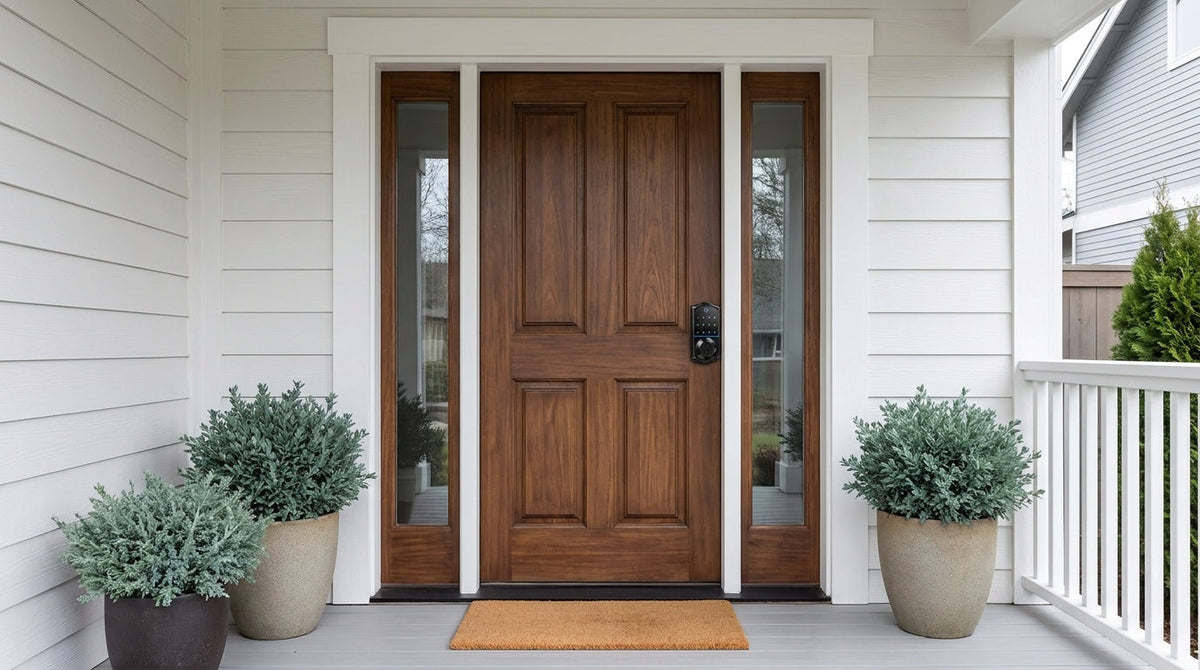
You've picked out a new lock, you're ready to upgrade your front door, and then you hit a question you didn't expect: what's your backset? It's one of the most common stumbling blocks homeowners face when buying door hardware, and it's surprisingly easy to get wrong. The good news is that once you understand what backset means and how to measure it, the whole process takes about two minutes.
This guide explains exactly what a door lock backset is, breaks down the difference between the two standard residential sizes — 2-3/8" and 2-3/4" — and walks you through measuring your own door so you can buy and install a new lock with confidence. Whether you're replacing a worn-out deadbolt or upgrading to a smart lock for the first time, getting this one measurement right is the key to a clean, frustration-free install.
Door Lock Backset Explained
How to measure 2‑3/8" vs 2‑3/4" — and why it matters before you buy
What Is a Backset?
The One Measurement That Makes or Breaks Your Lock Install
The backset is the horizontal distance from the edge of your door to the center of the bore hole — where your lock body, knob, or deadbolt sits. This single number determines whether your lock lines up correctly with the strike plate on the door frame.
The Two Standard Sizes
Interior & Many Exterior Doors
Found on most interior doors and exterior doors with a narrower stile. Places the lock slightly closer to the door edge.
Exterior, Older & Custom Doors
Common on exterior doors, commercial-style doors, and wider-stile doors. Sets the lock slightly further from the edge.
Only 3/8" Apart — But It Matters
The difference is less than the width of a pencil. Yet a mismatched backset means the bolt may not reach the strike plate — or may fail to throw completely — leaving your door unsecured or impossible to lock.
How to Measure (2 Minutes)
Step-by-Step Backset Measurement
Key Takeaways
Measure First, Shop Second
Two minutes of measuring prevents returns and failed installs.
Adjustable Latches Help
Many modern locks include latches that click into either size by hand.
Stile Width Matters
A 4‑1/2" stile typically only fits 2‑3/8". Wider stiles can use either size.
Smart Locks Too
Smart lock motors need the correct backset to throw cleanly on every cycle.
Adjustable Latches: A Built-In Safety Net
Many modern latches twist, push, or slide between 2‑3/8" and 2‑3/4" without any tools. Always confirm the setting before installation — and check product specs, as some premium hardware is fixed at one size.
🔒 Upgrading to a Smart Lock?
The same backset measurement applies — and it matters even more. A smart lock's motor needs the bolt to travel cleanly on every cycle. Use the identical 5-step process, confirm your door prep, and most smart locks with adjustable latches handle both standard sizes.
What Is a Door Lock Backset?
The backset is the horizontal distance from the edge of your door to the center of the bore hole — the large round opening where your lock's cylinder, knob, lever, or deadbolt body sits. It tells you how far your lock is set back from the door's edge. That single measurement determines whether the latch or bolt will line up correctly with the strike plate on your door frame when the door closes.
Backset is sometimes confused with bore hole diameter or door thickness, but it's a separate measurement entirely. The bore hole diameter is almost always 2-1/8 inches on modern residential doors. Door thickness is the depth of the slab itself. Backset is purely that left-to-right distance from the edge to the center of that large hole. All three numbers matter when you're buying new hardware, but backset is the one that catches most people off guard.
The Two Standard Backset Sizes: 2-3/8" vs 2-3/4"
In North America, virtually all residential door hardware is designed around just two backset measurements: 2-3/8 inches and 2-3/4 inches. If your door was built or drilled in the last several decades, its backset is almost certainly one of these two. Here's how they typically break down:
- 2-3/8" (60 mm): The more common of the two. You'll frequently find this on interior doors and on many exterior residential doors, particularly those with a narrower stile (the vertical framing member running along the lock side of the door). It places the lock slightly closer to the door's edge.
- 2-3/4" (70 mm): Slightly longer, placing the lock a bit further from the edge. This size is often found on exterior doors, commercial-style doors, and older or custom-built doors with a wider stile. It's also the standard for most commercial door applications.
The physical difference between these two sizes is just 3/8 of an inch — less than the width of a pencil. That might sound trivial, but in the world of door hardware, it's the difference between a lock that installs cleanly on the first try and one that simply won't work in your door.
How to Measure Your Door Backset Step by Step
Measuring your backset takes about two minutes and only requires a tape measure. You can measure with the existing lock in place or with the hardware removed — both methods work. Here's how to do it correctly:
- Open the door fully — This gives you clear access to the edge of the door and the face of the lock without the door frame getting in the way.
- Find the center of the bore hole — Look at the face of the door and locate the large round hole where your lock body, knob, or deadbolt cylinder sits. If hardware is installed, the center of the knob rose, lever rose, or keyhole marks this center point. If hardware is removed, you can visually find the midpoint of the opening.
- Place your tape measure flush against the door edge — Start from the flat edge of the door (the side where the latch exits), not from the door frame or trim.
- Measure straight across to the center of the bore hole — Pull the tape horizontally to that center point. Do not measure to the nearest edge of the hole — measure to the center. This is where most people go slightly wrong.
- Read the measurement — The result will be either 2-3/8" or 2-3/4". If you get a number that's close but not exact, double-check that you're measuring to the center. Real-world readings sometimes land a fraction off, but the actual backset on your door will always be one of these two standard sizes.
One helpful tip: if you have hardware installed and simply want to confirm which backset you have, you can measure from the door edge to the center of the visible knob, lever, or keyhole on the door's face. That center point will align very closely with 2-3/8" or 2-3/4", and you'll know immediately which size your door uses.
What Happens If You Get the Backset Wrong
Getting the backset wrong isn't a minor inconvenience — it means the new lock won't function properly in your door. If the latch or bolt is set for a longer backset than your door uses, the bolt may not reach far enough to extend into the strike plate, leaving the door unsecured. If the hardware is set for a shorter backset than your door requires, the bolt can end up partially exposed or fail to throw completely, which can also prevent the door from locking.
Beyond the functional problem, installing a mismatched lock can damage your door. Forcing hardware into the wrong configuration risks stripping screw holes, chipping the wood around the bore, or warping the latch pocket. Returning hardware after an attempted installation is frustrating and can come with restocking fees. The simplest way to avoid all of this is to measure before you shop — it adds two minutes to your process and eliminates the most common reason DIY lock installations go sideways.
Adjustable Latches: A Helpful Safety Net
Many modern lock and deadbolt latches are designed to work with both standard backset sizes. These adjustable latches can be switched between 2-3/8" and 2-3/4" through a simple twist, push, or slide of the latch mechanism, usually by hand. The latch clicks into position at either setting, and you install it according to whichever size matches your door.
This is genuinely useful when you're shopping online or replacing a lock as part of a larger home improvement project. Even with an adjustable latch, though, it's worth measuring your backset first so you can confirm the setting before sliding the latch into the door. Adjustable latches don't apply to every lock type — some premium hardware, handle sets, and certain deadbolts are fixed at one backset size and must be ordered to match your specific door prep. Always check the product specifications to confirm whether the latch is adjustable or fixed.
How Your Door Stile Width Affects Backset Choice
On some doors, the backset you can use is limited by the width of the door stile. The stile is the vertical wooden member that runs along the lock side of the door — it's the section the bore hole actually sits in. A standard residential stile runs about 4-1/2 inches wide, which typically only allows a 2-3/8" backset. Placing a 2-3/4" backset bore into a 4-1/2" stile pushes the hole uncomfortably close to the inner rail line, which can weaken the door and cause the lock's escutcheon plate to overlap onto an adjacent panel.
Doors with a wider stile — typically 5-1/2 inches or more — can generally accommodate either backset. If you're working with a standard-width stile door and you're unsure, the safe choice is 2-3/8". When in doubt, measure the stile width and compare it to the backset requirement listed in the lock manufacturer's installation template. This is especially relevant when you're buying a handle set or any hardware that includes a larger decorative escutcheon, since the visual framing around the lock needs room to sit squarely on the stile.
Backset Matters Even More for Smart Lock Installs
If you're upgrading to a smart lock rather than a standard mechanical lock, getting the backset right becomes even more important. Smart locks use a motor to throw the bolt, and that motor needs the bolt to travel cleanly and without resistance on every cycle. A mismatched backset can cause binding, incomplete bolt travel, or motor strain that wouldn't be noticeable with a manually operated lock but will show up immediately in a motorized one.
The measuring process is identical — you're still looking for that 2-3/8" or 2-3/4" distance from the door edge to the center of the bore hole. Most smart lock deadbolts, including those from Veise's keypad deadbolt line, include adjustable latches that handle both standard backset sizes, so you don't need to order a specific version for your door prep. Veise locks are compatible with wood doors between 1-3/8" and 2" thick, which covers the vast majority of standard residential doors.
The broader installation is also designed to stay straightforward. Veise locks are built on Kaadas Group's 38 years of lock industry expertise and 711 patents — the world's largest smart lock patent portfolio — and that engineering depth shows in the details: the latch adjusts without special tools, mounting hardware aligns with standard residential door prep, and the full install typically takes about 15 minutes with a screwdriver. No wiring, no locksmith, no special tools needed. Whether you choose a keypad deadbolt, a Wi-Fi smart lock, or a Smart Lock w/ G1 or Smart Lock w/ G2, the fit starts with that one backset measurement you take before you even open the box.
For families upgrading their front door, Veise's Wi-Fi smart lock and gateway-paired smart lock lines offer an added benefit beyond the physical fit: once the lock is in place, parents can check entry history remotely, get activity alerts, and manage access codes — all from a mobile app. Veise Effortless Home Improvement™ Experience is built around the idea that an upgrade like this should be approachable, not intimidating. And it all starts with a two-minute measurement.
Backset is one of those measurements that feels technical until you've done it once — and then it takes about two minutes every time. Knowing whether your door uses a 2-3/8" or 2-3/4" backset before you buy any lock hardware is the single most effective way to ensure a clean installation, avoid returns, and skip the frustration of hardware that almost fits but doesn't quite work. Measure from the door edge to the center of the bore hole, confirm your reading, and you're ready to shop with confidence.
If you're ready to move beyond a basic mechanical lock, that same measurement is all you need to get started with a smart lock upgrade. Veise offers a full range of options — from straightforward keypad deadbolts and keypad latch locks to fully connected Wi-Fi smart locks — all designed to fit standard residential door prep and install with a screwdriver in about 15 minutes. Easy from Day One.
Frequently Asked Questions
What is the most common door backset size for residential homes?
In the United States, both 2-3/8" and 2-3/4" are common in residential homes. The 2-3/8" size appears frequently on interior doors and many exterior doors, while 2-3/4" is often found on exterior doors and commercial-style applications. If you're unsure which your door uses, measure before buying any lock hardware.
Can I change my door's backset if I want a different size?
Technically yes, but it involves re-drilling the bore hole and potentially modifying the latch pocket and strike plate — a significant amount of work that can weaken the door if not done carefully. For most homeowners, it's much simpler to choose a lock that matches the existing backset. If the new hardware includes an adjustable latch, you can switch between 2-3/8" and 2-3/4" without any drilling.
Is the backset measurement the same for a deadbolt and a door knob?
Yes. The backset is always measured the same way — from the edge of the door to the center of the bore hole — regardless of whether you're installing a deadbolt, a knob, or a lever. The bore hole for both types is typically 2-1/8" in diameter on standard residential doors.
Do smart locks require a specific backset?
Smart locks use the same standard residential backsets as traditional locks — 2-3/8" or 2-3/4". Most smart lock models include adjustable latches that accommodate both sizes. Measure your door backset before installing and set the latch accordingly before sliding it into the edge bore.
What if my measurement doesn't come out to exactly 2-3/8" or 2-3/4"?
Double-check that you're measuring from the flat door edge (not the door frame) to the center of the bore hole (not the edge of the hole). Small tape-measure reading errors are common. In practice, virtually all modern residential doors are drilled to one of these two standard sizes, so your measurement should land very close to one of them. If you get a significantly different number, you may have a non-standard or older door prep, in which case it's worth consulting the lock manufacturer before purchasing.
Do Veise smart locks support both backset sizes?
Yes. Veise locks include adjustable latches that work with both the 2-3/8" and 2-3/4" standard backset sizes. They are compatible with wood doors between 1-3/8" and 2" thick, which covers the standard range for most residential doors. Always confirm your door prep matches the product specifications before installing.
Not Sure Which Lock Fits Your Door?
Our team can help you confirm your door measurements and find the right Veise lock for your home — no guesswork required.
Contact Us

Leave a comment
This site is protected by hCaptcha and the hCaptcha Privacy Policy and Terms of Service apply.