
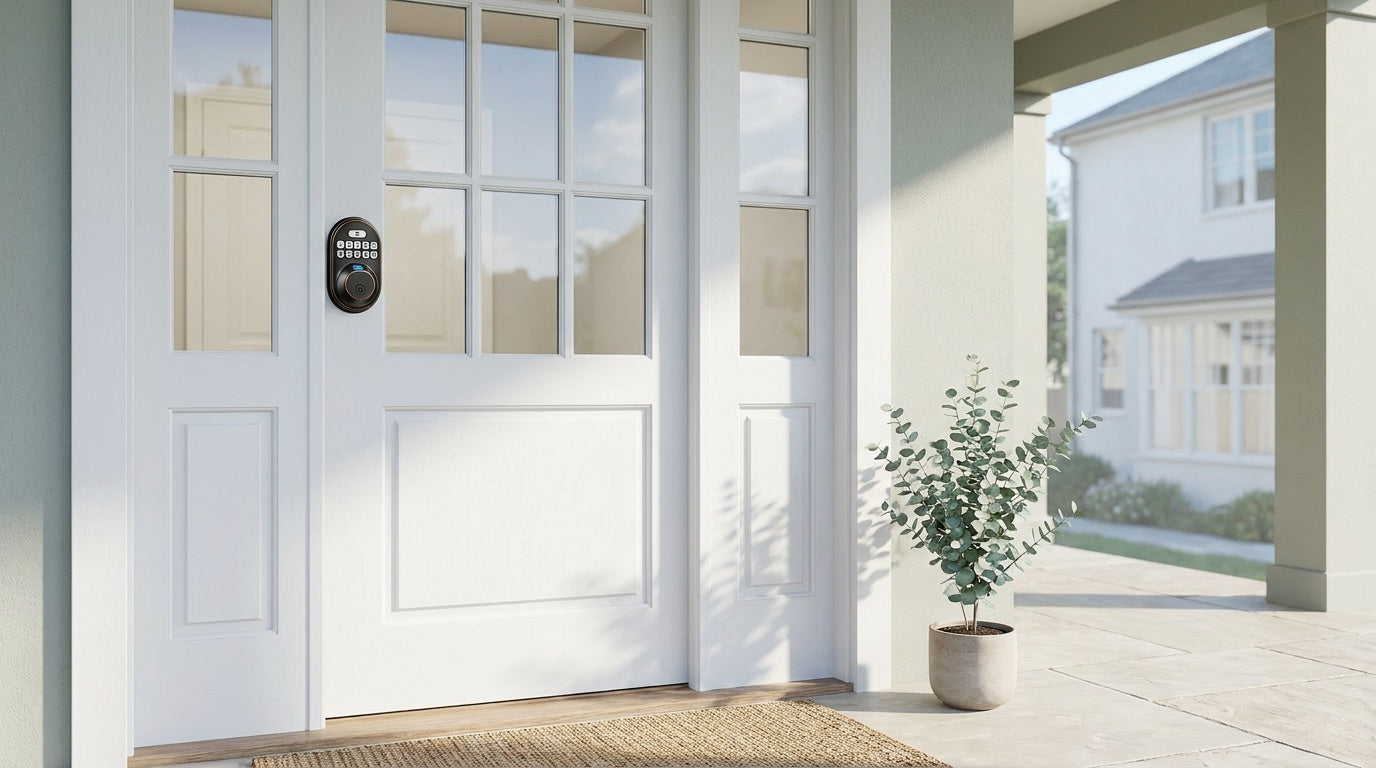
You've found a smart lock you like, you measure the door, and then the question hits: wait, is this even a metal door? Or maybe you already know your front door is steel and you're trying to figure out whether any smart lock will actually work on it. Either way, the answer is more nuanced than most product pages let on.
The short version: yes, smart locks can be installed on metal doors — but it takes more planning, the right tools, and a lock specifically rated for that door type. Not every smart lock on the market is built for metal, and buying the wrong one leads to alignment headaches, wireless connectivity problems, and a lock that may not perform reliably over time. This guide walks through exactly what makes metal door installs different, what to verify before you buy, and — for those with standard wood exterior doors — how to get a smart lock up and running in about 15 minutes.
What Counts as a Metal Door?
The term "metal door" covers a wider range of doors than most people realize, and the type matters a lot when choosing a smart lock. At one end you have solid steel doors — dense, reinforced slabs common in commercial buildings, warehouses, and high-security residential properties. At the other end you have steel-skin doors, which look and feel metallic on the outside but are built around a wood or composite internal frame. Many standard residential exterior doors fall into this second category.
Why does the distinction matter? Because a steel-skin door with a wood interior often behaves more like a wood door during installation. The lock hardware still mounts into the wood frame, standard drill bits may work, and wireless signal interference tends to be less severe than with a fully solid metal door. Before you assume your door is "off limits" for standard smart locks, it's worth checking whether you're dealing with a solid metal door or a steel-faced door with a wood substrate. A quick look at the door's edge — where the latch and deadbolt bolt insert into the door body — usually tells the story.
Why Metal Doors Are Different for Smart Lock Installation
Wood is forgiving. It's easy to drill, easy to chisel, and relatively straightforward to adjust if a measurement is slightly off. Metal is none of those things. Metal-core and solid steel doors are much harder to work with, and even a small mistake during installation can lead to lasting problems — a misaligned deadbolt, a stripped mounting screw, or a keypad that never quite sits flush. The material leaves almost no room for error, which is one reason metal door installations are often best handled by a professional locksmith.
There's also the issue of door weight. Heavy steel doors put more mechanical stress on lock hardware with every open and close cycle. A lock body, motor, or mounting assembly that works perfectly on a lightweight wood door may show wear much faster when subjected to the constant force of a solid metal slab. This is why manufacturers that do support metal doors typically engineer their hardware with heavier-duty components and more robust fasteners.
3 Key Challenges When Installing a Smart Lock on a Metal Door
Understanding what can go wrong is the first step to avoiding it. Here are the three most common issues that come up with metal door smart lock installations:
1. Wireless Signal Interference
Metal is a highly conductive material, and that conductivity interferes with radio frequency (RF) signals. When a smart lock's keypad, sensor module, or wireless antenna sits directly against a dense metal surface, communication between the lock and connected devices — a smartphone, a gateway, or a voice assistant — can become unreliable. Wi-Fi-connected locks are somewhat less susceptible because they communicate through your home's network rather than relying on short-range direct wireless links, but even Wi-Fi signal strength can degrade when a thick metal door sits between the lock's antenna and the router. If you go ahead with a metal door installation, testing signal strength at the door's location before finalizing placement is a critical step — and positioning your router within a reasonable distance of the front door can make a real difference.
2. Drilling and Boring Challenges
Standard wood-boring drill bits won't cut it on a steel door — literally. Drilling into metal requires metal-rated bits, and for the larger bore holes that a deadbolt or latch lock body requires, you'll need a bi-metal hole saw rather than a standard wood spade bit or hole saw. Going too fast or applying too much pressure generates heat that dulls bits quickly and can damage the door's finish. Starting with a smaller pilot hole and working up to the final diameter at a controlled speed is the accepted method. If you're not experienced with metalworking, this step alone is a strong argument for calling in a professional.
3. Hardware Alignment and Long-Term Fit
Metal doors offer very little flexibility when it comes to adjusting hardware placement after the fact. On a wood door, minor misalignments can often be corrected with a chisel or some light filing. On a metal door, once a hole is drilled it's drilled — re-centering or enlarging a bore is a much bigger project. This makes precise measurement before drilling absolutely critical. The strike plate alignment also matters more, because metal door frames are often reinforced and provide less tolerance for a deadbolt that isn't throwing cleanly into the strike pocket. Getting this right the first time saves significant headaches down the road.
What to Check Before Buying a Smart Lock for a Metal Door
Not all smart locks are compatible with metal or steel doors, and some manufacturers are upfront about this while others are not. Here's a quick pre-purchase checklist to run through before spending money on a lock that may not work with your door:
- Manufacturer's stated compatibility: Read the specs carefully. Look for explicit language like "compatible with steel or metal doors" — not just "works on most doors." If the product page doesn't specify, contact the brand directly before buying.
- Door thickness: Most smart locks fit doors between 1-3/8" and 2" thick, which covers the majority of residential doors. Heavy-duty metal doors can run thicker — up to 2-1/4" or beyond — and may need an adjustable deadbolt or adapter.
- Backset measurement: This is the distance from the edge of the door to the center of the lock bore, typically either 2-3/8" or 2-3/4". Measure yours before buying. A mismatch here means the lock body won't align with the existing hole (or the hole you'll need to drill).
- Existing lock type: If your metal door already has a deadbolt, check whether the new smart lock requires the same hole configuration. A lock that replaces the full hardware assembly needs the bore diameters to match.
- Wireless protocol and signal requirements: For smart locks with remote or app-based features, verify that the lock's wireless technology can maintain stable connectivity in a metal door environment. Wi-Fi-based locks that connect through your home network may perform more reliably than short-range wireless links on dense steel doors.
- Hardware quality and weight rating: Look for locks with solid construction, durable internal components, and mounting hardware rated for heavier door weights. Lightweight plastic housings may degrade faster under the added mechanical stress of a metal door.
One more thing worth mentioning: if your metal door is a fire door, a storm door, or a reinforced exterior security door with a multi-point locking system, a standard smart lock deadbolt almost certainly won't be compatible without significant modification. Multi-point locking systems are a specialized category that most consumer smart locks are not designed to integrate with.
Professional vs. DIY Installation on Metal Doors
For a standard wood door, a DIY smart lock swap is genuinely accessible — most quality locks require nothing more than a screwdriver and about 15 minutes of your time. Metal doors are a different story. The combination of specialized drilling requirements, precise alignment demands, and potential wireless signal calibration puts metal door installations in a higher skill bracket. That doesn't mean DIY is impossible, but it does mean you need to be realistic about your experience level before you start.
If you have solid experience working with metal and power tools, you're comfortable with precise layout work, and you've confirmed your chosen lock is rated for metal doors, a careful DIY install is achievable. Follow the manufacturer's instructions closely, use the included hardware rather than substituting components, and take your time with alignment before committing to any drill position. On the other hand, if you're less confident with tools or if the door has any unusual features — a reinforced frame, non-standard thickness, or an integrated locking system — hiring a licensed locksmith is a worthwhile investment. A professional will keep bore holes centered, protect the door's finish during drilling, and tune the strike plate fit so the lock operates smoothly from day one.
Got a Wood Door? Here's Where Smart Locks Get Easy
If your exterior door is solid wood, the entire process above becomes much simpler. Standard residential wood doors — including the vast majority of single-family home front doors — are exactly what most smart locks are built for. The installation process is straightforward, the material works with standard hardware, wireless signal interference is minimal, and the whole job typically takes about 15 minutes with a screwdriver, no wiring, no pro help needed.
It's also worth noting that many doors that look like metal on the outside are actually steel-skinned doors over a wood-composite or wood-frame interior. If your door's edge (the part you see when the door is open, where the latch and deadbolt sit) is wood, there's a good chance the door qualifies as a wood-core door for smart lock installation purposes. When in doubt, check with the lock manufacturer using your specific door's specs.
Veise Smart Locks for Wood Doors: A Quick Overview
It's important to be upfront: Veise smart locks are engineered for wood doors with a standard thickness of 1-3/8" to 2", and are not rated for fiberglass, metal, storm, or sliding doors. If your door is a true metal door, Veise is not the right fit — and we'd rather tell you that clearly than have you buy the wrong product. But if you have a wood door and you're looking to upgrade your home security, Veise is worth a serious look.
With roots in the lock industry since 1988 and the #1 smart lock brand on Amazon North America in both 2024 and 2025, Veise designs and manufactures its own products — not a reseller of generic OEM hardware. That vertical integration means tighter quality control, consistent performance, and real accountability when you need support. Locks are priced between $30 and $180, ANSI/BHMA Grade 3 certified (the residential standard), and built around the idea that a smart lock should be simple to install and simple to use every day.
Here's a quick look at the Veise lineup by category, so you can find the right fit for your door and your household:
Keypad Deadbolt Locks
The Keypad Deadbolt line is a strong fit for exterior front doors where you want reliable code-based access without the complexity of an app or remote connectivity. Every Veise keypad deadbolt includes both keypad code entry and a physical key cylinder as backup. The KS02 series adds a fingerprint reader — with a scan time under 0.3 seconds — for hands-free one-touch entry. These locks feature auto lock (configurable between 10 and 99 seconds on Keypad Deadbolt and Keypad Latch locks) and are a popular choice for new homeowners replacing old deadbolts, families managing everyday comings and goings, or anyone who simply wants a solid, keyless upgrade without a monthly subscription fee.
Keypad Latch Locks
The Keypad Latch Lock line currently offers two SKUs — the KS03 with an integrated top knob and the KS04 with an integrated top lever — both supporting keypad code and physical key entry. These are commonly a fit for interior doors, side doors, garage entry doors, office doors, and similar applications where you want code-based access without the full complexity of a smart system. The handle and lock are integrated into a single unit, keeping the installation clean and compact.
Smart Lock w/ Gateway 1/2
For households that want remote access — checking whether a door is locked from across town, receiving entry alerts, or managing access for guests at a short-term rental — a gateway-paired smart lock delivers those features without requiring a built-in Wi-Fi radio in the lock itself. The Smart Locks w/ G1 line is built on a single product series — the VE017 — and every SKU in the line ships with fingerprint access, multilingual voice prompts (English, Spanish, and French), a USB-C emergency power port, keypad code, key fob, and physical key backup. It also pairs with a Veise-developed first-party app for reliable remote control through the paired G1 gateway. If your household includes non-English speakers, the G1's multilingual voice support is a concrete practical advantage worth factoring into your decision.
The Smart Locks w/ G2 line offers more SKU variety, including both fingerprint and non-fingerprint options and several handle-set configurations (standalone deadbolt, lever bundle, knob bundle, or vertical handle bundle). Smart Lock w/ G2 also adds Apple Watch unlock and web portal control, which are unique to this line, and currently supports English voice prompts only. Both Smart Lock w/ G1 and Smart Lock w/ G2 support the shared unlock methods — keypad code, key fob, physical key, and remote app control via the paired gateway. Voice control through Alexa or Google Assistant is available when the paired gateway is in place, bridging the lock to your voice assistant. Note: remote access requires a smart lock (gateway-paired or Wi-Fi) — a keypad deadbolt or keypad latch lock cannot be paired with a gateway.
Wi-Fi Smart Locks
The Wi-Fi Smart Lock line has built-in Wi-Fi connectivity — no separate gateway required — making it the most straightforward path to full remote access, app control, and Alexa or Google Assistant voice commands right out of the box. Two series are available: the Touchscreen Wi-Fi Smart Lock (VE027 Series) with a sleek touchscreen interface and a USB-C emergency power port, and the Push-Button Wi-Fi Smart Lock (VE012W Series) with a traditional press-button keypad. The two series differ in four concrete ways: interface (touchscreen vs. press-button), USB-C emergency power (VE027 only), key fob support (VE027 only), and on-device multilingual voice prompts (English/Spanish/French on VE027; none on VE012W). They otherwise share Wi-Fi connectivity, fingerprint access (scan time under 0.3 seconds), keypad code, app control, Alexa/Google voice via built-in Wi-Fi, physical key backup, and an 8 AA battery design that delivers stronger signal and a more stable connection than the more common 4 AA setup. For parents who want to monitor when kids arrive home, or property managers overseeing a rental, the Wi-Fi line's real-time entry history and remote lock/unlock through the app make it the most capable everyday option in the Veise lineup. Even when Wi-Fi is down, app control continues to work locally as long as you're within short-range wireless distance of the lock.
All Veise locks install in about 15 minutes with a screwdriver — no wiring, no professional installation required — and carry no subscription fees. Fingerprints are processed and stored on the lock itself, with no cloud dependency and no data leaving the device. For a look at the full lineup, visit the Veise all-products collection.
The Bottom Line
Installing a smart lock on a metal door is possible, but it's genuinely more complex than a standard residential install. Signal interference, specialized drilling requirements, and tighter alignment tolerances all raise the difficulty level — and choosing a lock that isn't rated for metal doors is a recipe for frustration. Always verify manufacturer compatibility before buying, measure carefully, and seriously consider professional installation if you're working with a true solid metal or reinforced steel door.
If your door is wood the picture is much more straightforward. A quality smart lock goes on in minutes, requires no wiring, and brings real everyday convenience: keyless entry, remote access, entry history, and multiple ways for every member of the household to get in. Veise's lineup covers that full range of needs at an affordable price, backed by US-based support and no subscription required. Whether you're a new homeowner, a landlord managing a rental property, or a family looking for a more flexible way to handle the front door, the right wood-door smart lock is a simple, worthwhile upgrade.
Frequently Asked Questions
Can you put a smart lock on a metal door?
Yes, smart locks can be installed on metal doors, but not all smart locks are compatible with metal or steel door construction. You need a lock explicitly rated for metal doors, metal-rated drilling equipment, and — in many cases — professional installation due to the precision required. Always check the manufacturer's compatibility specifications before purchasing.
Why do metal doors cause problems for smart lock connectivity?
Metal is a conductive material that can interfere with radio frequency (RF) wireless signals. When a smart lock's antenna or wireless module sits against a dense metal surface, communication with paired devices like smartphones or voice assistants can become unreliable. Wi-Fi-based smart locks tend to be less affected than short-range wireless systems, but signal placement and router proximity still matter.
What tools do you need to install a smart lock on a metal door?
Installing a smart lock on a solid metal or steel door typically requires metal-rated (bi-metal) hole saws for the deadbolt and latch bore holes, a pilot drill bit, a power drill, a screwdriver, a tape measure, and a level. Standard wood boring bits are not appropriate for metal. A door lock installation template or jig helps ensure precise, centered hole placement.
Is a steel-skinned door the same as a metal door for smart lock purposes?
Not always. Many residential exterior doors have a steel skin over a wood or wood-composite interior frame. If the door's interior structure — including the edge where the latch and deadbolt mount — is wood, some smart locks designed for wood doors may be compatible. Check your specific door specs and the lock manufacturer's guidance to confirm.
Are Veise smart locks compatible with metal doors?
No. Veise smart locks are designed and rated for wood doors with a standard thickness of 1-3/8" to 2". They are not compatible with metal, fiberglass, storm, or sliding doors. If you have a wood door, Veise offers a wide range of options at $30–$180 — from simple keypad deadbolts to fully connected Wi-Fi smart locks — all installable in about 15 minutes with a screwdriver.
Do I need a professional to install a smart lock on a metal door?
For most homeowners, yes. Drilling into metal requires specialized bits, precise measurements, and careful alignment that leaves little room for adjustment after the fact. If you're experienced with metalworking and power tools, a careful DIY install on a compatible lock is achievable — but for reinforced steel doors, fire doors, or any door with a multi-point locking system, a licensed locksmith is strongly recommended.
What's the easiest type of door to put a smart lock on?
Standard wood exterior doors are by far the easiest. They accept most smart lock hardware with no special tools beyond a screwdriver, alignment is forgiving, and wireless connectivity is straightforward. Most quality smart locks for wood doors — including the full Veise lineup — can be installed in about 15 minutes with no wiring or professional help required.
Have a Wood Door? We're Here to Help You Choose.
Veise locks are built for wood doors — straightforward install, no subscription fees, and real support when you need it. If you're not sure which lock fits your door and your household, our US-based team is happy to help.
Contact Us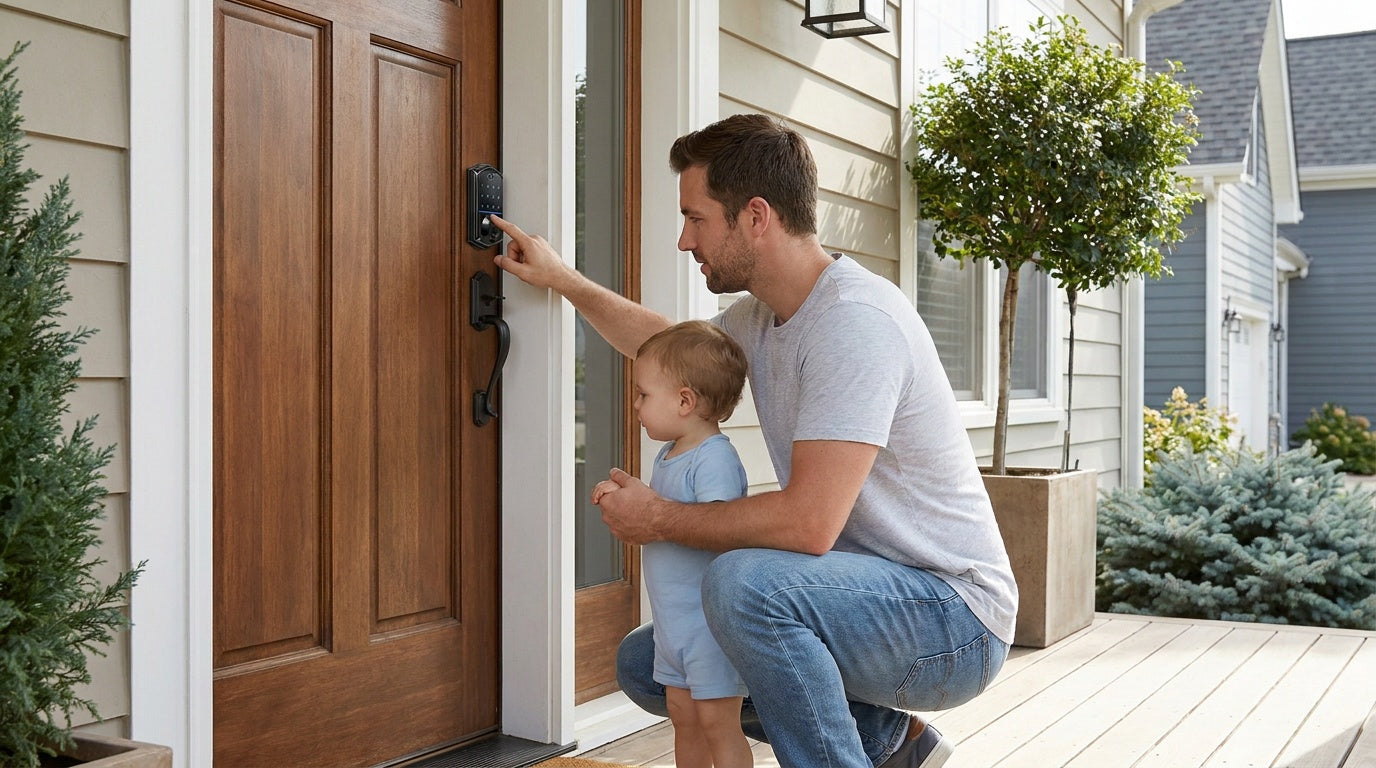
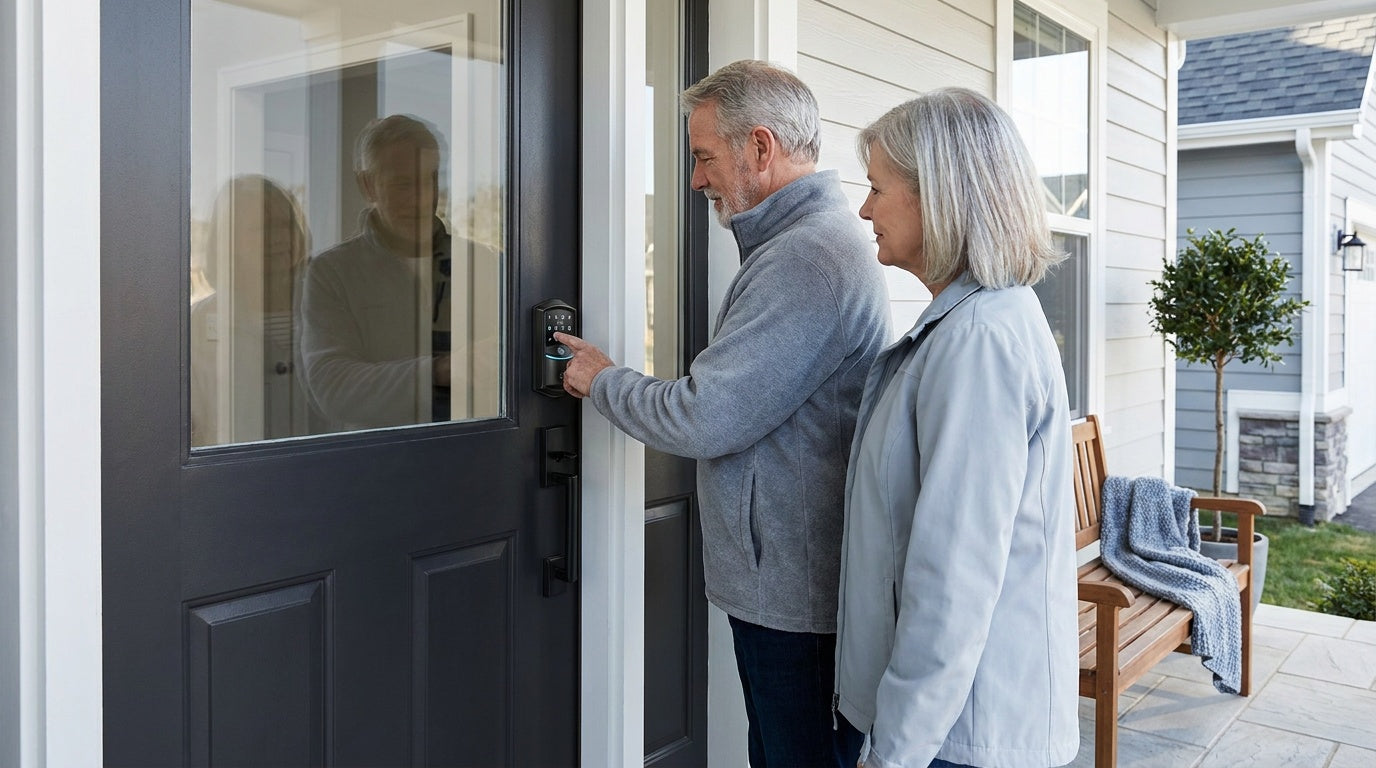

Leave a comment
This site is protected by hCaptcha and the hCaptcha Privacy Policy and Terms of Service apply.