
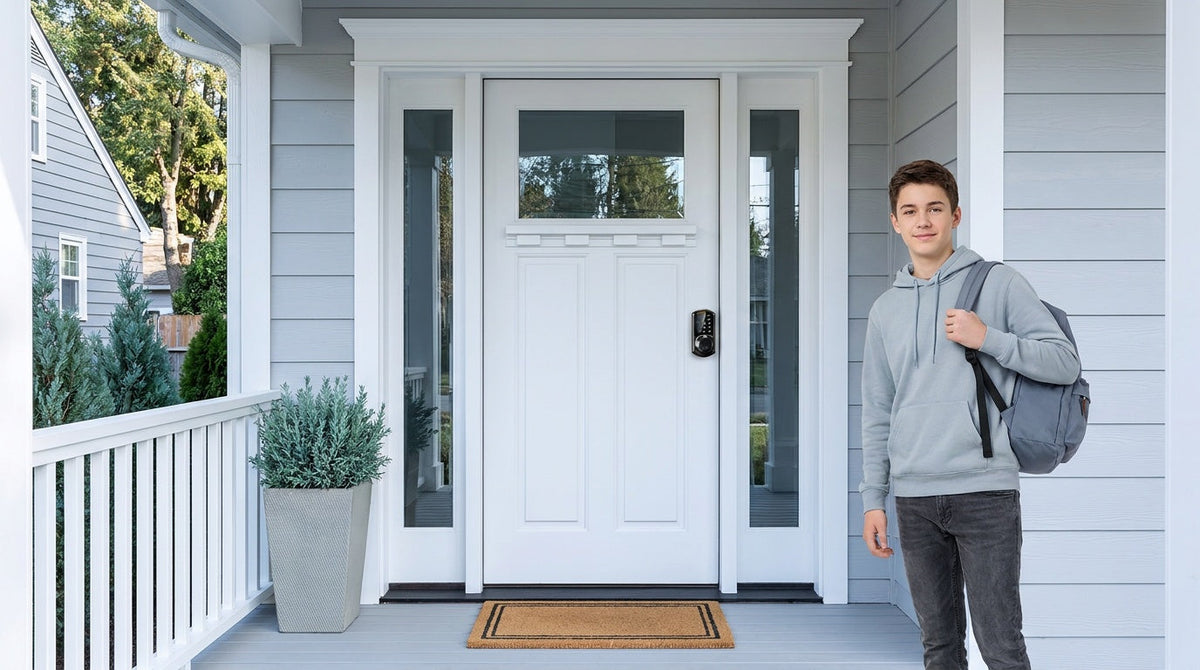
A fingerprint deadbolt is the version of keyless entry that actually belongs on a front door. It replaces the deadbolt you already have, drops a solid bolt into the door frame exactly as the old one did, and adds a biometric reader so the people who live there can walk in without a key. Everything a deadbolt was already doing for your door, it keeps doing.
The confusion starts because "fingerprint lock" also gets attached to a very different product: a compact padlock with a sensor on the body, built to clip through a gym locker or a shed hasp. Both read a fingerprint. That is genuinely where the similarity ends — one is a door lock, the other is a portable accessory, and the gap between them matters most at the door where it counts.
This guide explains what a fingerprint deadbolt is, where it belongs, why a padlock is the wrong tool for an entry door, and what to check before you buy one. One scope note up front: Veise makes door locks, not padlocks — the padlock section below is vendor-neutral background so you can place that product correctly.
What Is a Fingerprint Deadbolt?
A fingerprint deadbolt is a permanent door lock that replaces your existing deadbolt hardware entirely. It mounts directly into the door and door frame the same way a standard deadbolt does, but adds a biometric sensor to the exterior keypad assembly. When an authorized fingerprint is detected, the motor inside the lock retracts or extends the bolt — giving you keyless entry without removing the structural integrity of a deadbolt installation.
Because it's a full lock replacement, a fingerprint deadbolt carries the same physical security profile as any quality deadbolt: a hardened bolt that extends into the door frame, a strike plate secured into the frame stud, and a body designed to resist forced entry. The biometric layer adds authentication security on top of that physical foundation. Unlike a padlock, there's no shackle to cut, no chain to defeat — the lock is integrated into the door itself.
Most residential fingerprint deadbolts include a keypad code as a backup entry method, plus a physical key override for emergencies. That combination of three entry options — fingerprint, code, and key — is what makes fingerprint deadbolts a practical everyday lock for families rather than a novelty. On select connected models, you can also unlock remotely via a mobile app, receive entry alerts, and monitor who comes and goes.
Where a Fingerprint Deadbolt Belongs
A fingerprint deadbolt earns its place anywhere a door has to be reliably secured and repeatedly opened by more than one person. Here is where that plays out.
Any door that serves as a primary entry point to a home, office, or rental property typically calls for a deadbolt — and if you want keyless entry at that door, a fingerprint deadbolt is the natural choice. The bolt extends into the door frame, the lock is integrated into the door structure itself, and the physical security profile is the same as any standard residential deadbolt. The biometric reader simply replaces the need to carry or use a key for daily entry.
For families, fingerprint deadbolts solve a specific daily problem: kids who lose keys, spouses who come home with groceries in both hands, and guests who need temporary access without a key being cut or mailed. Every household member can have their own fingerprint enrolled, and the keypad code serves as a reliable backup when hands are wet, dirty, or gloved. That everyday reliability is what separates a deadbolt from a padlock — it has to work, every single time, for every person who lives in the home.
Property managers and short-term rental hosts also benefit significantly from fingerprint deadbolts on connected smart lock models. Rather than managing physical keys across multiple guests, access codes can be issued and changed remotely, entry logs can be reviewed from anywhere, and the lock can be monitored without being on-site. That kind of management capability simply isn't available on a padlock.
Why a Door Needs a Deadbolt, Not a Padlock
Padlocks are not a lesser lock; they are a different job. A fingerprint padlock is a portable, self-contained unit that releases a shackle — the U-shaped bar that slips through a hasp, chain, or locker loop — when a registered finger touches the sensor. It carries its own power, usually rechargeable over USB-C, and it goes wherever the thing being secured goes. For a gym locker that changes daily, a bike cable, a suitcase, or a shed hasp, that portability is exactly right, and skipping the combination dial removes the most common friction point of all: forgetting the code.
What a padlock cannot do is secure a door. A padlock is only ever as strong as its shackle and the anchor point it hangs from, and a door has neither — there is nothing to thread it through, and any hasp you add becomes the new weak point. A deadbolt has no shackle to cut and no chain to defeat, because the bolt itself passes into the door frame and the lock body is mortised into the door. That is the whole argument, and it is structural rather than a matter of quality or price.
Two practical differences follow from that. Backup entry: every Veise deadbolt ships with a keypad code and a physical key cylinder, while padlock backup varies by model and many include none at all — a dead battery on a locker is an inconvenience, a dead battery on your front door is not. And access management: remote codes, entry history, and app control exist on connected deadbolts and essentially not at all on padlocks. The table below lines the two up.
| Feature | Fingerprint Deadbolt | Fingerprint Padlock |
|---|---|---|
| Installation | Replaces existing deadbolt; about 15 min with a screwdriver | No installation — clip or thread through a hasp |
| Portability | Permanently mounted to a door | Fully portable — travels with you |
| Security level | Residential-grade — bolt extends into door frame | Light to medium — limited by shackle and anchor point |
| Best for | Front doors, exterior entry doors, rental properties | Gym lockers, bikes, luggage, sheds, storage units |
| Backup entry | Keypad code + physical key on every Veise model | Varies — some models include a physical key; many do not |
| Power source | AA batteries; low-battery alerts standard (USB-C on select models) | Rechargeable lithium battery (USB-C on most models) |
| Remote access | Available on smart (gateway-paired or Wi-Fi) models | Generally not available |
| Price range | Veise's lineup as a whole runs $30–$180 (affordable to mid-range) | ~$15–$60 |
Read down the deadbolt column and the pattern is consistent: everything a door actually needs — bolt into the frame, guaranteed backup entry, weather rating for an exterior face, optional remote access — sits on that side. The padlock column is not a weaker version of the same thing; it is a different product answering a different question.
What to Look for in a Fingerprint Deadbolt
A few practical criteria separate a fingerprint deadbolt that performs reliably for years from one that frustrates you within a month.
- Multiple backup entry methods: A quality fingerprint deadbolt should include at minimum a keypad code and a physical key override. This ensures you're never locked out due to a dead battery, injured finger, or scanner malfunction.
- Fingerprint enrollment process: Better deadbolts capture each finger multiple times during enrollment to build a reliable template that works across different angles, pressures, and real-world conditions.
- Auto lock: Look for a configurable auto lock that re-engages the lock automatically after a set interval (10 to 99 seconds on Keypad Deadbolt; 10 to 180 on connected models). It covers the most common security oversight — leaving the door unlocked by accident. The timer runs regardless of door position, so close the door before it elapses.
- Weather rating: Exterior deadbolts need at minimum an IP54 rating to handle rain and humidity without sensor degradation over time.
- Smart connectivity (if needed): If remote access, entry history, or app-based management matters to you, confirm that the specific model supports it. Remote access requires a smart lock — either a gateway-paired model or a Wi-Fi smart lock. A keypad deadbolt with a fingerprint sensor alone cannot be upgraded to remote access after purchase.
- Door compatibility: Most residential fingerprint deadbolts are designed for wood doors with standard thickness. Confirm compatibility with your door before purchasing.
How Veise Approaches Fingerprint Deadbolts
Easy from Day One. That's not a marketing tagline — it's the operating philosophy behind every product in the lineup. Veise is built on Kaadas Group's 38 years of lock industry expertise and 711 patents, the world's largest smart lock patent portfolio. The brand has sold over 10 million smart locks across 41+ countries and has been recognized by Frost & Sullivan as the global No.1 high-end smart lock brand by sales. What that means practically: Veise designs and manufactures its own locks from a vertically integrated factory, rather than reselling OEM hardware under a different label. The engineering is in-house, and so is the accountability.
Veise's fingerprint deadbolt lineup spans two main directions depending on what your household needs. The KS02 series (with fingerprint) is the core biometric line, available in keypad-only deadbolt form (KS02A) and as handle-set bundles with either a lever, knob or vertical handle (KS02B/KS02C/KS02D). The non-fingerprint deadbolt line (RZ and KS01 series) covers households that prefer code-only entry. All Veise keypad deadbolts are ANSI/BHMA Grade 3 certified — the recognized residential standard — and are designed for wood doors with a standard thickness of 1‑3/8" to 2".
On the biometric side, Veise uses an onboard AI chip that captures each fingerprint eight times during enrollment to build a template that holds up across real-world conditions. Recognition speed is under 0.3 seconds. Fingerprint data is stored locally on the lock itself — it never leaves the device and isn't uploaded to any cloud account, which is both a privacy benefit and a reliability advantage (the lock works without an Internet connection). Every Veise fingerprint deadbolt also includes a keypad code backup and a physical key override, so families always have a path in regardless of circumstances.
For households that want more than a standalone deadbolt — remote access, entry history, app-based management — Veise's Smart Locks w/ G1 and Smart Locks w/ G2 add gateway-paired connectivity on top of keypad, key fob, and physical key entry. The Smart Lock w/ G1 line (built on a single product series, the VE017) includes fingerprint as standard on every SKU, multilingual voice prompts in English, Spanish, and French, and a USB-C emergency power port as standard on every SKU. The Wi-Fi Smart Lock goes further — connecting directly to your router without a separate hub, supporting Alexa and Google Assistant voice control, and offering Touchscreen (VE027 series) or Push-Button (VE012W series) interface options to match your preference. Even when Wi-Fi is down, app control continues to work locally as long as you're within short-range wireless distance of the lock. No model across the entire lineup requires a subscription, and there are no monthly fees.
Installation across all Veise deadbolts follows the same Effortless Home Improvement™ Experience: about 15 minutes with a screwdriver, no wiring, no professional required. Because Veise locks are full replacements (not overlays), the installation must be done by the property owner or someone with authority to modify the door hardware. Explore the full range at the Keypad Deadbolt Locks collection, or browse all Veise products to find the right fit for every door in your home.
The Bottom Line
A fingerprint deadbolt is a permanent security fixture for the doors that matter most: your front door, your home's entry points, and any door where reliability and physical security have to coexist. It keeps the bolt-into-the-frame protection a deadbolt already gave you and removes the key from daily entry, while the key cylinder stays put as backup.
A fingerprint padlock is a useful portable tool for lockers, bikes, luggage, and light-duty storage — and a genuinely poor substitute for a door lock, for structural reasons rather than quality ones. If you are securing a door on a wood-framed home and want keyless entry your whole household can use, a fingerprint deadbolt is the category. From there the only real question is whether you want a standalone offline lock or a connected smart lock with remote access and entry history.
Frequently Asked Questions
What happens if the fingerprint sensor doesn't read my fingerprint?
Quality fingerprint deadbolts always include backup entry methods. On Veise models, that means a keypad code and a physical key override — so even if the sensor doesn't read your fingerprint cleanly (due to wet hands, a cut finger, or cold weather), you have two additional ways in. Fingerprint padlocks vary: some include a key backup, others do not, so check before you buy.
How long do the batteries last in a fingerprint deadbolt?
Most fingerprint deadbolts run on AA batteries and will alert you well in advance when power is running low. Battery life varies by usage frequency and model, but most residential deadbolts provide months of reliable use on a fresh set. Veise Wi-Fi Smart Locks use 8 AA batteries (instead of the more common 4 AA setup), providing stronger signal and a longer-lasting power reserve. Select Veise models, including the Smart Lock w/ G1 and the VE027 Series Wi-Fi Smart Lock, also feature a USB-C emergency power port for backup power when the batteries run low.
Are fingerprint locks safe from hacking?
On Veise fingerprint deadbolts, fingerprint data is stored locally on the lock's onboard AI chip and is never uploaded to any cloud account. There's no Internet-connected fingerprint database to breach. The data doesn't leave the device, which eliminates a significant category of remote attack. Physical security still depends on the quality of your deadbolt, strike plate, and door frame.
Can multiple people use the same fingerprint deadbolt?
Yes. Fingerprint deadbolts are designed to store multiple unique fingerprints, making them practical for every member of a household. Each person enrolls their own finger, and the lock recognizes each one independently. Keypad codes can also be assigned per person if needed. On connected smart lock models, access can be managed and monitored via a mobile app.
Do I need Wi-Fi for a fingerprint deadbolt to work?
No. Standalone fingerprint deadbolts (like Veise's KS02 series) work entirely offline — no Wi-Fi, no app, no Internet connection required. Wi-Fi is only needed if you want remote access, entry history, or app-based management, which are features of Veise's Wi-Fi Smart Lock and gateway-paired Smart Lock lines. Remote access requires a smart lock specifically — a keypad or fingerprint deadbolt alone cannot be upgraded to remote access after purchase.
What doors are fingerprint deadbolts compatible with?
Most residential fingerprint deadbolts, including all Veise models, are designed for wood doors with a standard thickness of 1‑3/8" to 2". They are not compatible with fiberglass, metal, storm, or sliding doors. Always confirm door material and thickness before purchasing.
Can I use a fingerprint padlock on my front door?
It is not a workable substitute. A padlock needs a hasp and a solid anchor point to be worth anything, and a standard entry door offers neither — bolting a hasp onto the door creates the weak point rather than removing it. Front doors call for a deadbolt that mortises into the door and throws a bolt into the frame. Keep the fingerprint padlock for the locker, the shed, or the bike.
Ready to Find the Right Lock for Your Home?
Whether you need a fingerprint deadbolt for your front door or want to explore the full Veise smart lock lineup, our team is here to help you choose with confidence — no pressure, no technical jargon.
Contact UsOr browse our collections: Keypad Deadbolt Locks • Smart Locks w/ G1 • Smart Locks w/ G2 • Wi-Fi Smart Locks • All Products

Leave a comment
This site is protected by hCaptcha and the hCaptcha Privacy Policy and Terms of Service apply.