
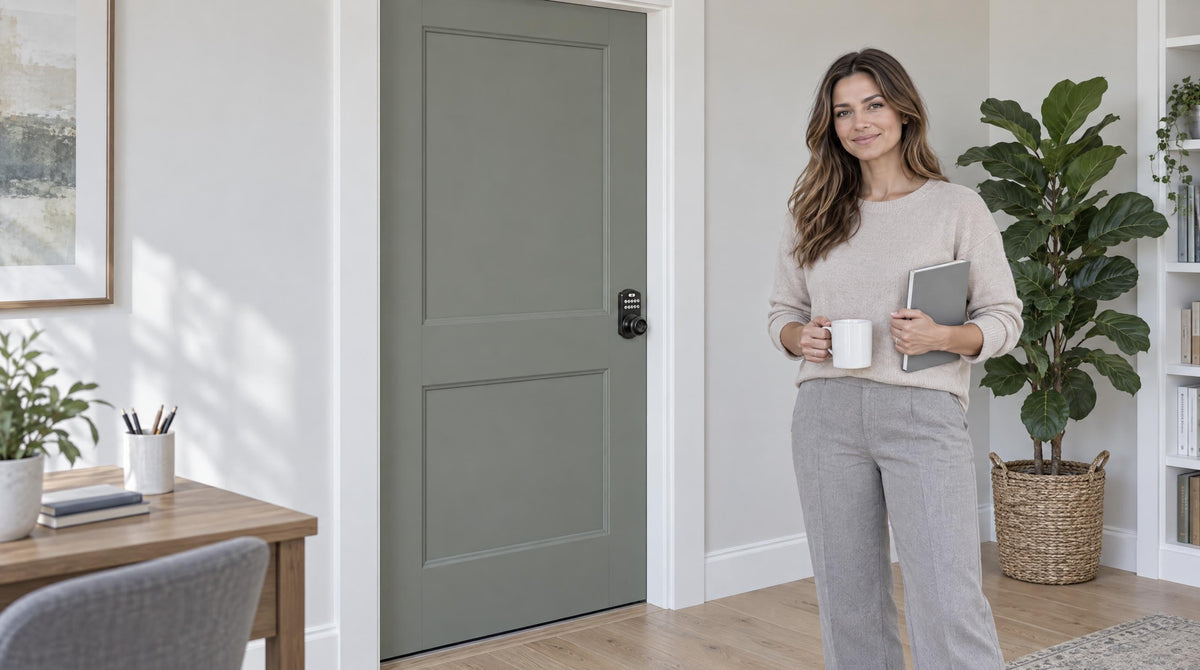
Most conversations about smart locks start and end at the front door — and for good reason. Your entry door is your first line of defense. But once you've secured the perimeter, a quieter question tends to surface: What about the doors inside?
The home office where you take client calls. The bedroom you share a wall with. The storage room where you keep valuables. The guest suite you rent out on weekends. These interior doors have real privacy and access needs — they just need a different solution than a deadbolt.
This guide cuts through the noise. Rather than assuming every interior door needs a smart lock, we'll help you figure out when it genuinely makes sense, when a simpler option will do, and — if you do go smart — which lock type fits which room. Built on Kaadas Group's 38 years of lock industry expertise and 711 patents, Veise's lineup covers the full range, from simple keypad latches to fully connected Wi-Fi smart locks, so you can match the right solution to every door in your home.
Interior Doors Are a Different Problem Than Entry Doors
Exterior entry doors need to stop unauthorized people from getting into your home. That calls for a deadbolt — a solid-bolt mechanism that resists forced entry. Interior doors serve a completely different purpose: they manage privacy and access among people who are already inside. That shift in purpose changes everything about what the right lock looks like.
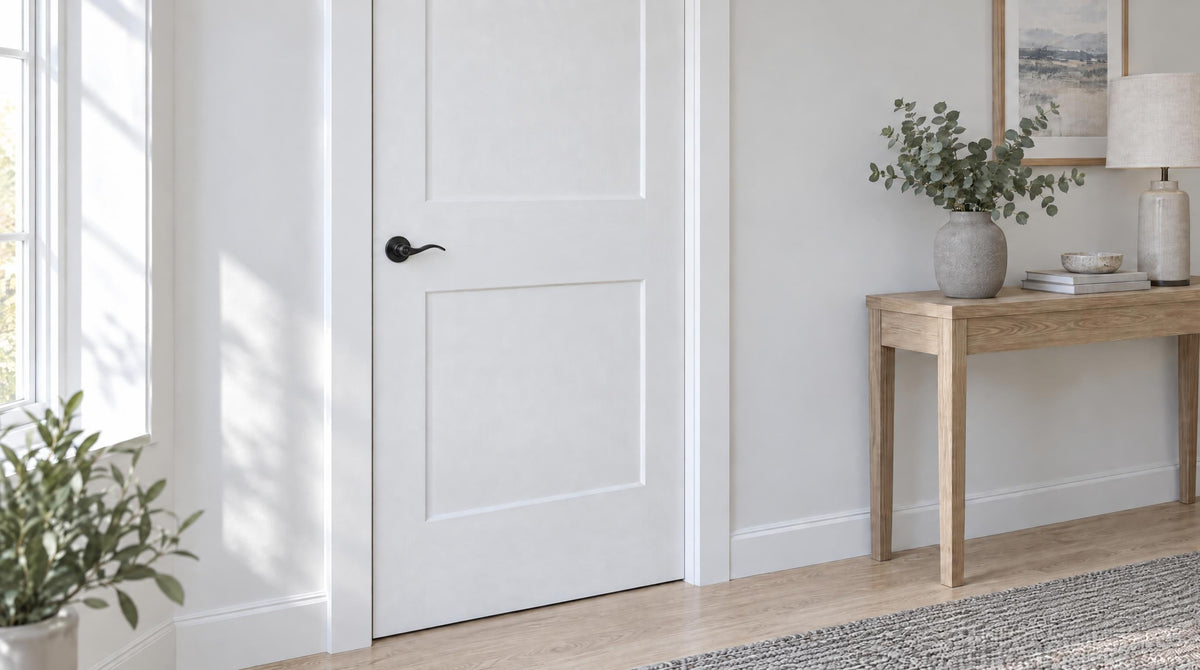
Most interior doors come factory-fitted with a privacy knob or lever — it locks from the inside with a turn knob, no key involved, and carries an emergency release on the outside that opens with a coin or screwdriver. That's not a flaw; it's a deliberate child-safety feature. Interior privacy locks are built to signal "please don't come in" rather than to control access from the hallway. For a bathroom or a nursery, that level of privacy is often perfectly appropriate.
But there are real-life situations where that level of control falls short. When you need to manage who can enter a room (not just whether the door is closed), when keys are a logistical headache, or when you want a record of when a door was accessed, a smart or keypad lock starts to earn its place indoors. The key is knowing which situations actually call for one.
When a Smart Lock on an Interior Door Actually Makes Sense
Not every interior door needs to go keyless. But for the following situations, the upgrade from a privacy knob to a keypad lock is a practical decision, not a gadget splurge.
Your Home Office Needs Real Access Control
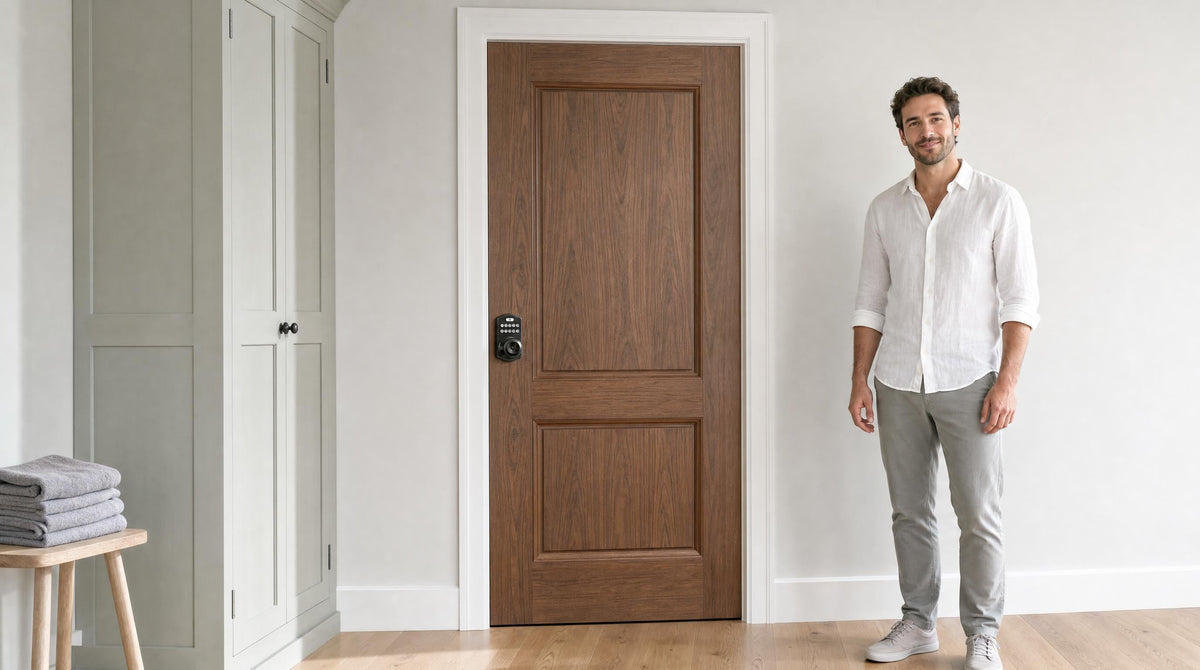
Working from home has changed how people think about interior privacy. If you keep client files, sensitive documents, or expensive equipment in a dedicated office, a privacy lock isn't built for that job — its emergency release exists so nobody gets shut in, which means it isn't controlling who comes through the door. A keypad latch lock gives you a personal code that only you (and anyone you authorize) can enter. No key to misplace for daily entry, and access is yours to grant or revoke. You simply punch in your code, and the door opens.
If you also want the ability to check remotely whether the office door is locked — useful when you've stepped out for a meeting and can't remember if you secured it — a Wi-Fi smart lock or a Smart Lock w/ G1 can give you that visibility through an app from anywhere with an active Internet connection.
You Manage a Short-Term Rental or Guest Room
Property owners who rent out a guest room or in-law suite face a recurring headache: key handoff. Every turnover means coordinating key exchanges, re-keying when a guest forgets to return one, or hiding a spare under the mat (which defeats the purpose). A keypad lock solves this cleanly. You assign a unique code for each guest's stay — a One-Time code, supported on every Veise lock, deletes itself after a single use, and connected models add scheduled Recurring and Duration codes that expire on their own. No physical handoff, no locksmith fees, no security gaps from unreturned keys.
For hosts managing multiple rooms or monitoring access remotely, a connected lock makes even more sense. A Wi-Fi smart lock lets you see entry history through the app, so you know when a room was accessed — a practical feature for any property owner who isn't always on-site.
You Have Young Kids (and Want to Know Who's Coming and Going)
Parents of school-age children often want to know when their kids get home and which rooms they're accessing throughout the day. A standard privacy knob offers zero visibility into this. A connected smart lock — either a Wi-Fi model or a gateway-paired smart lock — lets parents check entry history through the app without having to be in the room. For families in this situation, Veise recommends a Wi-Fi smart lock or a gateway-paired smart lock (rather than an electronic keypad option) specifically because the app visibility is where the real value is for family use.
You Share a Home and Need Personal Space
In a shared household — adult roommates, multigenerational families, or live-in caregivers — interior doors often need to do more than signal privacy. When multiple people share a home but maintain independent spaces (separate bedrooms, private sitting rooms, personal storage areas), a coded lock creates a clear boundary without the awkwardness of a confrontational conversation. Each person has their own code; access is clear and mutual.
You're Securing Storage, a Wine Cellar, or a Valuables Room
Rooms that hold valuables — a wine collection, a gun safe room, jewelry, collectibles, or expensive audio/video equipment — benefit from more than a privacy latch. A keypad deadbolt on these rooms is a practical choice. It provides the same bolt mechanism used on exterior security doors, combined with a personal code instead of a physical key. For rooms like these, the deadbolt format makes more sense than a latch lock, because the goal is security, not just privacy.
When a Standard Privacy Knob Is Probably Enough
To be straightforward: not every interior door needs an upgrade. A standard privacy door knob or privacy door lever is a perfectly sensible solution for bathrooms, powder rooms, and bedrooms in households where the goal is simply "please knock" — not access control. If you're not managing multiple users, don't need an entry log, and won't be frustrated by a misplaced key, the traditional option works just fine.
The honest answer is that smart locks on interior doors make sense when you're solving a real access management or visibility problem. If the problem you have is just "I'd like a moment of privacy in the bathroom," a privacy knob solves that at a fraction of the cost and effort. Upgrade when the situation calls for it — not just because the technology exists.
Which Type of Lock Fits Which Interior Door?
Once you've decided an interior door warrants a smarter solution, the next question is which category of lock is the right fit. Here's a practical breakdown:
Keypad Latch Lock — Simplest Code-Based Privacy
The Keypad Latch Lock is the most straightforward interior upgrade. It replaces a standard latch knob or lever and adds a personal keypad code, with a physical key as a backup. It's a self-contained unit with the handle built into the lock body — available with either a top knob (KS03) or a top lever (KS04) depending on your preference. There's no app, no gateway, and no connectivity to set up. Battery-powered and simple to install, it's an ideal choice for home offices, private bedrooms in shared homes, or any interior door where code-based access is the only upgrade you need.
Keypad Deadbolt — Code Access with Real Security
When the interior room holds something genuinely valuable, a Keypad Deadbolt is a stronger choice. It uses the same bolt mechanism as an exterior security deadbolt but unlocks via keypad code — and on the KS02 series, fingerprint. Veise's keypad deadbolt line includes both standalone deadbolt options and handle-set bundles (with lever or knob). The fingerprint-equipped models (KS02 series) recognize a registered print in under 0.3 seconds, which is handy when your hands are full. Physical key backup is included on all models. This category is a natural fit for storage rooms, study rooms, home server closets, or any space you want to protect with more than a latch.
Smart Lock w/ Gateway — Connected Access Without Wi-Fi Dependency
If you want app control and entry history for an interior door without installing a Wi-Fi lock, a gateway-paired smart lock is worth considering. The Smart Lock w/ G1 is Veise's most fully featured connected option in this category. The entire G1 line is built on a single product series (the VE017) that includes fingerprint access, multilingual voice prompts (English, Spanish, and French), a USB-C emergency power port on every model, and a physical key and key fob as backups — all standard. It pairs with a Veise-developed first-party app via a gateway (sold separately), giving you remote access and entry history from anywhere with an active Internet connection. Even when Wi-Fi is down, app control continues to work locally as long as you're within short-range wireless distance of the lock.
The Smart Lock w/ G2 is another gateway-paired option with more SKU variety — available in both fingerprint and non-fingerprint versions, in standalone or handle-set bundle formats. If Apple Watch unlock or web portal access matters to you, G2 line is the only line that offers those features.
Wi-Fi Smart Lock — Full Remote Control Built In
The Wi-Fi Smart Lock is the most connected interior option, with built-in Wi-Fi that supports remote app control, Alexa and Google Assistant voice commands, fingerprint access, keypad code, and a physical key backup — all without needing a separate gateway. Veise offers two Wi-Fi series: the Touchscreen Wi-Fi Smart Lock (VE027 Series), which features a touchscreen interface, a USB-C emergency power port, key fob support, and on-device EN/ES/FR voice prompts; and the Push-Button Wi-Fi Smart Lock (VE012W Series), which has a traditional press-button keypad and none of those four extras. Both series use an 8 AA/LR6 alkaline battery design for stronger, more stable wireless signal and a longer-lasting power reserve compared to the standard 4 AA setup. For parents who want real-time visibility into when children access a room, or for short-term rental hosts who monitor guest rooms remotely, this is the category that delivers the most peace of mind.
What to Look for in an Interior Smart Lock
Interior doors have different priorities than exterior ones. Here's what actually matters when you're evaluating options for an indoor space:
- Latch vs. deadbolt format: Most interior doors use a latch mechanism (spring-loaded, closes automatically when the door shuts). A latch-format smart lock handles everyday privacy and code access. A deadbolt format is better for rooms where genuine security — not just privacy — is the goal.
- Connectivity level: Ask yourself whether you need remote access and entry history, or just a personal code. Electronic keypad locks (latch or deadbolt) are simpler and less expensive. Connected locks (gateway-paired or Wi-Fi) add visibility and remote control but require more setup.
- Access methods: For a home office or storage room, a keypad code plus physical key backup is often enough. For family monitoring scenarios, fingerprint or app-based access adds convenience. Note that remote access requires a smart lock — gateway-paired or Wi-Fi — not an electronic keypad lock.
- Auto lock: All Veise locks include auto lock — configurable between 10 and 99 seconds on Keypad Deadbolt and Keypad Latch locks, and between 10 and 180 seconds on connected smart locks. It runs on a timer rather than a door sensor, so close the door before the interval expires. For interior doors in busy households, auto lock means you don't have to remember to secure the room every time.
- Door compatibility: Veise locks are designed for wood doors with a standard thickness of 1-3/8" to 2". They are not compatible with fiberglass, metal, storm, or sliding doors. Always confirm your door type before ordering.
- Price range: Veise's lineup runs from $30 to $180 depending on the category and features, putting reliable smart lock hardware within reach for most home improvement budgets.
Veise Products Worth Considering for Interior Doors
Backed by Kaadas Group's 38 years of lock industry expertise, 711 patents (the world's largest smart lock patent portfolio), and recognition by Frost & Sullivan as the global No.1 high-end smart lock brand by sales, Veise builds every lock in its own vertically integrated factory — meaning tighter quality control than brands that outsource production. Here's a quick-reference guide to the Veise categories that make the most sense for interior applications:
- Keypad Latch Locks — Best for: home offices, shared-home bedrooms, guest rooms needing basic code access. Simple, no app required, two handle styles (knob or lever).
- Keypad Deadbolt Locks — Best for: storage rooms, wine cellars, valuables rooms, or any interior space where you want bolt-level security plus a personal code. Fingerprint on every KS02 series model.
- Smart Locks w/ G1 — Best for: families and multilingual households wanting full connected features — fingerprint, multilingual voice (English/Spanish/French), app access, key fob, and physical key — all in one product line.
- Smart Locks w/ G2 — Best for: users who want Apple Watch unlock, web portal access, or a non-fingerprint connected option at a range of price points.
- Wi-Fi Smart Locks — Best for: parents monitoring kids' room access, short-term rental hosts, or anyone who wants full remote app control and voice assistant support without a separate gateway.
- Privacy Door Knobs and Privacy Door Levers — Best for: bathrooms, powder rooms, and any interior door where simple privacy (not access control) is the only goal.
For a complete look at all available options, browse the full Veise product lineup.
Installation: Easier Than You Think
One of the most common hesitations about adding a smart lock to an interior door is the assumption that it requires a contractor or complicated wiring. In practice, Veise smart locks are designed to install in about 15 minutes with a screwdriver — no wiring, no locksmith, no special tools, and no structural modifications to the door. The Effortless Home Improvement™ Experience is built into every product: straightforward instructions, hardware included, and a design that fits standard US wood door prep without extra tooling.
Because Veise locks are full lock replacements (rather than overlays that attach to an existing lock), the door gets a clean, finished look when the install is done. There's no bulky add-on sitting awkwardly over old hardware. And because Veise products require no subscription to access their core features, the only ongoing cost is a fresh set of AA/LR6 alkaline batteries every so often — they aren't included in the box, so pick up a set before you install. All models include a physical key backup, which covers the most common lockout scenarios.
The Right Lock for the Right Door
Smart locks for interior doors aren't a universal upgrade — they're a targeted solution for specific situations. When you're managing access for multiple people, protecting valuables, running a guest suite, or simply wanting to know who's coming and going in your own home, the investment pays off quickly in convenience and peace of mind. When the need is just basic bathroom privacy, a quality privacy knob does the job without the added complexity.
The Veise lineup is designed to cover the full range — from a no-fuss keypad latch for a home office to a fully connected Wi-Fi smart lock for a guest room you manage remotely. With 10M+ smart locks sold across 41+ countries and 400+ global R&D professionals behind every product, Veise builds locks that work reliably from day one and keep working. Easy from Day One.
Frequently Asked Questions
Can you put a smart lock on any interior door?
Veise smart locks are designed for standard wood doors with a thickness of 1-3/8" to 2". They are not compatible with fiberglass, metal, storm, or sliding doors. As long as your interior door meets those specifications and you are the property owner or have authority to modify the door hardware, installation is straightforward.
Do interior smart locks require a Wi-Fi connection to work?
Not all of them. Keypad latch locks and keypad deadbolts operate entirely offline — no Wi-Fi, no app, no gateway required. Gateway-paired smart locks (G1 or G2) and Wi-Fi smart locks do use connectivity for remote features, but keypad code and physical key access always work locally regardless of Internet status.
What's the difference between a keypad latch lock and a keypad deadbolt for interior use?
A keypad latch lock uses a spring-loaded latch that closes automatically when the door shuts — it's the same format as a standard door knob or lever, just with a personal code instead of a key. A keypad deadbolt uses a solid bolt mechanism that requires deliberate engagement, offering more robust security. For most home offices and bedrooms, a latch lock is sufficient. For rooms holding valuables, a deadbolt is the stronger choice.
Can I see when someone entered a room if I have a smart lock?
Yes, but only with a connected smart lock — either a gateway-paired model (Smart Lock w/ G1 or G2) or a Wi-Fi smart lock. These models log entry activity that you can review through the app. Electronic keypad locks (latch or deadbolt without a gateway) do not provide an entry log.
Are Veise smart locks hard to install on interior doors?
No. Veise locks are designed to install in about 15 minutes with a screwdriver. They replace your existing latch or deadbolt hardware entirely, fitting standard US door prep without wiring, a locksmith, or special tools. All required hardware is included in the box.
Do Veise interior locks require a monthly subscription?
No. Veise locks require no subscription. Core features — keypad access, fingerprint, app control (on connected models) — all work without any recurring fee. You pay once for the hardware and that's it.
What happens if the battery dies on my interior smart lock?
All Veise smart locks include a physical key backup, so you can always enter the room even if the battery is fully depleted. On every VE017 series (Smart Lock w/ G1) and VE027 series (Touchscreen Wi-Fi Smart Lock) model, a USB-C emergency power port lets you temporarily power the lock with a portable charger to enter your code without needing the physical key.
Not Sure Which Lock Is Right for Your Door?
The right interior lock depends on your door type, your household, and how much access control you actually need. The Veise team can help you sort it out — no pressure, just practical guidance.
Contact Us and we'll point you to the right product for every door in your home.

Leave a comment
This site is protected by hCaptcha and the hCaptcha Privacy Policy and Terms of Service apply.