
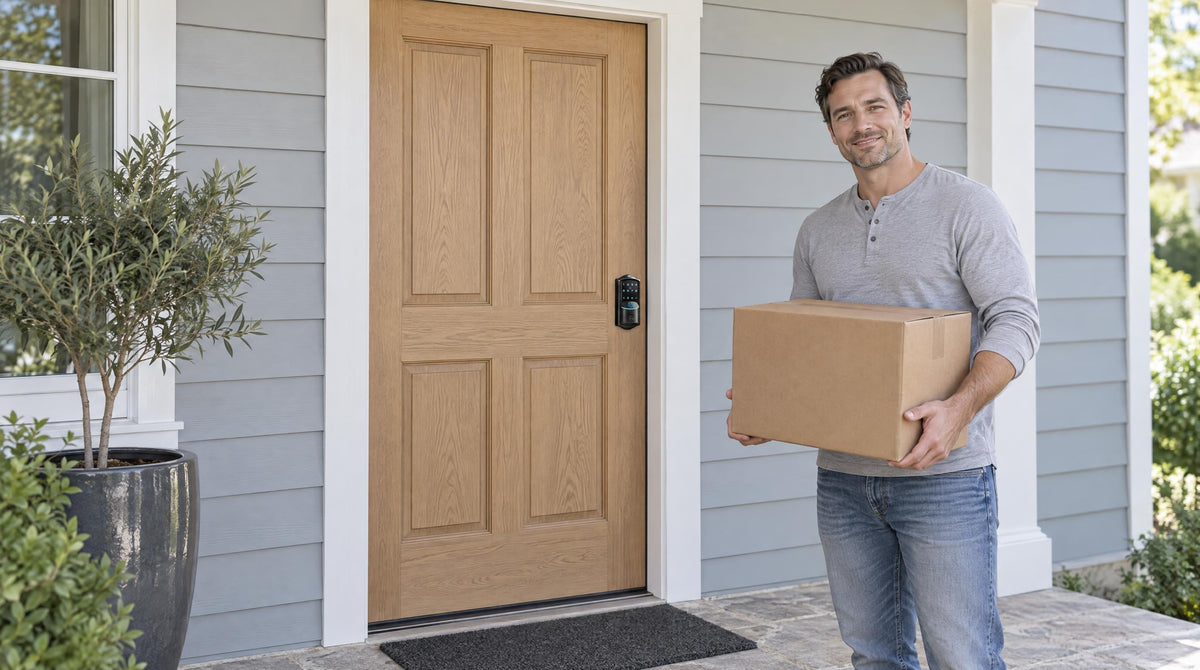
Imagine coming home to find nothing obviously wrong — no broken windows, no kicked-in door, no sign of a struggle. Yet something valuable is gone. No visible evidence of forced entry, and the lock looks perfectly fine. Scenarios like this leave homeowners baffled, and one silent culprit is often responsible: lock bumping.
Lock bumping is a lock-bypass technique that works on the most common type of residential lock — the traditional pin tumbler — and it uses a specially cut key rather than force. It leaves little to no visible damage, which makes it especially concerning for families who rely on everyday cylinder locks for their front door security. The good news is that once you understand how it works, protecting your home from it is straightforward. This guide explains lock bumping clearly, shows you the warning signs to watch for, and walks you through practical steps to close the vulnerability for good.
What Is Lock Bumping?
Lock bumping is a technique used to open a pin tumbler lock without the correct key. It relies on a specially cut tool called a bump key — also known as a "rapping key" — made to fit a given keyway rather than a specific lock.
The technique itself is not new. Records of similar rapping methods date back to a US patent from 1928, and Danish locksmiths were using a version of it in the 1970s as a quick disassembly tool. What changed over time is accessibility: bump keys became easier to source, instructional content spread widely online, and the technique became something that requires no professional skill to attempt. That shift from a locksmith workshop trick to a potential break-in tool is exactly why homeowners need to take it seriously today.
Why Lock Bumping Works on Standard Cylinders
A standard pin tumbler cylinder turns only when its internal pins line up at exactly the right heights — which is what the correct key does. A bump key, tapped sharply, can jostle those pins into that position for an instant, long enough to turn the cylinder. We won't detail the technique here; what matters for homeowners is that the weakness sits in the standard cylinder design rather than in any one brand or price point, and that no visible damage is required. Treat it as a reason to rethink what your front door relies on for everyday entry, not as a reason for alarm.
How Common Is Lock Bumping?
Most homes still rely on a standard cylinder-based deadbolt or knob lock for everyday entry, which is what makes the technique worth knowing about. A share of residential break-ins leave no sign of forced entry, and lock bumping is one of the techniques that can make that possible. It is quiet and — when executed carefully — nearly invisible to the untrained eye. Unlike kicking a door or smashing a window, it draws little attention from neighbors or passersby. Most break-ins are still opportunistic, so the practical goal is simply to make your door a poor target: the right lock, a well-anchored frame, and good visibility.
Signs Your Lock Has Been Bumped
One of the most unsettling aspects of lock bumping is that it can leave no obvious evidence at all. When done skillfully, the process is clean. However, a less practiced attempt — or one carried out with too much force — will often leave a few telltale signs. Here is what to look for:
- Tiny scratches or nicks around the keyhole. The bump key entering and striking the lock can scuff the metal rim of the keyhole, leaving fresh marks or small dents that do not match normal wear from daily key use.
- Shiny metal edges near the keyhole. Freshly exposed metal reflects light differently from aged metal. If you notice bright, clean-looking edges around the keyhole that were not there before, it may indicate the keyhole rim was struck during a bumping attempt.
- A stiff or sluggish key turn. After a bumping attempt, the pins inside the cylinder can become slightly deformed or misaligned, making your regular key feel stiffer or less smooth than usual when you insert and turn it.
- A loose lock cylinder. Repeated or forceful bumping can loosen the cylinder within the door hardware, creating a slight wobble or play that was not present before.
- A door found unlocked with no explanation. If you return home to find your door unlocked, no one else has a key, and there are no signs of forced entry elsewhere, a covert entry method like bumping may be the explanation.
If you notice any combination of these signs, treat it as a serious concern. Contact your local police department to report the potential tampering, then have a locksmith assess the lock and consider upgrading your entry hardware immediately.
How to Protect Your Home from Lock Bumping
The vulnerability sits in the pin tumbler mechanism itself, so protection strategies either reinforce that mechanism, replace it entirely, or layer additional barriers around it. A combination approach gives your home the strongest overall defense.
1. Upgrade to a Bump-Resistant or Bump-Proof Mechanical Lock
Not all traditional locks are equally vulnerable. Bump-resistant mechanical locks use modified pin designs and, in some high-security models, a secondary locking element independent of the pins. These locks will typically carry a UL 437 rating or a similar certification from an independent testing body, and they often feature subtle anti-bump markings near the keyhole. They cost more than a basic hardware-store cylinder, but they offer a meaningful upgrade if you want to keep a keyed entry.
2. Go Keypad or Smart: Take the Key Off Daily Duty
The most practical step for most households is to stop relying on the key cylinder for everyday entry. A keypad or smart lock still includes a physical key cylinder as a backup — every Veise lock does, and the key slot is visible on the exterior — but the code, fingerprint, app, or key fob becomes the way the door is actually used day to day, and the key stays in a drawer. That alone means far fewer keys in circulation to lose or copy. It also brings protections a mechanical cylinder simply doesn't have: on every Veise lock, 10 wrong code attempts trigger an automatic 3-minute pause; anti-peep code entry lets you pad your real PIN with extra random digits so an onlooker can't read it; auto lock re-engages the lock on a timer so the door isn't left unlocked; and on the VE017 series (Smart Lock w/ G1), Away Mode disables PIN and fingerprint entry during travel and flags abnormal unlock attempts. Connected models add entry alerts, so a quiet entry doesn't stay quiet.
3. Reinforce Your Door Frame and Strike Plate
A strong lock on a weak door frame is only half the equation. Many residential strike plates are secured with short screws that go only into the door trim, not the structural framing. Use the strike plate that ships with your lock and make sure its screws are secured into the framing stud behind the trim — that meaningfully increases resistance to forced entry. Similarly, a solid wood door is far more resistant to physical attack than a hollow-core door, regardless of what lock is installed on it. Think of door reinforcement as the layer of protection that stands alongside your lock upgrade, not a substitute for it.
4. Add a Secondary Lock or Guard
A secondary layer — such as a thumb-turn guard, a flip guard, or a door bar — can hold a lock firmly in place from the inside, making a bumped entry much harder to complete even if the cylinder is compromised. These options are primarily useful for doors that are locked from the inside at night (a bedroom door or a side entry used only when home), since they typically cannot be engaged or disengaged from the outside. A half-deadbolt can also serve as a discreet interior-side secondary lock, with no external keyhole to target at all.
5. Improve Visibility Around Entry Points
Even the fastest bump-key attempt still requires a person to stand at your front door with a tool in hand. Good exterior lighting, clear sightlines from the street, and a visible alarm sign all increase the perceived and actual risk for a would-be burglar. Motion-activated lighting and well-trimmed landscaping near entry points remove the cover that makes a covert technique like lock bumping feasible in a busy neighborhood.
Which Veise Lock Fits Your Home?
Every Veise keypad and smart lock keeps a physical key cylinder as a backup, but none of them rely on it for everyday entry — the code, fingerprint, app, or key fob does that job, and each lock is ANSI/BHMA Grade 3 certified with the built-in protections described above. Built on Kaadas Group's 38 years of lock industry expertise and 711 patents — the world's largest smart lock patent portfolio — Veise locks are engineered as full replacements for your existing hardware, not an electronic overlay on an aging lock. Here is how each lock category applies to different home security needs:
Keypad Deadbolt Locks
Veise keypad deadbolts are a straightforward, reliable upgrade for any front door that currently has a standard deadbolt. Authentication is primarily through a keypad code, with a physical key backup on all models and fingerprint recognition on the KS02 series. Because the door opens through a verified code or fingerprint day to day, the key stays in a drawer and there are far fewer copies in circulation. Installation takes about 15 minutes with a screwdriver, requires no wiring, and no professional help. The lock fits wood doors with a standard thickness of 1-3/8" to 2", the same opening your existing deadbolt already occupies. At the accessible end of Veise's $30–$180 lineup, a keypad deadbolt is a practical first step for families who want to take the key off everyday duty on their primary entry.
Keypad Latch Locks
Veise keypad latch locks are an integrated handle-and-lock unit well suited to interior doors, side entries, and garage access doors where a full deadbolt is not the primary hardware. They authenticate via keypad code and include a physical key backup. Two form factors are available — the KS03 with an integrated top knob and the KS04 with an integrated top lever — so you can match the handle style to the rest of your home hardware. Like the keypad deadbolt, everyday entry is by code, with the key as backup.
Smart Lock w/ Gateway 1/2
For families who want remote access on top of keypad entry, a Smart Lock w/ Gateway 1/2 adds app control, key fob backup, and voice assistant support via the paired gateway. The Smart Lock w/ G1 line is built on a single product series — the VE017 — and every model in the line ships with fingerprint recognition (under 0.3 seconds), multilingual voice prompts (English, Spanish, and French), and a USB-C emergency power port, making it a strong all-in-one choice. The Smart Lock w/ G2 line offers more SKU variety, including non-fingerprint options and Apple Watch unlock — a useful feature for households already in the Apple ecosystem. Remote locking, remote unlocking, and off-site activity alerts all require an active Internet connection, but if Wi-Fi is down, app control continues to work locally as long as you are within short-range wireless distance of the lock. For parents who want to check whether the kids got home safely or confirm the door is locked while traveling, this category delivers genuine peace of mind on top of the keypad fundamentals.
Wi-Fi Smart Locks
Veise Wi-Fi smart locks connect directly to your home Wi-Fi network with no separate gateway required, making setup especially simple. Two series are offered: the Touchscreen Wi-Fi Smart Lock (VE027 Series), which features a touchscreen interface and a USB-C emergency power port on every model, and the Push-Button Wi-Fi Smart Lock (VE012W Series), which uses a traditional press-button keypad. Both series support fingerprint recognition, keypad code, app control, and voice commands via Alexa and Google Assistant directly through the built-in Wi-Fi. The VE027 series also adds key fob support and on-device English, Spanish, and French voice prompts, neither of which is on the VE012W series. Both share an 8 AA/LR6 alkaline battery design for a stronger signal and longer-lasting power reserve than the standard 4 AA setup. Physical key backup is included on all models. For a household that wants the full suite of remote monitoring, entry history, and voice control in a single lock, a Wi-Fi smart lock is the most self-contained option Veise offers.
Whichever category fits your home, the core promise is the same: every Veise lock is designed to be a full replacement of your existing hardware, not an add-on overlay. Recognized by Frost & Sullivan as the global No.1 high-end smart lock brand by sales, and with 10M+ smart locks sold across 41+ countries, Veise brings proven, real-world reliability to a decision that matters. Easy from Day One.
Conclusion
Lock bumping is a real vulnerability, but it is also a solvable one. The technique works because traditional pin tumbler locks share the same fundamental design flaw — and that weakness stops being your front door's everyday entry the moment you move to a keypad or smart lock. Understanding what bumping is, knowing the signs to watch for, and layering your protection (upgraded lock, well-anchored strike plate, improved exterior visibility) puts you well ahead of where most households are today.
Whether you start with a Veise keypad deadbolt for a straightforward front-door upgrade or step up to a Wi-Fi smart lock for full remote monitoring, every option in the Veise lineup moves everyday entry to a code, fingerprint, or app — with the physical key kept as a backup — and adds lockout protection, anti-peep entry, and auto lock. The Effortless Home Improvement™ Experience means each lock installs in about 15 minutes with a screwdriver — no special tools, no wiring, no professional required. Protecting your home from lock bumping does not have to be complicated. The right lock, properly installed, closes the door on this threat for good.
Frequently Asked Questions
Can all locks be bumped?
No. Lock bumping targets standard pin tumbler cylinders — the most common type found on residential doors. Locks with different internal mechanisms, such as disc detainer locks and high-security locks with sidebar technology, resist the standard technique. A keypad or smart lock still includes a key cylinder as a backup — every Veise lock does — but daily entry no longer depends on it, and the lock adds protections a mechanical cylinder can't: automatic lockout after 10 wrong attempts, anti-peep code entry, auto lock, and entry alerts on connected models.
Is lock bumping illegal?
Laws vary by country and state. In many jurisdictions, possessing a bump key without a legitimate professional purpose (such as a licensed locksmith) can be treated as possession of burglary tools, which is a criminal offense. Using a bump key to enter a property without authorization is illegal everywhere. If you discover that your home has been entered this way, report it to the police.
Will my homeowner's insurance cover a lock bumping break-in?
This depends on your policy. Many standard policies require proof of forced entry, and because lock bumping leaves little visible damage, demonstrating that a break-in occurred can be difficult. Review your policy carefully and consider upgrading your locks as a proactive measure. Some insurers may also offer a discount for homes with certified security hardware, so it is worth asking.
Does a Veise keypad or smart lock still have a keyhole?
Yes. Every Veise lock — keypad deadbolt, keypad latch, Smart Lock w/ Gateway 1/2, and Wi-Fi smart lock — ships with a physical key cylinder as a backup, and the key slot is visible on the exterior. The difference is that the key is no longer how the door is used every day: a code, fingerprint, app, or key fob handles daily entry, so the key stays in a drawer and far fewer copies are in circulation. The lock also adds lockout protection, anti-peep entry, and auto lock on top of a Grade 3 deadbolt.
Do Veise smart locks require a subscription?
No. Veise smart locks do not require any subscription or ongoing fees. All core functionality — keypad access, app control, auto lock, entry history, and fingerprint recognition — is included with the hardware purchase at no additional cost.
How difficult is it to install a Veise lock?
Veise locks are designed for straightforward DIY installation on wood doors with standard thickness (1-3/8" to 2"). Most homeowners complete the swap in about 15 minutes using a screwdriver — no wiring and no professional help required. Because Veise is a full lock replacement (not an overlay), you will need to remove your existing lock hardware before installing. Property owners or anyone with authority to modify their door hardware can handle the install themselves.
Ready to Take the Key Off Front-Door Duty?
Browse the full Veise lineup and find the right lock for your home — no subscription, no professional install required.

Leave a comment
This site is protected by hCaptcha and the hCaptcha Privacy Policy and Terms of Service apply.