
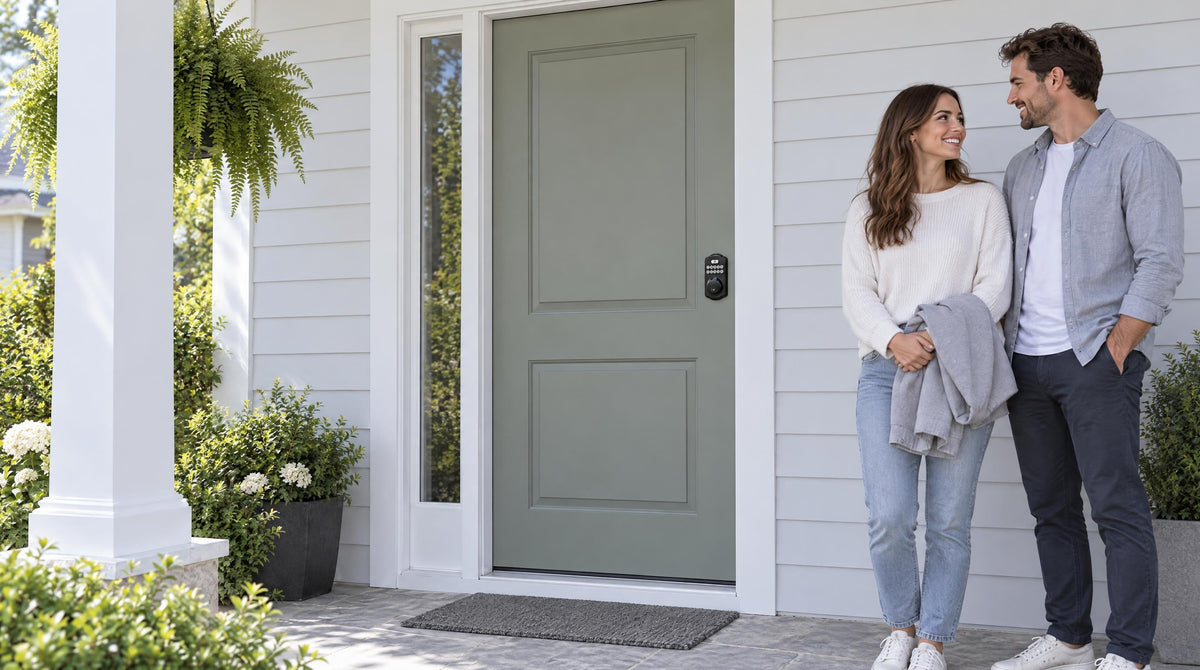
There are moments when you need a door secured right now — not after a locksmith appointment, not after a hardware run, but right now. Maybe the lock on your vacation rental feels unreliable. Maybe you moved into a new place and haven't replaced the old hardware yet. Maybe a bedroom door latch gave out and the kids are already in bed. Whatever the situation, knowing how to lock a door from the inside using what you have on hand is a genuinely useful skill.
At the same time, quick fixes are just that: quick. If you find yourself patching together security more than once, that's a signal your door hardware needs a real upgrade. This guide walks you through both sides — the practical short-term methods that work in a pinch, and the permanent solutions that give your family lasting peace of mind. Whether you need a stopgap for tonight or a smarter lock for the long run, you'll find the right answer here.
Why Locking From the Inside Matters
Locking a door from the inside goes beyond the obvious scenario of keeping intruders out. It also covers privacy (a bedroom or bathroom that needs a signal of "occupied"), personal safety during a late night at home, and practical situations like staying in an unfamiliar property where you can't vouch for the condition of the existing hardware. In short-term rentals and hotel rooms, the locks may be functional but worn — and a backup measure costs nothing but a little preparation.
It's also worth noting that inside-locking methods divide neatly into two categories: temporary measures (no tools, no installation, easy to remove) and permanent hardware upgrades (installed once, work every single time). Temporary methods are practical when you're traveling, when you're renting a room and can't modify the door, or when something breaks unexpectedly. Permanent upgrades are the right call for homeowners who want consistent, reliable security they can count on for years.
Know Your Door Before You Choose a Method
Not every method works on every door. Before reaching for a wedge or a belt, take five seconds to answer three questions: Does your door swing inward or outward? Does it have a lever handle or a round knob? And does it have a hydraulic door closer at the top (common in apartment hallways and offices)?
Most residential interior doors swing inward, which means wedges, chairs, and barricade bars all work well because they brace against the floor or the door itself. Outward-opening doors are trickier — wedges won't hold, and a chair against the knob will simply slide as the door opens away from it. For those, a belt looped around a fixed anchor point or a portable latch lock that attaches to the strike plate is a better choice. Knowing this upfront saves you from a frustrating moment when a clever-sounding method simply doesn't apply to your door.
Temporary Methods: How to Lock a Door From the Inside
The methods below range from "grab and go" to "requires a little prep." They're ordered roughly from most to least effective for a standard inward-swinging residential door. None of them require permanent installation, and most use items you likely already own or can pick up for a few dollars.
1. Use a Door Wedge or Rubber Stopper
A rubber door wedge is probably the simplest, most portable inside-locking tool available. You slide it under the door on the inside, and the friction between the wedge and the floor creates resistance that prevents the door from swinging open. The harder someone pushes, the deeper the wedge bites into the gap — making it surprisingly effective against steady pressure. Rubber wedges work best on hard floors (tile, hardwood, laminate); on thick carpet, the grip is weaker.
For travelers, a good wedge is worth keeping in a bag. They weigh almost nothing, cost just a few dollars, and work in hotel rooms, short-term rentals, and any unfamiliar space. The one limitation: wedges only work on inward-opening doors. If your door swings outward, skip to the belt or portable lock methods below.
2. Use a Portable Travel Lock
Portable travel locks (sometimes called door latch locks or security door locks) are small devices that clip onto the door's existing strike plate and block the latch from retracting. They require no tools, no drilling, and no permanent changes to the door or frame. When you leave, you simply remove them and slip them in your bag. These are particularly popular with travelers and anyone staying somewhere temporarily.
The strength of a good portable lock can be comparable to a standard deadbolt for a door that doesn't already have one. The catch: they need a functional strike plate to attach to, which most doors have. If the strike plate is damaged or missing, a wedge or barricade bar is a better fallback.
3. Brace It With a Security Bar or Floor Barricade
For the strongest temporary inside lock, a security bar or floor barricade is the go-to option. These devices work by wedging against the floor on one end and the door handle or door itself on the other, physically blocking the door from opening inward. A quality security bar can resist hundreds of pounds of outward force — far more than a chain lock or a standard latch. They're a smart choice for front doors in ground-floor apartments or any main entry where you want extra reinforcement at night.
Floor-mounted barricades use a base plate that anchors to the floor and a removable bar that slots in. These are semi-permanent and very strong, though they do require a quick screw installation for the base. Adjustable security bars that prop against the handle require no installation at all and can be stored in a closet when not in use. Either version is a meaningful security upgrade over a wedge alone.
4. The Chair Method
The classic chair-under-the-doorknob trick works by using the chair's back as a prop — angled so that the top rail locks under the handle and the chair legs press into the floor. The geometry creates leverage that resists the door being pushed open. It's a useful backup in a hotel room or any room with a round doorknob (it's harder to execute with lever handles, which the chair back can slip off of).
Keep in mind that this method works best with a sturdy, straight-backed chair and a non-slippery floor. A lightweight folding chair or a chair on a tile floor without traction will shift under pressure. It's better than nothing in a pinch, but it's not a substitute for a real lock — think of it as a way to add a few extra seconds of resistance and a noise alert if someone does try to push through.
5. The Belt Method
A belt works as a door lock in two specific scenarios. The first is on a door with a hydraulic closer (the metal arm at the top of the door, common in office hallways and apartment buildings): loop one end of the belt around the door handle and the other end around the arm of the closer, pull it snug, and the closer can't move — which keeps the door shut. The second scenario is for outward-opening doors: tie one end to the handle and the other to a fixed, heavy anchor point (a bed frame, a heavy piece of furniture), so the door is physically held closed from the inside.
A genuine leather belt holds better under stress than a fabric or synthetic one. This is a last-resort method — useful when nothing else is available — but in the right situation, it's surprisingly effective. If your door has a hydraulic closer and you're in an unfamiliar space, this is one of the fastest inside locks you can set up in under thirty seconds.
6. The Fork Hack
This one requires a little prep work, but it's a clever hack that's become popular online for good reason. The idea: bend the tines (prongs) of a metal fork to a 90-degree angle so they fit into the door's latch hole in the strike plate. Then cut the fork's handle short. When the door is closed, the bent tines sit in the latch hole and the cut handle slots between the tines on the inside, acting like a bar that keeps the door from opening.
It works best on older-style knob-and-latch setups with a standard strike plate hole. It's not going to stop a determined forced entry, but as a privacy lock or a quick backup when no other option exists, it's genuinely useful. Just make sure you have a pair of pliers and wire cutters handy if you want to prepare one in advance — it's not something you can improvise in the moment without tools.
When Temporary Isn't Enough: Permanent Lock Upgrades
Temporary methods are valuable in the right context, but if you're reaching for a chair or a wedge every night before bed in your own home, that's not a security solution — that's a gap in your hardware. For homeowners, the right answer is a permanent lock upgrade. This doesn't have to mean an expensive contractor or a complicated installation. It often just means replacing or adding the right lock to the right door.
For interior doors — bedrooms, bathrooms, home offices — a privacy knob or privacy lever is the standard choice. These lock from the inside with a simple turn and have an emergency release on the outside (usually a small slot for a coin or screwdriver) so no one gets permanently locked in. Veise offers both Privacy Door Knobs and Privacy Door Levers that install quickly and coordinate across rooms for a consistent look throughout the home.
For exterior doors — front door, back door, garage entry — a deadbolt is typically the right primary lock. A single-cylinder deadbolt operates with a key on the outside and a thumb-turn on the inside, giving you solid inside-locking ability without needing to find a key in the middle of the night. Veise's Deadbolt Lock collection covers standalone deadbolts that install above or below existing handle hardware, as well as complete Keyed Entry Handlesets that bundle a deadbolt with a keyed lever or keyed knob in one coordinated package.
If you want keypad convenience on an exterior door without the smart-home complexity, a Keypad Deadbolt Lock gives you code-based inside and outside locking with a physical key as a backup — no fumbling for keys in the dark, no forgotten codes leaving you locked out. For interior or secondary doors where a full deadbolt isn't needed, a Keypad Latch Lock combines a handle and keypad in one unit, keeping entry simple without over-engineering the hardware.
Interior Doors vs. Exterior Doors: Matching the Right Lock
One of the most common sources of confusion in home security is treating every door the same way. The right lock depends on what that door is protecting. Here's a quick way to think about it:
- Bedroom and bathroom doors: Privacy knobs or privacy levers. The goal is a simple "occupied" signal with an inside lock — not a high-security latch. Easy for kids to use, easy for adults to unlock from outside in an emergency.
- Home office or utility room doors: A keyed entry knob or lever works well here, or a privacy function if you just want inside-locking ability. Veise's Keyed Entry Door Knobs and Keyed Entry Door Levers are practical, durable options that install in minutes.
- Front door and back door: A deadbolt — standalone or combined with a keyed entry handle — is the standard for exterior entries. The thumb-turn inside gives you fast, reliable inside-locking ability at any hour.
- Garage-to-house door: Often overlooked, but this door deserves the same treatment as a front entry. A deadbolt here is worth the investment.
The key principle: match the security level to the risk level. Interior doors need privacy, not fortress-grade hardware. Exterior doors need real resistance to forced entry. Getting that match right means your home is neither under-protected where it matters nor over-engineered where it doesn't need to be.
Step Up to a Smart Lock for Whole-Home Security
If a reliable inside lock is your starting point, a smart lock is the natural next step for homeowners who want more. Rather than just locking from the inside, a smart lock lets you lock and unlock from anywhere — check whether the front door is secured while you're at work, let in a trusted family member remotely, or receive an alert the moment someone enters. That kind of visibility is especially useful for families with kids coming home from school before parents arrive.
Veise smart locks are designed around the Effortless Home Improvement™ Experience — meaning real families can install one in about 15 minutes with a screwdriver, no wiring, no professional help required. Backed by Kaadas Group's 38 years of lock industry expertise and 711 patents (the world's largest smart lock patent portfolio), every Veise lock is built in-house at their own factory — not assembled from third-party parts like many competing brands. That vertical integration means tighter quality control and locks that are built to last.
Veise offers several smart lock categories, each suited to different needs:
- Wi-Fi Smart Lock: Built-in Wi-Fi means no separate gateway needed. Lock or unlock remotely via app, control with Alexa or Google Assistant, and monitor entry history from your phone. Available in a Touchscreen (VE027 Series) and a Push-Button (VE012W Series) — both include fingerprint recognition (<0.3s scan) and multiple unlock methods; the VE027 series adds a touchscreen, USB-C emergency power, key fob, and English/Spanish/French voice prompts, none of which are on the VE012W series. A solid pick for families who want remote visibility without extra equipment.
- Smart Lock w/ G1: The entire G1 line is one series — the VE017. Every Smart Lock w/ G1 ships with fingerprint access, multilingual voice prompts (English, Spanish, and French), a USB-C emergency power port, key fob backup, and physical key backup. Pairs with a Veise-developed first-party app for the most seamless connected experience. An excellent all-in-one pick for households that want reliable app control without compromise.
- Smart Lock w/ G2: Smart Lock w/ G2 brings Apple Watch unlock and web portal control — unique features not available on any other Veise lock. Multiple SKU options including both fingerprint and non-fingerprint models, in standalone or handleset configurations. English voice prompts only.
- Keypad Deadbolt: For homeowners who want keypad code entry and physical key backup without app connectivity. The KS02 series adds fingerprint. Simple, reliable, and affordable — a strong upgrade over a standard keyed deadbolt for anyone who hates carrying keys.
All Veise locks are ANSI/BHMA Grade 3 certified — the recognized standard for residential hardware — and are compatible with standard wood doors (1-3/8" to 2" thickness). The full lineup ranges from $30 to $180, positioning Veise as an affordable mid-range option that doesn't ask you to choose between quality and budget. No subscription required.
Browse the complete range at All Veise Products to find the right fit for every door in your home.
The Bottom Line
Locking a door from the inside doesn't have to be complicated. In a pinch, a wedge, a portable lock, or even a sturdy chair can do the job. But for your own home, the most reliable solution will always be the right hardware installed properly — whether that's a privacy knob on a bedroom door, a solid deadbolt on the front entry, or a smart lock that lets you monitor and control access from anywhere. The goal isn't to patch things up every night. It's to set up your home once, correctly, and stop thinking about it.
If you're ready to make that upgrade, Veise has a full range of mechanical locks, keypad locks, and smart locks built to make that process as straightforward as possible — no subscription, no complicated setup, and no professional help required for most installs. From simple Privacy Door Knobs and Deadbolt Locks to fully connected Wi-Fi Smart Locks, there's a solution for every door in your home. Easy from Day One.
Frequently Asked Questions
What is the easiest way to lock a door from the inside without a lock?
The easiest method is a rubber door wedge pushed firmly under an inward-swinging door. It requires no tools, costs just a few dollars, and creates strong friction resistance. For outward-swinging doors, a portable travel lock attached to the strike plate is the quickest no-drill option.
Does the chair-under-the-doorknob trick actually work?
It can work in the right conditions — a sturdy chair, a non-slippery floor, and a round doorknob that the chair back can brace under. It won't stop a forced entry, but it adds resistance and makes a noise if someone pushes against the door. It's a useful short-term privacy measure, not a security solution.
What is the best lock for inside a bedroom door?
A privacy knob or privacy lever is the standard recommendation for bedroom doors. These lock from the inside with a simple turn, and they have an emergency release slot on the outside so no one gets trapped. They're easy for children to use and don't require a key.
Can you lock a door from the inside without any tools or hardware?
Yes. A rubber door wedge, a portable travel lock, a security bar, a heavy chair against the knob, or a belt looped around the handle and a fixed anchor point are all no-drill, no-tool options. Their effectiveness varies by door type and situation, but several of them — especially a good security bar or portable lock — offer meaningful protection.
What is the difference between a privacy lock and a deadbolt?
A privacy lock is designed for interior doors — it locks from the inside with a button or turn and has a simple outside emergency release. It provides privacy, not high-security protection. A deadbolt extends a solid metal bolt deep into the door frame and is designed for exterior doors where resistance to forced entry is the goal. Both types are useful; they just serve different purposes on different doors.
How do smart locks help with inside door security?
A smart lock lets you lock your door from inside the home or remotely via a mobile app with just a tap. You can also set auto lock so the lock re-engages automatically after a set interval — 10 to 99 seconds on Keypad Deadbolt and Keypad Latch locks, 10 to 180 seconds on connected models — no more wondering whether you remembered to lock up. Wi-Fi smart locks and Smart Lock w/ Gateway 1/2 (Veise's Wi-Fi Smart Lock and Smart Lock w/ G1 and G2 lines) go further, giving you a live entry log, remote alerts, and the ability to grant or revoke access from anywhere with an Internet connection.
Are Veise smart locks hard to install?
No. Veise smart locks are designed for DIY installation — most homeowners complete the install in about 15 minutes with just a screwdriver. No wiring and no professional help required. They are compatible with standard wood doors between 1-3/8" and 2" thick and require a full lock replacement (not an overlay), so the buyer should be the property owner or someone with authority to modify the door hardware.
Have Questions About the Right Lock for Your Door?
The Veise team is here to help you find the right fit — whether you're replacing a single bedroom lock or upgrading every entry in your home.

Leave a comment
This site is protected by hCaptcha and the hCaptcha Privacy Policy and Terms of Service apply.