
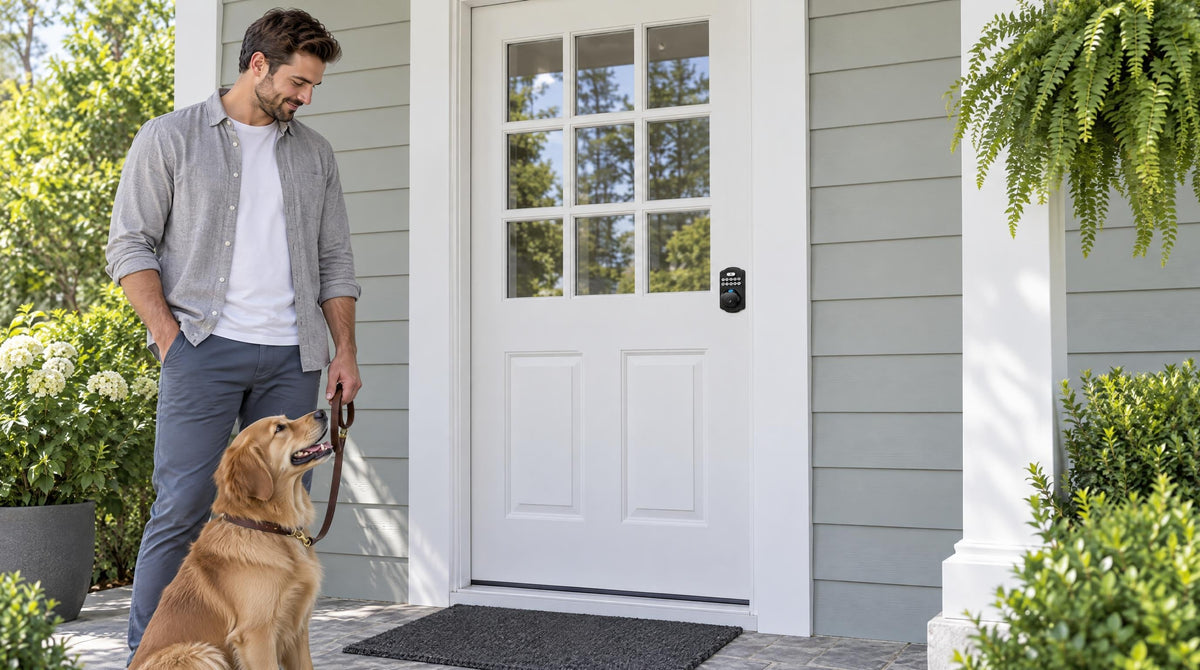
Every year, homeowners search for a simpler, more reliable way to secure their front door — and fingerprint locks keep rising to the top of that list. Touch a sensor, hear the click, walk inside. No key to hunt for, no code to forget. But as the technology becomes more common, so does the question: are fingerprint door locks actually safe?
The honest answer is: it depends on who made it, how it stores your data, and what type of sensor sits inside the lock body. Generic marketing language tells you fingerprint locks are "virtually impenetrable." The engineering data tells a more nuanced story — one where well-built locks genuinely outperform traditional keys in most real-world scenarios, but where cut-corner products introduce risks that cheap marketing glosses over. This article walks through what the research actually shows, explains the risks worth caring about (and those that aren't), and gives you a practical checklist for choosing a fingerprint lock you can trust.
How Fingerprint Door Locks Actually Work
A fingerprint door lock captures the unique ridge-and-valley pattern of your finger, converts that pattern into a mathematical template, and stores the template locally on the lock's chip. When you touch the sensor to unlock, the live scan is compared against the stored template in a fraction of a second. If the match score clears a preset threshold, the deadbolt or latch releases. No image of your actual fingerprint is ever stored — only a numerical representation of it, which cannot be reverse-engineered into a usable print. Fingerprint deadbolt locks and Wi-Fi smart locks with fingerprint capability both follow this same foundational process.
The sensor technology inside the lock matters enormously. Optical sensors work like a tiny camera — they capture a 2D light-based image of your fingertip surface. They are cost-effective and widely used, but because they rely on image capture, optical sensors are more vulnerable to basic spoofing attempts since the underlying system is still image-based. Capacitive sensors, by contrast, measure the electrical charge differential between the ridges and valleys of your finger as it makes physical contact with the sensor plate. A capacitive-type sensor offers security advantages over optical sensors — for example, placing a high-quality photograph of a finger over a capacitive sensor will not fool it, because it requires the physical presence of a real finger to generate a charge pattern. For a residential front door, this distinction is a meaningful one.
Once enrolled, the lock compares future scans to your stored template using an algorithm tuned to balance two competing error types: the rate at which an unauthorized person is wrongly accepted, and the rate at which a legitimate household member is wrongly rejected. Getting both numbers low simultaneously is the core engineering challenge of any fingerprint system.
What the Data Actually Shows About Fingerprint Lock Safety
Security researchers measure fingerprint lock performance using two standardized metrics: False Acceptance Rate (FAR) and False Rejection Rate (FRR). FAR measures how often an unauthorized person's fingerprint is incorrectly accepted. FRR measures how often a legitimate household member is wrongly turned away. Professionals evaluating fingerprint door locks for security applications rely on these standardized error-rate benchmarks rather than marketing claims.
The numbers, when quality components are involved, are genuinely impressive. False acceptance rates on professional-grade systems are typically below 0.0001% — orders of magnitude more secure than a 4-digit PIN that can be shoulder-surfed or brute-forced. For context, a standard 4-digit PIN code has 10,000 possible combinations, giving an intruder a 1 in 10,000 chance of guessing correctly — while advanced biometric fingerprint sensors can achieve a false acceptance rate as low as 1 in 10,000,000. That gap is significant for any homeowner trying to make a practical security decision.
False rejection rates have also improved substantially as sensor algorithms have matured. False rejection rates have dropped dramatically in leading systems, with properly enrolled fingerprints now sitting below 0.5%. The enrollment process itself plays a direct role here. Veise locks, for example, capture your finger eight times during setup to build a reliable template across different angles and pressure levels — meaning the lock recognizes you consistently whether you press firmly or rest your finger lightly. The result for a typical family is a lock that opens quickly and reliably for everyone enrolled, while keeping everyone else out.
How does this compare to a traditional keyed deadbolt? Traditional keys can be copied in minutes at any hardware store, lost on a commute, or simply hidden under a doormat. Unlike keys that can be copied in minutes or passwords that can be guessed, shared, or phished, your fingerprint is unique and stays with you. The data consistently shows that fingerprint authentication, when implemented on quality hardware, raises the security floor substantially above what a physical key provides.
The Real Risks (and How Serious They Are)
Security honesty requires acknowledging that fingerprint locks are not perfect — but it also requires putting the risks in realistic context. The threats that researchers study and the threats that actually face a residential homeowner are quite different things.
Spoofing with Artificial Fingerprints
This is the attack that makes headlines. Research conducted by Cisco Talos demonstrated that artificial fingerprints created using materials like fabric glue or 3D printing technology could successfully deceive fingerprint sensors on multiple devices, achieving approximately 80 percent success rates in testing. That sounds alarming until you factor in what the attack actually requires: a research team, specialized lab materials, a lifted copy of your specific fingerprint, significant time, and close physical access to your lock. The kind of burglar who breaks into residential homes does not operate this way. Most burglars don't enter through the front door anyway — they look for unlocked doors or windows they can force open. Spoofing attacks are a real concern for high-value corporate or government targets; for a family home, they are a theoretical risk rather than a practical one.
Environmental Factors
Factors like dirt, moisture, or injuries on fingers can affect a scanner's ability to recognize fingerprints accurately. A well-designed lock addresses this through multi-sample enrollment (capturing the finger from multiple angles during setup), adaptive template updating, and a physical key backup on every model. If your finger is wet from washing dishes or slightly cut, the physical key is always there as a fallback. Veise keypad deadbolt locks and smart locks include a physical key backup on every model precisely because real-world reliability matters more than a clean spec sheet.
Power and Battery Dependency
Fingerprint door locks rely on electricity or batteries, and power outages or drained batteries can render them inoperative. This is a real consideration, not a dismissible one. Choose a lock with a clearly communicated battery life, a low-battery alert that gives you enough lead time, and an emergency power option. On the Veise VE017 and VE027 series, a USB-C emergency power port — standard on every model in those two series — means you can connect a portable charger to the port and unlock immediately — no locksmith call required.
Brute-Force and Digital Attacks
Some researchers have documented attack methods that exploit gaps in how fingerprint data is handled at the hardware level. A method called BrutePrint exploits vulnerabilities in fingerprint authentication systems stemming from inadequate protection of fingerprint data on the Serial Peripheral Interface hardware, allowing attackers to circumvent traditional failed-attempt limitations. Well-built locks counter this with lockout policies that engage after a set number of failed attempts (Veise lock automatically pauses for 3 minutes after 10 wrong attempts), which are long enough to frustrate a malicious actor trying multiple different fingerprints but short enough not to inconvenience a legitimate user who just had a few bad scans. For connected smart locks, keeping firmware updated closes the software-side gaps as they're discovered.
The Privacy Question: Where Does Your Fingerprint Data Go?
Many homeowners are more worried about their fingerprint data than about physical break-ins — and that concern is fair. If a password is compromised, you change it. A fingerprint is permanent. Since a fingerprint lasts a lifetime, once it is leaked, it is leaked for the rest of the user's life. This makes data handling one of the most important questions to ask before buying any biometric lock.
The answer depends entirely on how a lock is designed. Reputable manufacturers never store actual fingerprint images — only non-reversible mathematical templates that cannot be reverse-engineered into a usable fingerprint even if the device is compromised. Many systems also support on-device processing, with no biometric data ever leaving the lock. This is the architecture that matters: your fingerprint is processed and stored entirely on the lock itself, never uploaded to a server, never tied to a cloud account, and never exposed to an Internet breach.
Veise fingerprint locks are built on exactly this principle. The AI chip inside each lock processes enrollment and matching locally — your fingerprint template lives on the device and nowhere else. You don't need an Internet connection to enroll a new family member, and a server outage will never lock you out of your own home. For families who value both convenience and privacy, this local-first design is not a minor feature — it is the feature.
What to Look for in a Safe Fingerprint Lock
Not all fingerprint locks are built to the same standard. Here is what to check before buying:
- Sensor type: Capacitive sensors offer higher baseline security than optical sensors, particularly in terms of resistance to spoofing. For a residential front door, capacitive is the better choice.
- Fast, stable recognition: Look for a scan time around 0.3 seconds and a multi-scan enrollment process that captures the finger from several angles, so the lock reads every household member consistently.
- On-device data storage: Confirm that fingerprint templates are stored and processed locally on the lock, not on a cloud server.
- Lockout policy: The lock should disable the fingerprint sensor after a set number of failed attempts to block brute-force entry.
- Multiple backup entry methods: A physical key backup is essential. A keypad code backup adds another layer. Look for locks that offer multiple ways to enter so no single point of failure can strand you outside your own door.
- ANSI/BHMA certification: For residential use, ANSI/BHMA Grade 3 is the standard — it covers the mechanical and structural integrity tests that validate the lock's physical strength, not just its electronics.
- Brand engineering depth: Choose a manufacturer with genuine lock-engineering experience, not just a consumer electronics brand that recently added a fingerprint scanner to a commodity product.
Each of these criteria filters out a significant portion of the market. The locks that clear all of them are genuinely safe for residential use.
How Veise Fingerprint Locks Are Built for Real-World Safety
Easy from Day One — that promise carries weight because of where it comes from. Veise is built on Kaadas Group's 38 years of lock industry expertise and backed by 711 patents, the world's largest smart lock patent portfolio. With 10M+ smart locks sold across 41+ countries and recognition by Frost & Sullivan as the global No. 1 high-end smart lock brand by sales, the engineering behind every Veise lock reflects decades of real-world residential security work — not a recent pivot into smart home gadgetry.
Fingerprint capability is available across several Veise lock categories, and understanding which one fits your door and household is straightforward. The Keypad Deadbolt line offers fingerprint models (the KS02 series) for exterior doors where a full deadbolt replacement makes sense. These locks recognize your finger in under 0.3 seconds, store multiple unique fingerprints for everyone in the household, and always include a physical key backup. Every model carries ANSI/BHMA Grade 3 certification — the residential standard — and requires nothing more than a screwdriver and about 15 minutes to install, with no wiring and no subscription fees.
For families who want remote monitoring alongside fingerprint entry, the Wi-Fi Smart Lock line combines on-device biometric storage with full app control via built-in Wi-Fi. Parents can check entry history, receive alerts for access attempts, and remotely lock or unlock from anywhere — all through the app without a separate gateway. The VE027 series features a touchscreen interface, a USB-C emergency power port, key fob support, and on-device voice prompts in English, Spanish, and French; the VE012W series uses a traditional press-button keypad and has none of those four extras. Both run on an 8 AA battery design for stronger signal and a more robust power reserve than the standard 4 AA configurations common in the market.
Families who want connected features without built-in Wi-Fi can look to the Smart Lock w/ G1 line. The entire G1 line is built on a single VE017 series, which means every G1 model ships with fingerprint as standard, USB-C emergency power, and multilingual voice prompts in English, Spanish, and French — a concrete advantage for multilingual households. Pairing the lock with the G1 gateway (sold separately) gives you the same remote app access and entry-history monitoring as a Wi-Fi lock, with app control continuing to work locally even when Wi-Fi is down, as long as you're within short-range wireless distance.
Because Veise is vertically integrated — designing, engineering, and manufacturing in its own facilities rather than reselling other companies' products — every lock that leaves the factory reflects direct quality control from sensor selection through firmware. That is the difference between a brand that owns its security decisions and one that depends on a supplier's choices. All Veise locks are compatible with wood doors in standard thicknesses of 1-3/8" to 2", and full replacement of the existing lock is required (which means the Effortless Home Entry™ experience starts with a clean, secure installation that leaves nothing of the old lock hardware in place).
The Bottom Line
Fingerprint door locks are, by the data, safer than traditional keyed locks in the scenarios that matter most to residential homeowners. The false acceptance rates on quality hardware are exceptionally low, the spoofing attacks that researchers document require resources no typical burglar has, and taking the physical key off everyday duty means far fewer copies in circulation — one of the most common real-world security vulnerabilities in any home. The risks that are real — environmental interference, battery dependency, and data privacy — are all manageable with the right hardware and a manufacturer who builds with those trade-offs in mind from the start.
The important caveat: the word "fingerprint" on a box does not guarantee safety. Sensor quality, data storage architecture, lockout policies, and engineering depth all vary widely across the market. Buying from a manufacturer with genuine lock expertise and transparent engineering practices is not a premium — it is the baseline requirement for getting the security the technology is capable of delivering.
Frequently Asked Questions
Are fingerprint door locks safer than traditional keyed locks?
In most real-world scenarios, yes. Fingerprint locks take the key off everyday duty, which means far fewer copies in circulation to be lost, stolen, or duplicated — among the most common ways unauthorized access occurs in residential settings. Quality fingerprint locks achieve false acceptance rates far lower than the odds of someone guessing a PIN, and a Grade 3 deadbolt still throws a solid bolt into the door frame. The main trade-off is battery dependency, which the physical key backup addresses.
Can someone use a fake fingerprint to break into a fingerprint lock?
It is possible under controlled laboratory conditions using specialized materials, but it is not a realistic threat for most homes. Creating a functional fake fingerprint requires a high-quality impression of the target's specific print, significant time, and materials that most burglars do not use. For residential use, this attack vector is largely theoretical. Capacitive sensor locks are also harder to fool with artificial prints than optical sensor locks.
Where is my fingerprint data stored on a smart lock?
On well-designed locks, your fingerprint data never leaves the device. The lock stores a mathematical template — not an image of your actual fingerprint — on a chip inside the lock body. This template cannot be reverse-engineered into a usable print, and it is never uploaded to a server or cloud account. Always confirm this architecture before purchasing, as not all manufacturers follow this approach.
What happens if the battery dies on a fingerprint lock?
Most quality fingerprint locks include a physical key backup for exactly this situation. Some models also feature a USB-C emergency power port (standard on every Veise VE017 series and VE027 series model) that lets you connect a portable charger to power the lock long enough to unlock — no locksmith needed. A voice or beep prompt at the lock gives advance notice before power is fully depleted, and connected models add a push notification through the app.
How many fingerprints can a lock store?
This varies by model. Most quality residential locks store multiple unique fingerprints — enough to cover every member of a household of any size. When evaluating a specific lock, check the manufacturer's spec sheet for that model's storage capacity rather than relying on a general industry figure. What matters more than a specific count is that templates are stored locally on the device, not on an external server.
Do fingerprint locks work well in cold or wet weather?
Quality outdoor-rated fingerprint locks are engineered for weather exposure, and capacitive sensors are generally more reliable than optical sensors in varied conditions. Wet or dirty fingers can occasionally cause a false rejection, which is why every Veise fingerprint lock includes a physical key backup and a keypad code as additional entry options. Enrolling the same finger multiple times from different angles during setup also improves recognition consistency across real-world conditions.
Do I need a subscription to use a Veise fingerprint lock?
No. Veise locks do not require any subscription for core features, including fingerprint unlocking, keypad access, auto lock, and physical key backup. Connected features like remote access and entry history monitoring via the app are available on Wi-Fi Smart Lock and Smart Lock w/ Gateway 1/2 models at no ongoing cost beyond the hardware purchase.
Ready to Find the Right Fingerprint Lock for Your Home?
Whether you need a straightforward fingerprint deadbolt or a fully connected smart lock with remote monitoring, Veise has a solution built on 38 years of lock industry expertise — no subscription required, installs in 15 minutes with a screwdriver.
Browse All Veise LocksHave questions about which lock fits your door or your household? Contact the Veise team.

Leave a comment
This site is protected by hCaptcha and the hCaptcha Privacy Policy and Terms of Service apply.